A14808. Not Splitting
编程题
普及/提高-
知识点
题目描述
There is a $k \times k$ grid, where $k$ is even. The square in row $r$ and column $c$ is denoted by $(r,c)$ . Two squares $(r_1, c_1)$ and $(r_2, c_2)$ are considered adjacent if $\lvert r_1 - r_2 \rvert + \lvert c_1 - c_2 \rvert = 1$ .
An array of adjacent pairs of squares is called strong if it is possible to cut the grid along grid lines into two connected, [congruent](https://en.wikipedia.org/wiki/Congruence_(geometry)) pieces so that each pair is part of the same piece. Two pieces are congruent if one can be matched with the other by translation, rotation, and reflection, or a combination of these.
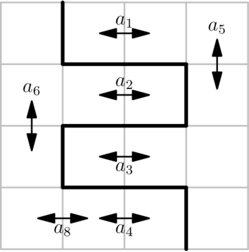 The picture above represents the first test case. Arrows indicate pairs of squares, and the thick black line represents the cut. You are given an array $a$ of $n$ pairs of adjacent squares. Find the size of the largest strong subsequence of $a$ . An array $p$ is a subsequence of an array $q$ if $p$ can be obtained from $q$ by deletion of several (possibly, zero or all) elements.
An array of adjacent pairs of squares is called strong if it is possible to cut the grid along grid lines into two connected, [congruent](https://en.wikipedia.org/wiki/Congruence_(geometry)) pieces so that each pair is part of the same piece. Two pieces are congruent if one can be matched with the other by translation, rotation, and reflection, or a combination of these.
 The picture above represents the first test case. Arrows indicate pairs of squares, and the thick black line represents the cut. You are given an array $a$ of $n$ pairs of adjacent squares. Find the size of the largest strong subsequence of $a$ . An array $p$ is a subsequence of an array $q$ if $p$ can be obtained from $q$ by deletion of several (possibly, zero or all) elements.
输入格式
The input consists of multiple test cases. The first line contains an integer $t$ ( $1 \leq t \leq 100$ ) — the number of test cases. The description of the test cases follows.
The first line of each test case contains two space-separated integers $n$ and $k$ ( $1 \leq n \leq 10^5$ ; $2 \leq k \leq 500$ , $k$ is even) — the length of $a$ and the size of the grid, respectively.
Then $n$ lines follow. The $i$ -th of these lines contains four space-separated integers $r_{i,1}$ , $c_{i,1}$ , $r_{i,2}$ , and $c_{i,2}$ ( $1 \leq r_{i,1}, c_{i,1}, r_{i,2}, c_{i,2} \leq k$ ) — the $i$ -th element of $a$ , represented by the row and column of the first square $(r_{i,1}, c_{i,1})$ and the row and column of the second square $(r_{i,2}, c_{i,2})$ . These squares are adjacent.
It is guaranteed that the sum of $n$ over all test cases does not exceed $10^5$ , and the sum of $k$ over all test cases does not exceed $500$ .
The first line of each test case contains two space-separated integers $n$ and $k$ ( $1 \leq n \leq 10^5$ ; $2 \leq k \leq 500$ , $k$ is even) — the length of $a$ and the size of the grid, respectively.
Then $n$ lines follow. The $i$ -th of these lines contains four space-separated integers $r_{i,1}$ , $c_{i,1}$ , $r_{i,2}$ , and $c_{i,2}$ ( $1 \leq r_{i,1}, c_{i,1}, r_{i,2}, c_{i,2} \leq k$ ) — the $i$ -th element of $a$ , represented by the row and column of the first square $(r_{i,1}, c_{i,1})$ and the row and column of the second square $(r_{i,2}, c_{i,2})$ . These squares are adjacent.
It is guaranteed that the sum of $n$ over all test cases does not exceed $10^5$ , and the sum of $k$ over all test cases does not exceed $500$ .
输出格式
For each test case, output a single integer — the size of the largest strong subsequence of $a$ .
输入输出样例
输入 #1
3
8 4
1 2 1 3
2 2 2 3
3 2 3 3
4 2 4 3
1 4 2 4
2 1 3 1
2 2 3 2
4 1 4 2
7 2
1 1 1 2
2 1 2 2
1 1 1 2
1 1 2 1
1 2 2 2
1 1 2 1
1 2 2 2
1 6
3 3 3 4
输出 #1
7
4
1
说明/提示
In the first test case, the array $a$ is not good, but if we take the subsequence $[a_1, a_2, a_3, a_4, a_5, a_6, a_8]$ , then the square can be split as shown in the statement.
In the second test case, we can take the subsequence consisting of the last four elements of $a$ and cut the square with a horizontal line through its center.
In the second test case, we can take the subsequence consisting of the last four elements of $a$ and cut the square with a horizontal line through its center.