A14649. Omkar and Heavenly Tree
编程题
普及/提高-
知识点
题目描述
Lord Omkar would like to have a tree with $n$ nodes ( $3 \le n \le 10^5$ ) and has asked his disciples to construct the tree. However, Lord Omkar has created $m$ ( $\mathbf{1 \le m < n}$ ) restrictions to ensure that the tree will be as heavenly as possible.
A tree with $n$ nodes is an connected undirected graph with $n$ nodes and $n-1$ edges. Note that for any two nodes, there is exactly one simple path between them, where a simple path is a path between two nodes that does not contain any node more than once.
Here is an example of a tree:
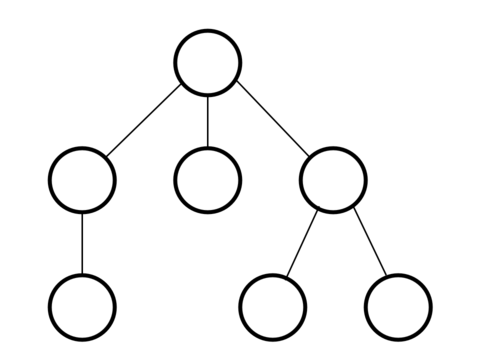A restriction consists of $3$ pairwise distinct integers, $a$ , $b$ , and $c$ ( $1 \le a,b,c \le n$ ). It signifies that node $b$ cannot lie on the simple path between node $a$ and node $c$ .
Can you help Lord Omkar and become his most trusted disciple? You will need to find heavenly trees for multiple sets of restrictions. It can be shown that a heavenly tree will always exist for any set of restrictions under the given constraints.
A tree with $n$ nodes is an connected undirected graph with $n$ nodes and $n-1$ edges. Note that for any two nodes, there is exactly one simple path between them, where a simple path is a path between two nodes that does not contain any node more than once.
Here is an example of a tree:
A restriction consists of $3$ pairwise distinct integers, $a$ , $b$ , and $c$ ( $1 \le a,b,c \le n$ ). It signifies that node $b$ cannot lie on the simple path between node $a$ and node $c$ .
Can you help Lord Omkar and become his most trusted disciple? You will need to find heavenly trees for multiple sets of restrictions. It can be shown that a heavenly tree will always exist for any set of restrictions under the given constraints.
输入格式
Each test contains multiple test cases. The first line contains the number of test cases $t$ ( $1 \leq t \leq 10^4$ ). Description of the test cases follows.
The first line of each test case contains two integers, $n$ and $m$ ( $3 \leq n \leq 10^5$ , $\mathbf{1 \leq m < n}$ ), representing the size of the tree and the number of restrictions.
The $i$ -th of the next $m$ lines contains three integers $a_i$ , $b_i$ , $c_i$ ( $1 \le a_i, b_i, c_i \le n$ , $a$ , $b$ , $c$ are distinct), signifying that node $b_i$ cannot lie on the simple path between nodes $a_i$ and $c_i$ .
It is guaranteed that the sum of $n$ across all test cases will not exceed $10^5$ .
The first line of each test case contains two integers, $n$ and $m$ ( $3 \leq n \leq 10^5$ , $\mathbf{1 \leq m < n}$ ), representing the size of the tree and the number of restrictions.
The $i$ -th of the next $m$ lines contains three integers $a_i$ , $b_i$ , $c_i$ ( $1 \le a_i, b_i, c_i \le n$ , $a$ , $b$ , $c$ are distinct), signifying that node $b_i$ cannot lie on the simple path between nodes $a_i$ and $c_i$ .
It is guaranteed that the sum of $n$ across all test cases will not exceed $10^5$ .
输出格式
For each test case, output $n-1$ lines representing the $n-1$ edges in the tree. On each line, output two integers $u$ and $v$ ( $1 \le u, v \le n$ , $u \neq v$ ) signifying that there is an edge between nodes $u$ and $v$ . Given edges have to form a tree that satisfies Omkar's restrictions.
输入输出样例
输入 #1
2
7 4
1 2 3
3 4 5
5 6 7
6 5 4
5 3
1 2 3
2 3 4
3 4 5
输出 #1
1 2
1 3
3 5
3 4
2 7
7 6
5 1
1 3
3 2
2 4
说明/提示
The output of the first sample case corresponds to the following tree:
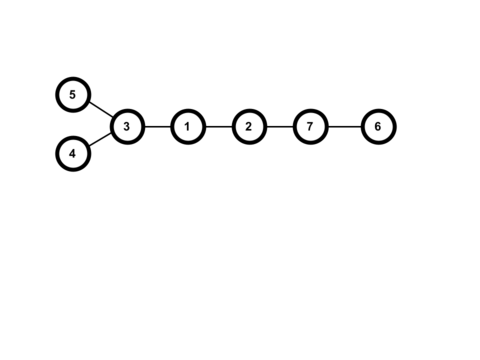 For the first restriction, the simple path between $1$ and $3$ is $1, 3$ , which doesn't contain $2$ . The simple path between $3$ and $5$ is $3, 5$ , which doesn't contain $4$ . The simple path between $5$ and $7$ is $5, 3, 1, 2, 7$ , which doesn't contain $6$ . The simple path between $6$ and $4$ is $6, 7, 2, 1, 3, 4$ , which doesn't contain $5$ . Thus, this tree meets all of the restrictions.The output of the second sample case corresponds to the following tree:
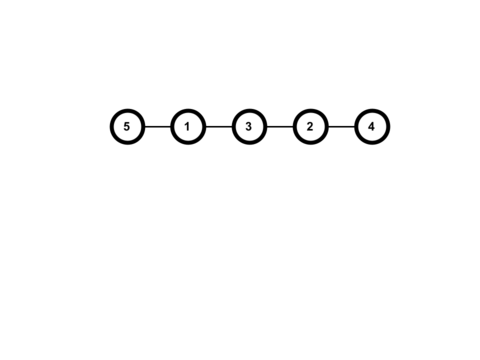
 For the first restriction, the simple path between $1$ and $3$ is $1, 3$ , which doesn't contain $2$ . The simple path between $3$ and $5$ is $3, 5$ , which doesn't contain $4$ . The simple path between $5$ and $7$ is $5, 3, 1, 2, 7$ , which doesn't contain $6$ . The simple path between $6$ and $4$ is $6, 7, 2, 1, 3, 4$ , which doesn't contain $5$ . Thus, this tree meets all of the restrictions.The output of the second sample case corresponds to the following tree:
