A14511 | Polygon
时间限制1s
内存限制256MB
通过 / 提交0/0
题目描述
You are given a strictly convex polygon with $n$ vertices.
You will make $k$ cuts that meet the following conditions:
- each cut is a segment that connects two different nonadjacent vertices;
- two cuts can intersect only at vertices of the polygon.
Your task is to maximize the area of the smallest region that will be formed by the polygon and those $k$ cuts.
You will make $k$ cuts that meet the following conditions:
- each cut is a segment that connects two different nonadjacent vertices;
- two cuts can intersect only at vertices of the polygon.
Your task is to maximize the area of the smallest region that will be formed by the polygon and those $k$ cuts.
输入格式
The first line contains two integers $n$ , $k$ ( $3 \le n \le 200$ , $0 \le k \le n-3$ ).
The following $n$ lines describe vertices of the polygon in anticlockwise direction. The $i$ -th line contains two integers $x_i$ , $y_i$ ( $|x_i|, |y_i| \le 10^8$ ) — the coordinates of the $i$ -th vertex.
It is guaranteed that the polygon is convex and that no two adjacent sides are parallel.
The following $n$ lines describe vertices of the polygon in anticlockwise direction. The $i$ -th line contains two integers $x_i$ , $y_i$ ( $|x_i|, |y_i| \le 10^8$ ) — the coordinates of the $i$ -th vertex.
It is guaranteed that the polygon is convex and that no two adjacent sides are parallel.
输出格式
Print one integer: the maximum possible area of the smallest region after making $k$ cuts multiplied by $2$ .
输入输出样例
输入 #1
8 4
-2 -4
2 -2
4 2
1 5
0 5
-4 4
-5 0
-5 -1
输出 #1
11
输入 #2
6 3
2 -2
2 -1
1 2
0 2
-2 1
-1 0
输出 #2
3
In the first example, it's optimal to make cuts between the following pairs of vertices:
- $(-2, -4)$ and $(4, 2)$ ,
- $(-2, -4)$ and $(1, 5)$ ,
- $(-5, -1)$ and $(1, 5)$ ,
- $(-5, 0)$ and $(0, 5)$ .
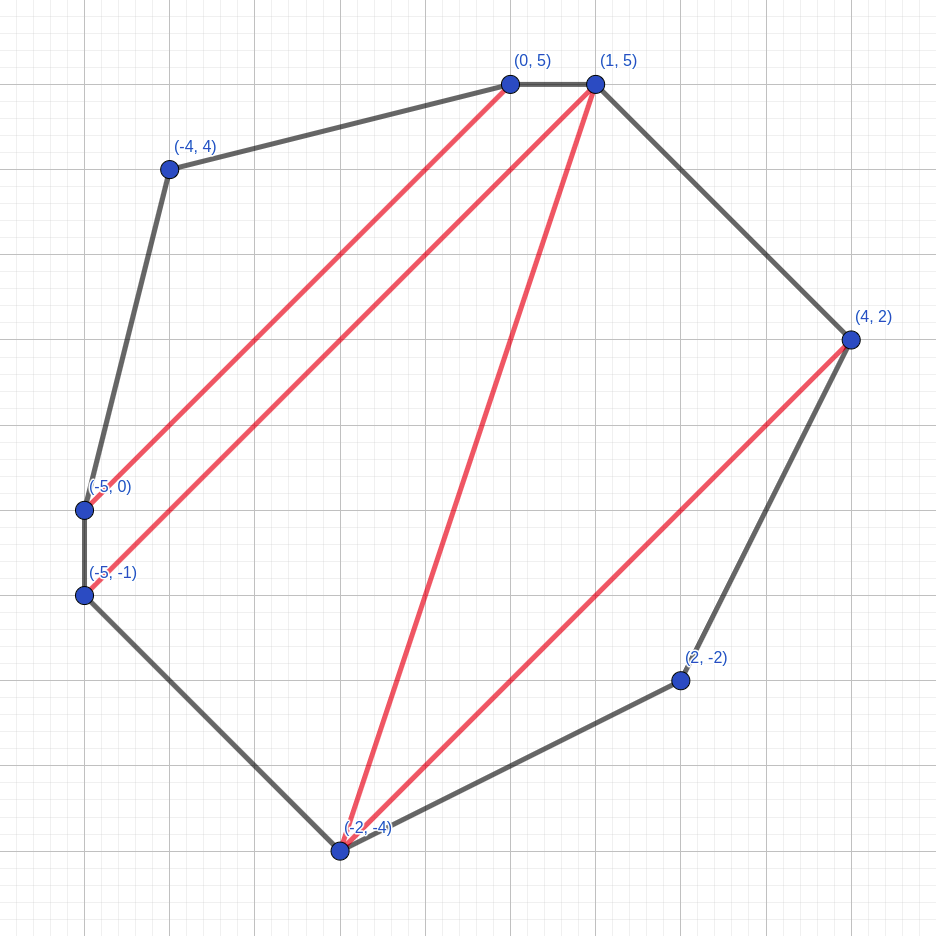 Points $(-5, -1)$ , $(1, 5)$ , $(0, 5)$ , $(-5, 0)$ determine the smallest region with double area of $11$ . In the second example, it's optimal to make cuts between the following pairs of vertices:
- $(2, -1)$ and $(0, 2)$ ,
- $(2, -1)$ and $(1, 0)$ ,
- $(-1, 0)$ and $(0, 2)$ .
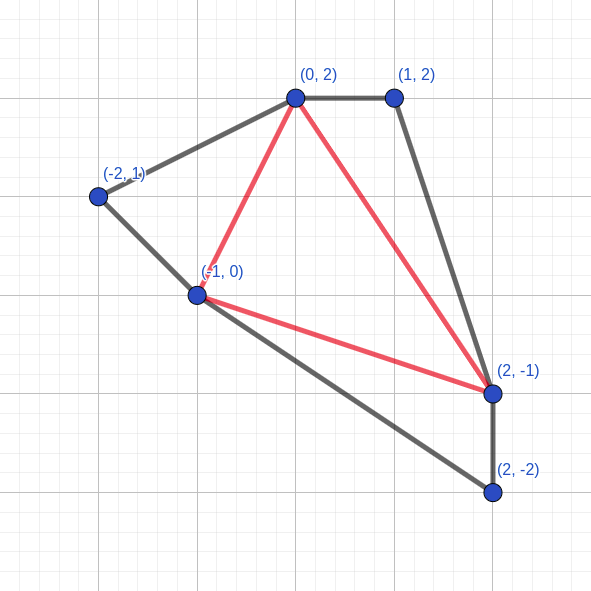 Points $(2, -2)$ , $(2, -1)$ , $(-1, 0)$ determine one of the smallest regions with double area of $3$ .
- $(-2, -4)$ and $(4, 2)$ ,
- $(-2, -4)$ and $(1, 5)$ ,
- $(-5, -1)$ and $(1, 5)$ ,
- $(-5, 0)$ and $(0, 5)$ .
 Points $(-5, -1)$ , $(1, 5)$ , $(0, 5)$ , $(-5, 0)$ determine the smallest region with double area of $11$ . In the second example, it's optimal to make cuts between the following pairs of vertices:
- $(2, -1)$ and $(0, 2)$ ,
- $(2, -1)$ and $(1, 0)$ ,
- $(-1, 0)$ and $(0, 2)$ .
 Points $(2, -2)$ , $(2, -1)$ , $(-1, 0)$ determine one of the smallest regions with double area of $3$ .
C++ 编辑器
输入
输出
可保存默认模板;新题优先使用已保存模板。
当前快捷键仅展示,暂不支持修改。
- 撤销
Ctrl / ⌘ + Z - 重做
Ctrl / ⌘ + Y - 查找
Ctrl / ⌘ + F - 全选
Ctrl / ⌘ + A - 复制
Ctrl / ⌘ + C - 剪切
Ctrl / ⌘ + X - 粘贴
Ctrl / ⌘ + V - 自动排版
工具栏排版按钮 - 草稿保存
编辑时自动保存到本机
历史
提交记录
状态说明时间源码
AI
作答助手
你好,我是作答助手。可以问思路、复杂度、样例含义或代码报错原因;不会直接给出完整 AC 代码。
确定要清空代码吗?
提交通过
评测结果:Accepted