A14410. Colors and Intervals
编程题
普及/提高-
知识点
题目描述
The numbers $1, \, 2, \, \dots, \, n \cdot k$ are colored with $n$ colors. These colors are indexed by $1, \, 2, \, \dots, \, n$ . For each $1 \le i \le n$ , there are exactly $k$ numbers colored with color $i$ .
Let $[a, \, b]$ denote the interval of integers between $a$ and $b$ inclusive, that is, the set $\{a, \, a + 1, \, \dots, \, b\}$ . You must choose $n$ intervals $[a_1, \, b_1], \, [a_2, \, b_2], \, \dots, [a_n, \, b_n]$ such that:
- for each $1 \le i \le n$ , it holds $1 \le a_i < b_i \le n \cdot k$ ;
- for each $1 \le i \le n$ , the numbers $a_i$ and $b_i$ are colored with color $i$ ;
- each number $1 \le x \le n \cdot k$ belongs to at most $\left\lceil \frac{n}{k - 1} \right\rceil$ intervals.
One can show that such a family of intervals always exists under the given constraints.
Let $[a, \, b]$ denote the interval of integers between $a$ and $b$ inclusive, that is, the set $\{a, \, a + 1, \, \dots, \, b\}$ . You must choose $n$ intervals $[a_1, \, b_1], \, [a_2, \, b_2], \, \dots, [a_n, \, b_n]$ such that:
- for each $1 \le i \le n$ , it holds $1 \le a_i < b_i \le n \cdot k$ ;
- for each $1 \le i \le n$ , the numbers $a_i$ and $b_i$ are colored with color $i$ ;
- each number $1 \le x \le n \cdot k$ belongs to at most $\left\lceil \frac{n}{k - 1} \right\rceil$ intervals.
One can show that such a family of intervals always exists under the given constraints.
输入格式
The first line contains two integers $n$ and $k$ ( $1 \le n \le 100$ , $2 \le k \le 100$ ) — the number of colors and the number of occurrences of each color.
The second line contains $n \cdot k$ integers $c_1, \, c_2, \, \dots, \, c_{nk}$ ( $1 \le c_j \le n$ ), where $c_j$ is the color of number $j$ . It is guaranteed that, for each $1 \le i \le n$ , it holds $c_j = i$ for exactly $k$ distinct indices $j$ .
The second line contains $n \cdot k$ integers $c_1, \, c_2, \, \dots, \, c_{nk}$ ( $1 \le c_j \le n$ ), where $c_j$ is the color of number $j$ . It is guaranteed that, for each $1 \le i \le n$ , it holds $c_j = i$ for exactly $k$ distinct indices $j$ .
输出格式
Output $n$ lines. The $i$ -th line should contain the two integers $a_i$ and $b_i$ .
If there are multiple valid choices of the intervals, output any.
If there are multiple valid choices of the intervals, output any.
输入输出样例
输入 #1
4 3
2 4 3 1 1 4 2 3 2 1 3 4
输出 #1
4 5
1 7
8 11
6 12
输入 #2
1 2
1 1
输出 #2
1 2
输入 #3
3 3
3 1 2 3 2 1 2 1 3
输出 #3
6 8
3 7
1 4
输入 #4
2 3
2 1 1 1 2 2
输出 #4
2 3
5 6
说明/提示
In the first sample, each number can be contained in at most $\left\lceil \frac{4}{3 - 1} \right\rceil = 2$ intervals. The output is described by the following picture:
In the second sample, the only interval to be chosen is forced to be $[1, \, 2]$ , and each number is indeed contained in at most $\left\lceil \frac{1}{2 - 1} \right\rceil = 1$ interval.
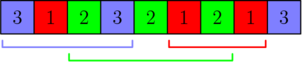
In the third sample, each number can be contained in at most $\left\lceil \frac{3}{3 - 1} \right\rceil = 2$ intervals. The output is described by the following picture:
In the second sample, the only interval to be chosen is forced to be $[1, \, 2]$ , and each number is indeed contained in at most $\left\lceil \frac{1}{2 - 1} \right\rceil = 1$ interval.
In the third sample, each number can be contained in at most $\left\lceil \frac{3}{3 - 1} \right\rceil = 2$ intervals. The output is described by the following picture:
