A14374. Ezzat and Grid
编程题
普及/提高-
知识点
题目描述
Moamen was drawing a grid of $n$ rows and $10^9$ columns containing only digits $0$ and $1$ . Ezzat noticed what Moamen was drawing and became interested in the minimum number of rows one needs to remove to make the grid beautiful.
A grid is beautiful if and only if for every two consecutive rows there is at least one column containing $1$ in these two rows.
Ezzat will give you the number of rows $n$ , and $m$ segments of the grid that contain digits $1$ . Every segment is represented with three integers $i$ , $l$ , and $r$ , where $i$ represents the row number, and $l$ and $r$ represent the first and the last column of the segment in that row.
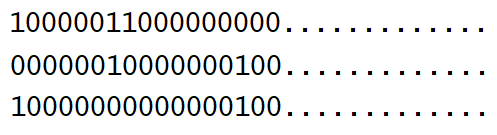
For example, if $n = 3$ , $m = 6$ , and the segments are $(1,1,1)$ , $(1,7,8)$ , $(2,7,7)$ , $(2,15,15)$ , $(3,1,1)$ , $(3,15,15)$ , then the grid is:
Your task is to tell Ezzat the minimum number of rows that should be removed to make the grid beautiful.
A grid is beautiful if and only if for every two consecutive rows there is at least one column containing $1$ in these two rows.
Ezzat will give you the number of rows $n$ , and $m$ segments of the grid that contain digits $1$ . Every segment is represented with three integers $i$ , $l$ , and $r$ , where $i$ represents the row number, and $l$ and $r$ represent the first and the last column of the segment in that row.
For example, if $n = 3$ , $m = 6$ , and the segments are $(1,1,1)$ , $(1,7,8)$ , $(2,7,7)$ , $(2,15,15)$ , $(3,1,1)$ , $(3,15,15)$ , then the grid is:
Your task is to tell Ezzat the minimum number of rows that should be removed to make the grid beautiful.
输入格式
The first line contains two integers $n$ and $m$ ( $1 \le n, m \le 3\cdot10^5$ ).
Each of the next $m$ lines contains three integers $i$ , $l$ , and $r$ ( $1 \le i \le n$ , $1 \le l \le r \le 10^9$ ). Each of these $m$ lines means that row number $i$ contains digits $1$ in columns from $l$ to $r$ , inclusive.
Note that the segments may overlap.
Each of the next $m$ lines contains three integers $i$ , $l$ , and $r$ ( $1 \le i \le n$ , $1 \le l \le r \le 10^9$ ). Each of these $m$ lines means that row number $i$ contains digits $1$ in columns from $l$ to $r$ , inclusive.
Note that the segments may overlap.
输出格式
In the first line, print a single integer $k$ — the minimum number of rows that should be removed.
In the second line print $k$ distinct integers $r_1, r_2, \ldots, r_k$ , representing the rows that should be removed ( $1 \le r_i \le n$ ), in any order.
If there are multiple answers, print any.
In the second line print $k$ distinct integers $r_1, r_2, \ldots, r_k$ , representing the rows that should be removed ( $1 \le r_i \le n$ ), in any order.
If there are multiple answers, print any.
输入输出样例
输入 #1
3 6
1 1 1
1 7 8
2 7 7
2 15 15
3 1 1
3 15 15
输出 #1
0
输入 #2
5 4
1 2 3
2 4 6
3 3 5
5 1 1
输出 #2
3
2 4 5
说明/提示
In the first test case, the grid is the one explained in the problem statement. The grid has the following properties:
1. The $1$ -st row and the $2$ -nd row have a common $1$ in the column $7$ .
2. The $2$ -nd row and the $3$ -rd row have a common $1$ in the column $15$ .
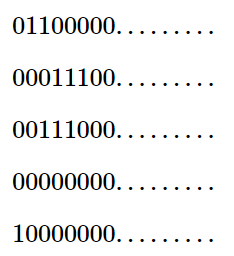
As a result, this grid is beautiful and we do not need to remove any row.In the second test case, the given grid is as follows:
1. The $1$ -st row and the $2$ -nd row have a common $1$ in the column $7$ .
2. The $2$ -nd row and the $3$ -rd row have a common $1$ in the column $15$ .
As a result, this grid is beautiful and we do not need to remove any row.In the second test case, the given grid is as follows:
