A14312 | Histogram Ugliness
时间限制1s
内存限制256MB
通过 / 提交0/0
题目描述
Little Dormi received a histogram with $n$ bars of height $a_1, a_2, \ldots, a_n$ for Christmas. However, the more he played with his new histogram, the more he realized its imperfections, so today he wanted to modify it to his liking.
To modify the histogram, Little Dormi is able to perform the following operation an arbitrary number of times:
- Select an index $i$ ( $1 \le i \le n$ ) where $a_i>0$ , and assign $a_i := a_i-1$ .
Little Dormi defines the ugliness score of his histogram (after performing some number of operations) as the sum of the vertical length of its outline and the number of operations he performed on it. And to make the histogram as perfect as possible, he would like to minimize the ugliness score after modifying it with some number of operations.
However, as his histogram is very large, Little Dormi is having trouble minimizing the ugliness score, so as Little Dormi's older brother, help him find the minimal ugliness.
Consider the following example where the histogram has $4$ columns of heights $4,8,9,6$ :
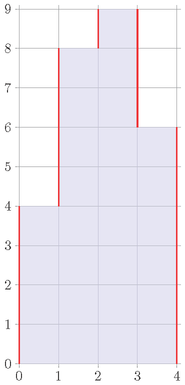The blue region represents the histogram, and the red lines represent the vertical portion of the outline. Currently, the vertical length of the outline is $4+4+1+3+6 = 18$ , so if Little Dormi does not modify the histogram at all, the ugliness would be $18$ .
However, Little Dormi can apply the operation once on column $2$ and twice on column $3$ , resulting in a histogram with heights $4,7,7,6$ :
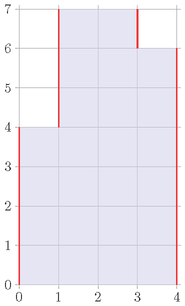Now, as the total vertical length of the outline (red lines) is $4+3+1+6=14$ , the ugliness is $14+3=17$ dollars. It can be proven that this is optimal.
To modify the histogram, Little Dormi is able to perform the following operation an arbitrary number of times:
- Select an index $i$ ( $1 \le i \le n$ ) where $a_i>0$ , and assign $a_i := a_i-1$ .
Little Dormi defines the ugliness score of his histogram (after performing some number of operations) as the sum of the vertical length of its outline and the number of operations he performed on it. And to make the histogram as perfect as possible, he would like to minimize the ugliness score after modifying it with some number of operations.
However, as his histogram is very large, Little Dormi is having trouble minimizing the ugliness score, so as Little Dormi's older brother, help him find the minimal ugliness.
Consider the following example where the histogram has $4$ columns of heights $4,8,9,6$ :
The blue region represents the histogram, and the red lines represent the vertical portion of the outline. Currently, the vertical length of the outline is $4+4+1+3+6 = 18$ , so if Little Dormi does not modify the histogram at all, the ugliness would be $18$ .
However, Little Dormi can apply the operation once on column $2$ and twice on column $3$ , resulting in a histogram with heights $4,7,7,6$ :
Now, as the total vertical length of the outline (red lines) is $4+3+1+6=14$ , the ugliness is $14+3=17$ dollars. It can be proven that this is optimal.
输入格式
Each test contains multiple test cases. The first line contains the number of test cases $t$ ( $1 \le t \le 10^4$ ). Description of the test cases follows.
The first line of each test case contains a single integer $n$ ( $1 \le n \le 4 \cdot 10^5$ ).
The second line of each test case contains $n$ integers $a_1, a_2, \ldots, a_n$ ( $0 \le a_i \le 10^9$ ).
It is guaranteed that the sum of $n$ over all test cases does not exceed $4 \cdot 10^5$ .
The first line of each test case contains a single integer $n$ ( $1 \le n \le 4 \cdot 10^5$ ).
The second line of each test case contains $n$ integers $a_1, a_2, \ldots, a_n$ ( $0 \le a_i \le 10^9$ ).
It is guaranteed that the sum of $n$ over all test cases does not exceed $4 \cdot 10^5$ .
输出格式
For each test case output one integer, the minimal ugliness Little Dormi can achieve with the histogram in that test case.
输入输出样例
输入 #1
2
4
4 8 9 6
6
2 1 7 4 0 0
输出 #1
17
12
Example $1$ is the example described in the statement.
The initial histogram for example $2$ is given below:
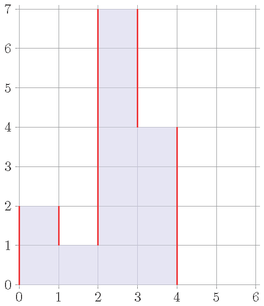The ugliness is currently $2+1+6+3+4=16$ .
By applying the operation once on column $1$ , six times on column $3$ , and three times on column $4$ , we can end up with a histogram with heights $1,1,1,1,0,0$ :
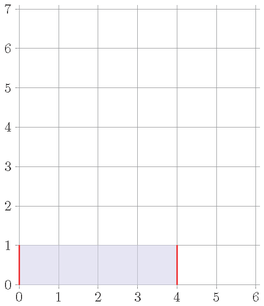The vertical length of the outline is now $1+1=2$ and Little Dormi made $1+6+3=10$ operations, so the final ugliness is $2+10=12$ , which can be proven to be optimal.
The initial histogram for example $2$ is given below:
The ugliness is currently $2+1+6+3+4=16$ .
By applying the operation once on column $1$ , six times on column $3$ , and three times on column $4$ , we can end up with a histogram with heights $1,1,1,1,0,0$ :
The vertical length of the outline is now $1+1=2$ and Little Dormi made $1+6+3=10$ operations, so the final ugliness is $2+10=12$ , which can be proven to be optimal.
C++ 编辑器
输入
输出
可保存默认模板;新题优先使用已保存模板。
当前快捷键仅展示,暂不支持修改。
- 撤销
Ctrl / ⌘ + Z - 重做
Ctrl / ⌘ + Y - 查找
Ctrl / ⌘ + F - 全选
Ctrl / ⌘ + A - 复制
Ctrl / ⌘ + C - 剪切
Ctrl / ⌘ + X - 粘贴
Ctrl / ⌘ + V - 自动排版
工具栏排版按钮 - 草稿保存
编辑时自动保存到本机
历史
提交记录
状态说明时间源码
AI
作答助手
你好,我是作答助手。可以问思路、复杂度、样例含义或代码报错原因;不会直接给出完整 AC 代码。
确定要清空代码吗?
提交通过
评测结果:Accepted