A14237. Complete the MST
编程题
普及/提高-
知识点
题目描述
As a teacher, Riko Hakozaki often needs to help her students with problems from various subjects. Today, she is asked a programming task which goes as follows.
You are given an undirected complete graph with $n$ nodes, where some edges are pre-assigned with a positive weight while the rest aren't. You need to assign all unassigned edges with non-negative weights so that in the resulting fully-assigned complete graph the [XOR](https://en.wikipedia.org/wiki/Bitwise_operation#XOR) sum of all weights would be equal to $0$ .
Define the ugliness of a fully-assigned complete graph the weight of its [minimum spanning tree](https://en.wikipedia.org/wiki/Minimum_spanning_tree), where the weight of a spanning tree equals the sum of weights of its edges. You need to assign the weights so that the ugliness of the resulting graph is as small as possible.
As a reminder, an undirected complete graph with $n$ nodes contains all edges $(u, v)$ with $1 \le u < v \le n$ ; such a graph has $\frac{n(n-1)}{2}$ edges.
She is not sure how to solve this problem, so she asks you to solve it for her.
You are given an undirected complete graph with $n$ nodes, where some edges are pre-assigned with a positive weight while the rest aren't. You need to assign all unassigned edges with non-negative weights so that in the resulting fully-assigned complete graph the [XOR](https://en.wikipedia.org/wiki/Bitwise_operation#XOR) sum of all weights would be equal to $0$ .
Define the ugliness of a fully-assigned complete graph the weight of its [minimum spanning tree](https://en.wikipedia.org/wiki/Minimum_spanning_tree), where the weight of a spanning tree equals the sum of weights of its edges. You need to assign the weights so that the ugliness of the resulting graph is as small as possible.
As a reminder, an undirected complete graph with $n$ nodes contains all edges $(u, v)$ with $1 \le u < v \le n$ ; such a graph has $\frac{n(n-1)}{2}$ edges.
She is not sure how to solve this problem, so she asks you to solve it for her.
输入格式
The first line contains two integers $n$ and $m$ ( $2 \le n \le 2 \cdot 10^5$ , $0 \le m \le \min(2 \cdot 10^5, \frac{n(n-1)}{2} - 1)$ ) — the number of nodes and the number of pre-assigned edges. The inputs are given so that there is at least one unassigned edge.
The $i$ -th of the following $m$ lines contains three integers $u_i$ , $v_i$ , and $w_i$ ( $1 \le u_i, v_i \le n$ , $u \ne v$ , $1 \le w_i < 2^{30}$ ), representing the edge from $u_i$ to $v_i$ has been pre-assigned with the weight $w_i$ . No edge appears in the input more than once.
The $i$ -th of the following $m$ lines contains three integers $u_i$ , $v_i$ , and $w_i$ ( $1 \le u_i, v_i \le n$ , $u \ne v$ , $1 \le w_i < 2^{30}$ ), representing the edge from $u_i$ to $v_i$ has been pre-assigned with the weight $w_i$ . No edge appears in the input more than once.
输出格式
Print on one line one integer — the minimum ugliness among all weight assignments with XOR sum equal to $0$ .
输入输出样例
输入 #1
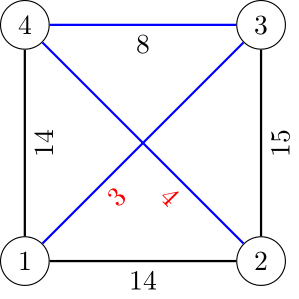
4 4
2 1 14
1 4 14
3 2 15
4 3 8
输出 #1
15
输入 #2
6 6
3 6 4
2 4 1
4 5 7
3 4 10
3 5 1
5 2 15
输出 #2
0
输入 #3
5 6
2 3 11
5 3 7
1 4 10
2 4 14
4 3 8
2 5 6
输出 #3
6
说明/提示
The following image showcases the first test case. The black weights are pre-assigned from the statement, the red weights are assigned by us, and the minimum spanning tree is denoted by the blue edges.