A14132. Paired Payment
编程题
普及/提高-
知识点
题目描述
There are $n$ cities and $m$ bidirectional roads in the country. The roads in the country form an undirected weighted graph. The graph is not guaranteed to be connected. Each road has it's own parameter $w$ . You can travel through the roads, but the government made a new law: you can only go through two roads at a time (go from city $a$ to city $b$ and then from city $b$ to city $c$ ) and you will have to pay $(w_{ab} + w_{bc})^2$ money to go through those roads. Find out whether it is possible to travel from city $1$ to every other city $t$ and what's the minimum amount of money you need to get from $1$ to $t$ .
输入格式
First line contains two integers $n$ , $m$ ( $2 \leq n \leq 10^5$ , $1 \leq m \leq min(\frac{n \cdot (n - 1)}{2}, 2 \cdot 10^5)$ ).
Next $m$ lines each contain three integers $v_i$ , $u_i$ , $w_i$ ( $1 \leq v_i, u_i \leq n$ , $1 \leq w_i \leq 50$ , $u_i \neq v_i$ ). It's guaranteed that there are no multiple edges, i.e. for any edge $(u_i, v_i)$ there are no other edges $(u_i, v_i)$ or $(v_i, u_i)$ .
Next $m$ lines each contain three integers $v_i$ , $u_i$ , $w_i$ ( $1 \leq v_i, u_i \leq n$ , $1 \leq w_i \leq 50$ , $u_i \neq v_i$ ). It's guaranteed that there are no multiple edges, i.e. for any edge $(u_i, v_i)$ there are no other edges $(u_i, v_i)$ or $(v_i, u_i)$ .
输出格式
For every city $t$ print one integer. If there is no correct path between $1$ and $t$ output $-1$ . Otherwise print out the minimum amount of money needed to travel from $1$ to $t$ .
输入输出样例
输入 #1
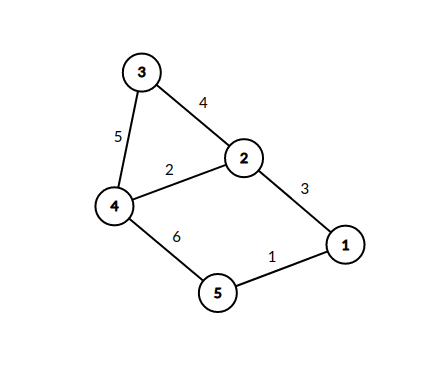
5 6
1 2 3
2 3 4
3 4 5
4 5 6
1 5 1
2 4 2
输出 #1
0 98 49 25 114
输入 #2
3 2
1 2 1
2 3 2
输出 #2
0 -1 9
说明/提示
The graph in the first example looks like this.
In the second example the path from $1$ to $3$ goes through $2$ , so the resulting payment is $(1 + 2)^2 = 9$ .
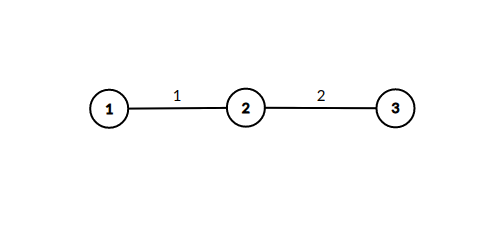

In the second example the path from $1$ to $3$ goes through $2$ , so the resulting payment is $(1 + 2)^2 = 9$ .
