A14109. Yuezheng Ling and Dynamic Tree
编程题
普及/提高-
知识点
题目描述
Yuezheng Ling gives Luo Tianyi a tree which has $n$ nodes, rooted at $1$ .
Luo Tianyi will tell you that the parent of the $i$ -th node is $a_i$ ( $1 \leq a_i<i$ for $2 \le i \le n$ ), and she will ask you to perform $q$ queries of $2$ types:
1. She'll give you three integers $l$ , $r$ and $x$ ( $2 \le l \le r \le n$ , $1 \le x \le 10^5$ ). You need to replace $a_i$ with $\max(a_i-x,1)$ for all $i$ with $l \leq i \leq r$ .
2. She'll give you two integers $u$ , $v$ ( $1 \le u, v \le n$ ). You need to find the [LCA](https://en.wikipedia.org/wiki/Lowest_common_ancestor) of nodes $u$ and $v$ (their lowest common ancestor).
Luo Tianyi will tell you that the parent of the $i$ -th node is $a_i$ ( $1 \leq a_i<i$ for $2 \le i \le n$ ), and she will ask you to perform $q$ queries of $2$ types:
1. She'll give you three integers $l$ , $r$ and $x$ ( $2 \le l \le r \le n$ , $1 \le x \le 10^5$ ). You need to replace $a_i$ with $\max(a_i-x,1)$ for all $i$ with $l \leq i \leq r$ .
2. She'll give you two integers $u$ , $v$ ( $1 \le u, v \le n$ ). You need to find the [LCA](https://en.wikipedia.org/wiki/Lowest_common_ancestor) of nodes $u$ and $v$ (their lowest common ancestor).
输入格式
The first line contains two integers $n$ and $q$ ( $2\leq n,q \leq 10^5$ ) — the number of nodes and the number of queries, respectively.
The second line contains $n-1$ integers $a_2, a_3,\dots, a_n$ ( $1 \le a_i < i$ ), where $a_i$ is the parent of the node $i$ .
Next $q$ lines contain queries. For each query, the first integer of each line is $t$ ( $t = 1$ or $2$ ) — the type of the query.
If $t = 1$ , this represents the query of the first type. Then, three integers will follow: $l$ , $r$ , $x$ ( $2 \le l \le r \le n$ , $1 \le x \le 10^5$ ), meaning that you have to replace $a_i$ with $\max(a_i-x,1)$ for all $i$ with $l \leq i \leq r$ .
If $t = 2$ , this represents the query of the second type. Then, two integers will follow: $u$ and $v$ ( $1 \le u, v \le n$ ), and you have to find the LCA of $u$ and $v$ .
It's guaranteed that there is at least one query of the second type.
The second line contains $n-1$ integers $a_2, a_3,\dots, a_n$ ( $1 \le a_i < i$ ), where $a_i$ is the parent of the node $i$ .
Next $q$ lines contain queries. For each query, the first integer of each line is $t$ ( $t = 1$ or $2$ ) — the type of the query.
If $t = 1$ , this represents the query of the first type. Then, three integers will follow: $l$ , $r$ , $x$ ( $2 \le l \le r \le n$ , $1 \le x \le 10^5$ ), meaning that you have to replace $a_i$ with $\max(a_i-x,1)$ for all $i$ with $l \leq i \leq r$ .
If $t = 2$ , this represents the query of the second type. Then, two integers will follow: $u$ and $v$ ( $1 \le u, v \le n$ ), and you have to find the LCA of $u$ and $v$ .
It's guaranteed that there is at least one query of the second type.
输出格式
For each query of the second type output answer on a new line.
输入输出样例
输入 #1
6 4
1 2 3 3 4
2 3 4
1 2 3 1
2 5 6
2 2 3
输出 #1
3
3
1
说明/提示
The tree in example is shown below.
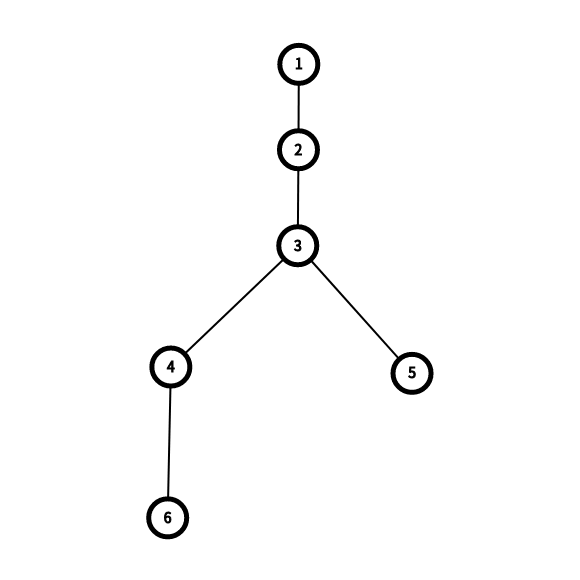After the query of the first type, the tree changes and is looking as shown below.
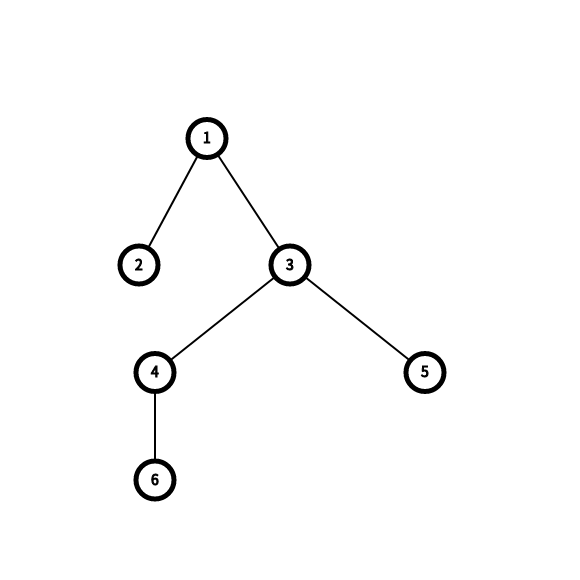
After the query of the first type, the tree changes and is looking as shown below.
