A13871 | Red-Blue Shuffle
时间限制1s
内存限制256MB
通过 / 提交0/0
题目描述
There are $n$ cards numbered $1, \ldots, n$ . The card $i$ has a red digit $r_i$ and a blue digit $b_i$ written on it.
We arrange all $n$ cards in random order from left to right, with all permutations of $1, \ldots, n$ having the same probability. We then read all red digits on the cards from left to right, and obtain an integer $R$ . In the same way, we read all blue digits and obtain an integer $B$ . When reading a number, leading zeros can be ignored. If all digits in a number are zeros, then the number is equal to $0$ . Below is an illustration of a possible rearrangement of three cards, and how $R$ and $B$ can be found.
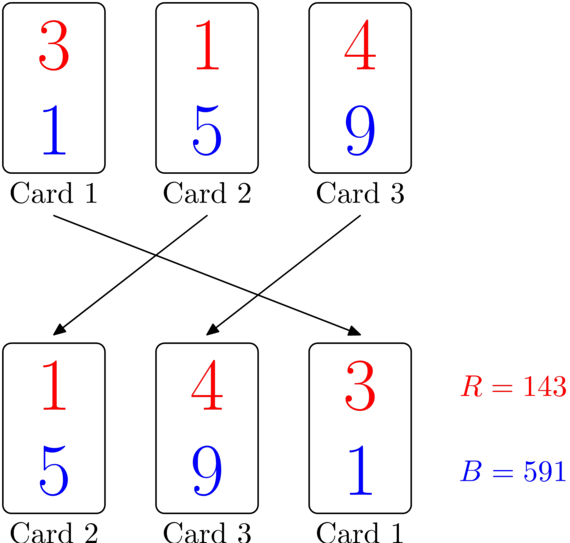Two players, Red and Blue, are involved in a bet. Red bets that after the shuffle $R > B$ , and Blue bets that $R < B$ . If in the end $R = B$ , the bet results in a draw, and neither player wins.
Determine, which of the two players is more likely (has higher probability) to win the bet, or that their chances are equal. Refer to the Note section for a formal discussion of comparing probabilities.
We arrange all $n$ cards in random order from left to right, with all permutations of $1, \ldots, n$ having the same probability. We then read all red digits on the cards from left to right, and obtain an integer $R$ . In the same way, we read all blue digits and obtain an integer $B$ . When reading a number, leading zeros can be ignored. If all digits in a number are zeros, then the number is equal to $0$ . Below is an illustration of a possible rearrangement of three cards, and how $R$ and $B$ can be found.
Two players, Red and Blue, are involved in a bet. Red bets that after the shuffle $R > B$ , and Blue bets that $R < B$ . If in the end $R = B$ , the bet results in a draw, and neither player wins.
Determine, which of the two players is more likely (has higher probability) to win the bet, or that their chances are equal. Refer to the Note section for a formal discussion of comparing probabilities.
输入格式
The first line contains a single integer $T$ ( $1 \leq T \leq 100$ ) — the number of test cases.
Descriptions of $T$ test cases follow. Each test case description starts with a line containing a single integer $n$ ( $1 \leq n \leq 1000$ ) — the number of cards.
The following line contains a string of $n$ digits $r_1, \ldots, r_n$ — red digits on cards $1, \ldots, n$ respectively.
The following line contains a string of $n$ digits $b_1, \ldots, b_n$ — blue digits on cards $1, \ldots, n$ respectively.
Note that digits in the same line are not separated with any delimiters.
Descriptions of $T$ test cases follow. Each test case description starts with a line containing a single integer $n$ ( $1 \leq n \leq 1000$ ) — the number of cards.
The following line contains a string of $n$ digits $r_1, \ldots, r_n$ — red digits on cards $1, \ldots, n$ respectively.
The following line contains a string of $n$ digits $b_1, \ldots, b_n$ — blue digits on cards $1, \ldots, n$ respectively.
Note that digits in the same line are not separated with any delimiters.
输出格式
Print $T$ answers for the test cases in order, one per line.
If Red has a strictly higher change to win, print "RED".
If Blue has a strictly higher change to win, print "BLUE".
If both players are equally likely to win, print "EQUAL".
Note that all answers are case-sensitive.
If Red has a strictly higher change to win, print "RED".
If Blue has a strictly higher change to win, print "BLUE".
If both players are equally likely to win, print "EQUAL".
Note that all answers are case-sensitive.
输入输出样例
输入 #1
3
3
777
111
3
314
159
5
09281
09281
输出 #1
RED
BLUE
EQUAL
Formally, let $n_R$ be the number of permutations of cards $1, \ldots, n$ such that the resulting numbers $R$ and $B$ satisfy $R > B$ . Similarly, let $n_B$ be the number of permutations such that $R < B$ . If $n_R > n_B$ , you should print "RED". If $n_R < n_B$ , you should print "BLUE". If $n_R = n_B$ , print "EQUAL".
In the first sample case, $R = 777$ and $B = 111$ regardless of the card order, thus Red always wins.
In the second sample case, there are two card orders when Red wins, and four card orders when Blue wins:
4. order $1, 2, 3$ : $314 > 159$ ;
5. order $1, 3, 2$ : $341 > 195$ ;
6. order $2, 1, 3$ : $134 < 519$ ;
7. order $2, 3, 1$ : $143 < 591$ ;
8. order $3, 1, 2$ : $431 < 915$ ;
9. order $3, 2, 1$ : $413 < 951$ .
Since $R < B$ is more frequent, the answer is "BLUE".
In the third sample case, $R = B$ regardless of the card order, thus the bet is always a draw, and both Red and Blue have zero chance to win.
In the first sample case, $R = 777$ and $B = 111$ regardless of the card order, thus Red always wins.
In the second sample case, there are two card orders when Red wins, and four card orders when Blue wins:
4. order $1, 2, 3$ : $314 > 159$ ;
5. order $1, 3, 2$ : $341 > 195$ ;
6. order $2, 1, 3$ : $134 < 519$ ;
7. order $2, 3, 1$ : $143 < 591$ ;
8. order $3, 1, 2$ : $431 < 915$ ;
9. order $3, 2, 1$ : $413 < 951$ .
Since $R < B$ is more frequent, the answer is "BLUE".
In the third sample case, $R = B$ regardless of the card order, thus the bet is always a draw, and both Red and Blue have zero chance to win.
C++ 编辑器
输入
输出
可保存默认模板;新题优先使用已保存模板。
当前快捷键仅展示,暂不支持修改。
- 撤销
Ctrl / ⌘ + Z - 重做
Ctrl / ⌘ + Y - 查找
Ctrl / ⌘ + F - 全选
Ctrl / ⌘ + A - 复制
Ctrl / ⌘ + C - 剪切
Ctrl / ⌘ + X - 粘贴
Ctrl / ⌘ + V - 自动排版
工具栏排版按钮 - 草稿保存
编辑时自动保存到本机
历史
提交记录
状态说明时间源码
AI
作答助手
你好,我是作答助手。可以问思路、复杂度、样例含义或代码报错原因;不会直接给出完整 AC 代码。
确定要清空代码吗?
提交通过
评测结果:Accepted