A13757 | Boboniu and Banknote Collection
时间限制1s
内存限制256MB
通过 / 提交0/0
题目描述
No matter what trouble you're in, don't be afraid, but face it with a smile.
I've made another billion dollars!
— Boboniu
Boboniu has issued his currencies, named Bobo Yuan. Bobo Yuan (BBY) is a series of currencies. Boboniu gives each of them a positive integer identifier, such as BBY-1, BBY-2, etc.
Boboniu has a BBY collection. His collection looks like a sequence. For example:
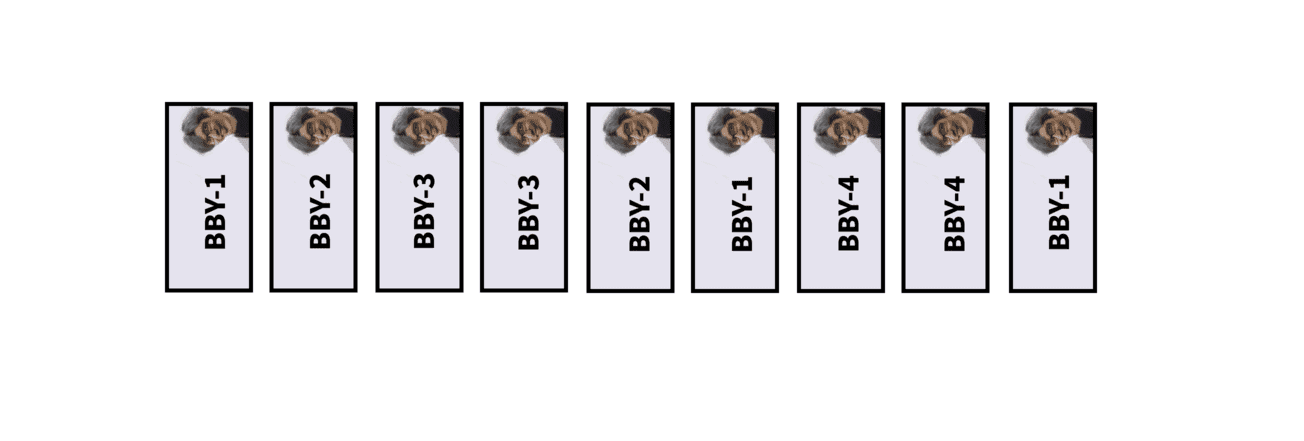We can use sequence $a=[1,2,3,3,2,1,4,4,1]$ of length $n=9$ to denote it.
Now Boboniu wants to fold his collection. You can imagine that Boboniu stick his collection to a long piece of paper and fold it between currencies:
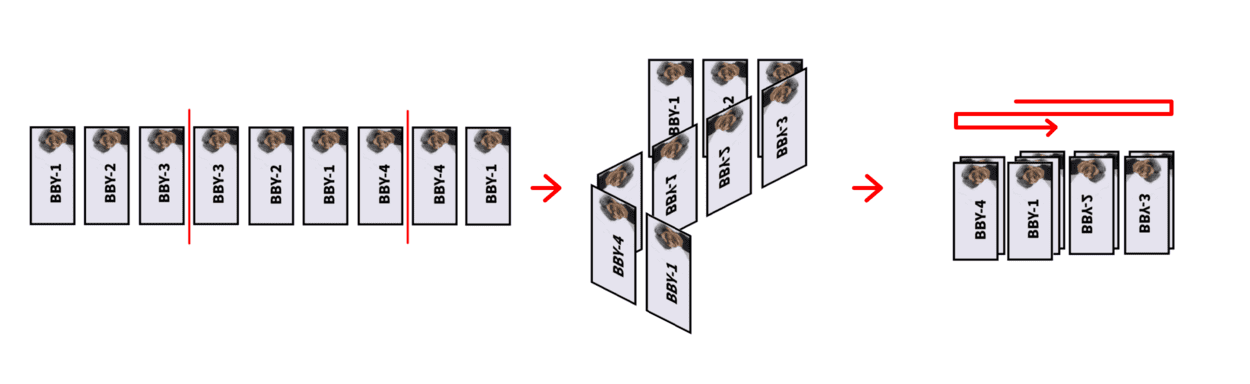Boboniu will only fold the same identifier of currencies together. In other words, if $a_i$ is folded over $a_j$ ( $1\le i,j\le n$ ), then $a_i=a_j$ must hold. Boboniu doesn't care if you follow this rule in the process of folding. But once it is finished, the rule should be obeyed.
A formal definition of fold is described in notes.
According to the picture above, you can fold $a$ two times. In fact, you can fold $a=[1,2,3,3,2,1,4,4,1]$ at most two times. So the maximum number of folds of it is $2$ .
As an international fan of Boboniu, you're asked to calculate the maximum number of folds.
You're given a sequence $a$ of length $n$ , for each $i$ ( $1\le i\le n$ ), you need to calculate the maximum number of folds of $[a_1,a_2,\ldots,a_i]$ .
I've made another billion dollars!
— Boboniu
Boboniu has issued his currencies, named Bobo Yuan. Bobo Yuan (BBY) is a series of currencies. Boboniu gives each of them a positive integer identifier, such as BBY-1, BBY-2, etc.
Boboniu has a BBY collection. His collection looks like a sequence. For example:
We can use sequence $a=[1,2,3,3,2,1,4,4,1]$ of length $n=9$ to denote it.
Now Boboniu wants to fold his collection. You can imagine that Boboniu stick his collection to a long piece of paper and fold it between currencies:
Boboniu will only fold the same identifier of currencies together. In other words, if $a_i$ is folded over $a_j$ ( $1\le i,j\le n$ ), then $a_i=a_j$ must hold. Boboniu doesn't care if you follow this rule in the process of folding. But once it is finished, the rule should be obeyed.
A formal definition of fold is described in notes.
According to the picture above, you can fold $a$ two times. In fact, you can fold $a=[1,2,3,3,2,1,4,4,1]$ at most two times. So the maximum number of folds of it is $2$ .
As an international fan of Boboniu, you're asked to calculate the maximum number of folds.
You're given a sequence $a$ of length $n$ , for each $i$ ( $1\le i\le n$ ), you need to calculate the maximum number of folds of $[a_1,a_2,\ldots,a_i]$ .
输入格式
The first line contains an integer $n$ ( $1\le n\le 10^5$ ).
The second line contains $n$ integers $a_1,a_2,\ldots,a_n$ ( $1\le a_i\le n$ ).
The second line contains $n$ integers $a_1,a_2,\ldots,a_n$ ( $1\le a_i\le n$ ).
输出格式
Print $n$ integers. The $i$ -th of them should be equal to the maximum number of folds of $[a_1,a_2,\ldots,a_i]$ .
输入输出样例
输入 #1
9
1 2 3 3 2 1 4 4 1
输出 #1
0 0 0 1 1 1 1 2 2
输入 #2
9
1 2 2 2 2 1 1 2 2
输出 #2
0 0 1 2 3 3 4 4 5
输入 #3
15
1 2 3 4 5 5 4 3 2 2 3 4 4 3 6
输出 #3
0 0 0 0 0 1 1 1 1 2 2 2 3 3 0
输入 #4
50
1 2 4 6 6 4 2 1 3 5 5 3 1 2 4 4 2 1 3 3 1 2 2 1 1 1 2 4 6 6 4 2 1 3 5 5 3 1 2 4 4 2 1 3 3 1 2 2 1 1
输出 #4
0 0 0 0 1 1 1 1 1 1 2 2 2 2 2 3 3 3 3 4 4 4 5 5 6 7 3 3 3 4 4 4 4 3 3 4 4 4 4 4 5 5 5 5 6 6 6 7 7 8
Formally, for a sequence $a$ of length $n$ , let's define the folding sequence as a sequence $b$ of length $n$ such that:
- $b_i$ ( $1\le i\le n$ ) is either $1$ or $-1$ .
- Let $p(i)=[b_i=1]+\sum_{j=1}^{i-1}b_j$ . For all $1\le i<j\le n$ , if $p(i)=p(j)$ , then $a_i$ should be equal to $a_j$ .
( $[A]$ is the value of boolean expression $A$ . i. e. $[A]=1$ if $A$ is true, else $[A]=0$ ).
Now we define the number of folds of $b$ as $f(b)=\sum_{i=1}^{n-1}[b_i\ne b_{i+1}]$ .
The maximum number of folds of $a$ is $F(a)=\max\{ f(b)\mid b \text{ is a folding sequence of }a \}$ .
- $b_i$ ( $1\le i\le n$ ) is either $1$ or $-1$ .
- Let $p(i)=[b_i=1]+\sum_{j=1}^{i-1}b_j$ . For all $1\le i<j\le n$ , if $p(i)=p(j)$ , then $a_i$ should be equal to $a_j$ .
( $[A]$ is the value of boolean expression $A$ . i. e. $[A]=1$ if $A$ is true, else $[A]=0$ ).
Now we define the number of folds of $b$ as $f(b)=\sum_{i=1}^{n-1}[b_i\ne b_{i+1}]$ .
The maximum number of folds of $a$ is $F(a)=\max\{ f(b)\mid b \text{ is a folding sequence of }a \}$ .
C++ 编辑器
输入
输出
可保存默认模板;新题优先使用已保存模板。
当前快捷键仅展示,暂不支持修改。
- 撤销
Ctrl / ⌘ + Z - 重做
Ctrl / ⌘ + Y - 查找
Ctrl / ⌘ + F - 全选
Ctrl / ⌘ + A - 复制
Ctrl / ⌘ + C - 剪切
Ctrl / ⌘ + X - 粘贴
Ctrl / ⌘ + V - 自动排版
工具栏排版按钮 - 草稿保存
编辑时自动保存到本机
历史
提交记录
状态说明时间源码
AI
作答助手
你好,我是作答助手。可以问思路、复杂度、样例含义或代码报错原因;不会直接给出完整 AC 代码。
确定要清空代码吗?
提交通过
评测结果:Accepted