A13698. Avoid Rainbow Cycles
编程题
普及/提高-
知识点
题目描述
You are given $m$ sets of integers $A_1, A_2, \ldots, A_m$ ; elements of these sets are integers between $1$ and $n$ , inclusive.
There are two arrays of positive integers $a_1, a_2, \ldots, a_m$ and $b_1, b_2, \ldots, b_n$ .
In one operation you can delete an element $j$ from the set $A_i$ and pay $a_i + b_j$ coins for that.
You can make several (maybe none) operations (some sets can become empty).
After that, you will make an edge-colored undirected graph consisting of $n$ vertices. For each set $A_i$ you will add an edge $(x, y)$ with color $i$ for all $x, y \in A_i$ and $x < y$ . Some pairs of vertices can be connected with more than one edge, but such edges have different colors.
You call a cycle $i_1 \to e_1 \to i_2 \to e_2 \to \ldots \to i_k \to e_k \to i_1$ ( $e_j$ is some edge connecting vertices $i_j$ and $i_{j+1}$ in this graph) rainbow if all edges on it have different colors.
Find the minimum number of coins you should pay to get a graph without rainbow cycles.
There are two arrays of positive integers $a_1, a_2, \ldots, a_m$ and $b_1, b_2, \ldots, b_n$ .
In one operation you can delete an element $j$ from the set $A_i$ and pay $a_i + b_j$ coins for that.
You can make several (maybe none) operations (some sets can become empty).
After that, you will make an edge-colored undirected graph consisting of $n$ vertices. For each set $A_i$ you will add an edge $(x, y)$ with color $i$ for all $x, y \in A_i$ and $x < y$ . Some pairs of vertices can be connected with more than one edge, but such edges have different colors.
You call a cycle $i_1 \to e_1 \to i_2 \to e_2 \to \ldots \to i_k \to e_k \to i_1$ ( $e_j$ is some edge connecting vertices $i_j$ and $i_{j+1}$ in this graph) rainbow if all edges on it have different colors.
Find the minimum number of coins you should pay to get a graph without rainbow cycles.
输入格式
The first line contains two integers $m$ and $n$ ( $1 \leq m, n \leq 10^5$ ), the number of sets and the number of vertices in the graph.
The second line contains $m$ integers $a_1, a_2, \ldots, a_m$ ( $1 \leq a_i \leq 10^9$ ).
The third line contains $n$ integers $b_1, b_2, \ldots, b_n$ ( $1 \leq b_i \leq 10^9$ ).
In the each of the next of $m$ lines there are descriptions of sets. In the $i$ -th line the first integer $s_i$ ( $1 \leq s_i \leq n$ ) is equal to the size of $A_i$ . Then $s_i$ integers follow: the elements of the set $A_i$ . These integers are from $1$ to $n$ and distinct.
It is guaranteed that the sum of $s_i$ for all $1 \leq i \leq m$ does not exceed $2 \cdot 10^5$ .
The second line contains $m$ integers $a_1, a_2, \ldots, a_m$ ( $1 \leq a_i \leq 10^9$ ).
The third line contains $n$ integers $b_1, b_2, \ldots, b_n$ ( $1 \leq b_i \leq 10^9$ ).
In the each of the next of $m$ lines there are descriptions of sets. In the $i$ -th line the first integer $s_i$ ( $1 \leq s_i \leq n$ ) is equal to the size of $A_i$ . Then $s_i$ integers follow: the elements of the set $A_i$ . These integers are from $1$ to $n$ and distinct.
It is guaranteed that the sum of $s_i$ for all $1 \leq i \leq m$ does not exceed $2 \cdot 10^5$ .
输出格式
Print one integer: the minimum number of coins you should pay for operations to avoid rainbow cycles in the obtained graph.
输入输出样例
输入 #1
3 2
1 2 3
4 5
2 1 2
2 1 2
2 1 2
输出 #1
11
输入 #2
7 8
3 6 7 9 10 7 239
8 1 9 7 10 2 6 239
3 2 1 3
2 4 1
3 1 3 7
2 4 3
5 3 4 5 6 7
2 5 7
1 8
输出 #2
66
说明/提示
In the first test, you can make such operations:
- Delete element $1$ from set $1$ . You should pay $a_1 + b_1 = 5$ coins for that.
- Delete element $1$ from set $2$ . You should pay $a_2 + b_1 = 6$ coins for that.
You pay $11$ coins in total. After these operations, the first and the second sets will be equal to $\{2\}$ and the third set will be equal to $\{1, 2\}$ .
So, the graph will consist of one edge $(1, 2)$ of color $3$ .
In the second test, you can make such operations:
- Delete element $1$ from set $1$ . You should pay $a_1 + b_1 = 11$ coins for that.
- Delete element $4$ from set $2$ . You should pay $a_2 + b_4 = 13$ coins for that.
- Delete element $7$ from set $3$ . You should pay $a_3 + b_7 = 13$ coins for that.
- Delete element $4$ from set $4$ . You should pay $a_4 + b_4 = 16$ coins for that.
- Delete element $7$ from set $6$ . You should pay $a_6 + b_7 = 13$ coins for that.
You pay $66$ coins in total.
After these operations, the sets will be:
- $\{2, 3\}$ ;
- $\{1\}$ ;
- $\{1, 3\}$ ;
- $\{3\}$ ;
- $\{3, 4, 5, 6, 7\}$ ;
- $\{5\}$ ;
- $\{8\}$ .
We will get the graph:
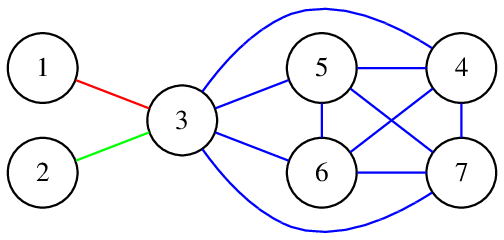
There are no rainbow cycles in it.
- Delete element $1$ from set $1$ . You should pay $a_1 + b_1 = 5$ coins for that.
- Delete element $1$ from set $2$ . You should pay $a_2 + b_1 = 6$ coins for that.
You pay $11$ coins in total. After these operations, the first and the second sets will be equal to $\{2\}$ and the third set will be equal to $\{1, 2\}$ .
So, the graph will consist of one edge $(1, 2)$ of color $3$ .
In the second test, you can make such operations:
- Delete element $1$ from set $1$ . You should pay $a_1 + b_1 = 11$ coins for that.
- Delete element $4$ from set $2$ . You should pay $a_2 + b_4 = 13$ coins for that.
- Delete element $7$ from set $3$ . You should pay $a_3 + b_7 = 13$ coins for that.
- Delete element $4$ from set $4$ . You should pay $a_4 + b_4 = 16$ coins for that.
- Delete element $7$ from set $6$ . You should pay $a_6 + b_7 = 13$ coins for that.
You pay $66$ coins in total.
After these operations, the sets will be:
- $\{2, 3\}$ ;
- $\{1\}$ ;
- $\{1, 3\}$ ;
- $\{3\}$ ;
- $\{3, 4, 5, 6, 7\}$ ;
- $\{5\}$ ;
- $\{8\}$ .
We will get the graph:

There are no rainbow cycles in it.