A13678 | Perform Easily
时间限制1s
内存限制256MB
通过 / 提交0/0
题目描述
After battling Shikamaru, Tayuya decided that her flute is too predictable, and replaced it with a guitar. The guitar has $6$ strings and an infinite number of frets numbered from $1$ . Fretting the fret number $j$ on the $i$ -th string produces the note $a_{i} + j$ .
Tayuya wants to play a melody of $n$ notes. Each note can be played on different string-fret combination. The easiness of performance depends on the difference between the maximal and the minimal indices of used frets. The less this difference is, the easier it is to perform the technique. Please determine the minimal possible difference.
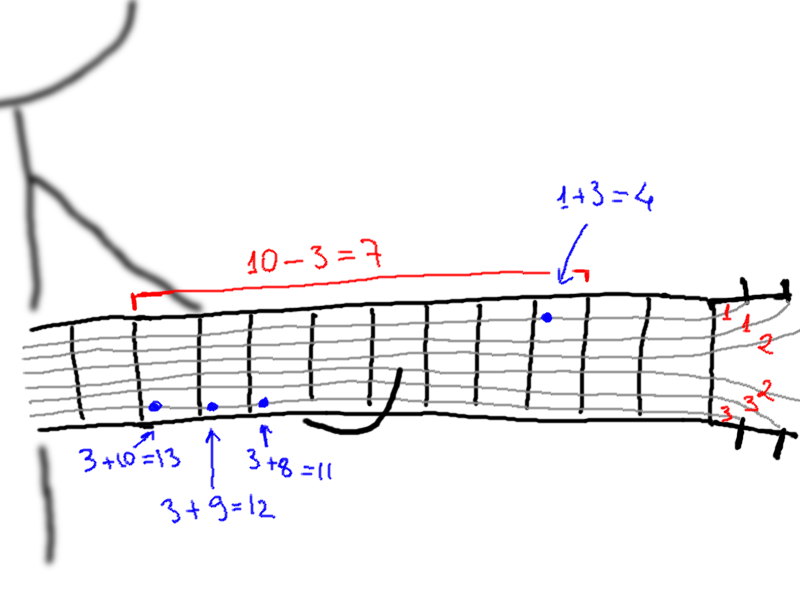
For example, if $a = [1, 1, 2, 2, 3, 3]$ , and the sequence of notes is $4, 11, 11, 12, 12, 13, 13$ (corresponding to the second example), we can play the first note on the first string, and all the other notes on the sixth string. Then the maximal fret will be $10$ , the minimal one will be $3$ , and the answer is $10 - 3 = 7$ , as shown on the picture.
Tayuya wants to play a melody of $n$ notes. Each note can be played on different string-fret combination. The easiness of performance depends on the difference between the maximal and the minimal indices of used frets. The less this difference is, the easier it is to perform the technique. Please determine the minimal possible difference.
For example, if $a = [1, 1, 2, 2, 3, 3]$ , and the sequence of notes is $4, 11, 11, 12, 12, 13, 13$ (corresponding to the second example), we can play the first note on the first string, and all the other notes on the sixth string. Then the maximal fret will be $10$ , the minimal one will be $3$ , and the answer is $10 - 3 = 7$ , as shown on the picture.

输入格式
The first line contains $6$ space-separated numbers $a_{1}$ , $a_{2}$ , ..., $a_{6}$ ( $1 \leq a_{i} \leq 10^{9}$ ) which describe the Tayuya's strings.
The second line contains the only integer $n$ ( $1 \leq n \leq 100\,000$ ) standing for the number of notes in the melody.
The third line consists of $n$ integers $b_{1}$ , $b_{2}$ , ..., $b_{n}$ ( $1 \leq b_{i} \leq 10^{9}$ ), separated by space. They describe the notes to be played. It's guaranteed that $b_i > a_j$ for all $1\leq i\leq n$ and $1\leq j\leq 6$ , in other words, you can play each note on any string.
The second line contains the only integer $n$ ( $1 \leq n \leq 100\,000$ ) standing for the number of notes in the melody.
The third line consists of $n$ integers $b_{1}$ , $b_{2}$ , ..., $b_{n}$ ( $1 \leq b_{i} \leq 10^{9}$ ), separated by space. They describe the notes to be played. It's guaranteed that $b_i > a_j$ for all $1\leq i\leq n$ and $1\leq j\leq 6$ , in other words, you can play each note on any string.
输出格式
Print the minimal possible difference of the maximal and the minimal indices of used frets.
输入输出样例
输入 #1
1 4 100 10 30 5
6
101 104 105 110 130 200
输出 #1
0
输入 #2
1 1 2 2 3 3
7
13 4 11 12 11 13 12
输出 #2
7
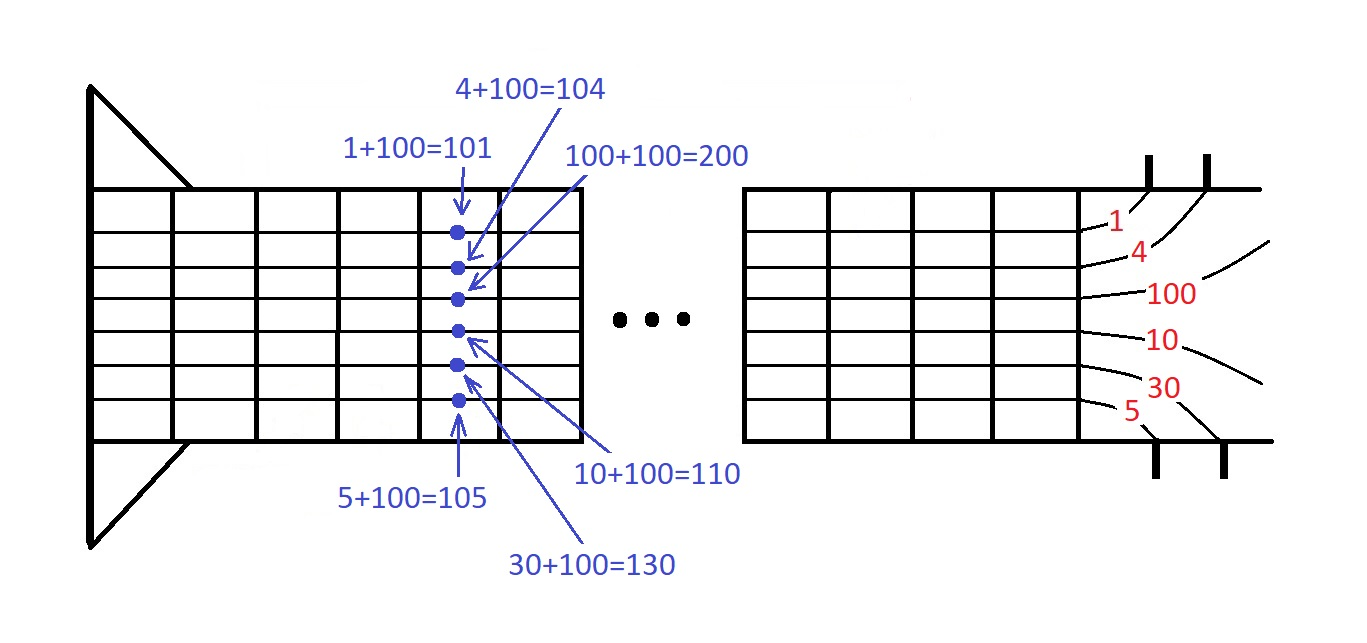
In the first sample test it is optimal to play the first note on the first string, the second note on the second string, the third note on the sixth string, the fourth note on the fourth string, the fifth note on the fifth string, and the sixth note on the third string. In this case the $100$ -th fret is used each time, so the difference is $100 - 100 = 0$ .
In the second test it's optimal, for example, to play the second note on the first string, and all the other notes on the sixth string. Then the maximal fret will be $10$ , the minimal one will be $3$ , and the answer is $10 - 3 = 7$ .
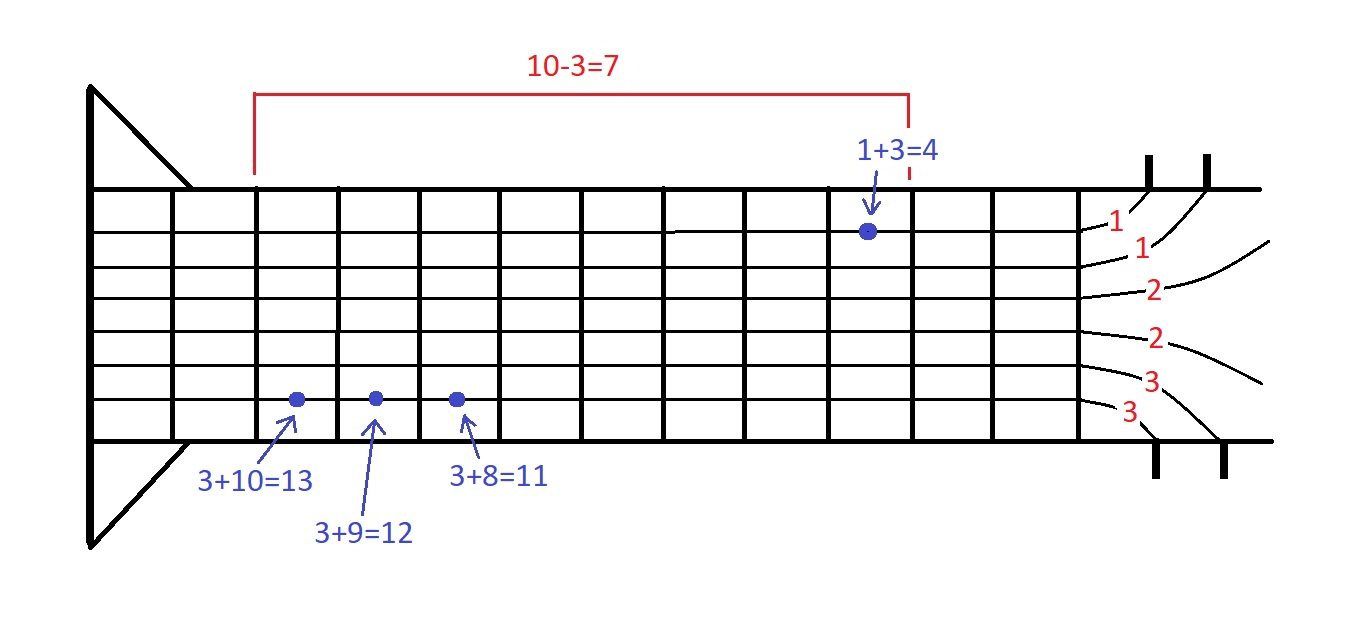
In the second test it's optimal, for example, to play the second note on the first string, and all the other notes on the sixth string. Then the maximal fret will be $10$ , the minimal one will be $3$ , and the answer is $10 - 3 = 7$ .

C++ 编辑器
输入
输出
可保存默认模板;新题优先使用已保存模板。
当前快捷键仅展示,暂不支持修改。
- 撤销
Ctrl / ⌘ + Z - 重做
Ctrl / ⌘ + Y - 查找
Ctrl / ⌘ + F - 全选
Ctrl / ⌘ + A - 复制
Ctrl / ⌘ + C - 剪切
Ctrl / ⌘ + X - 粘贴
Ctrl / ⌘ + V - 自动排版
工具栏排版按钮 - 草稿保存
编辑时自动保存到本机
历史
提交记录
状态说明时间源码
AI
作答助手
你好,我是作答助手。可以问思路、复杂度、样例含义或代码报错原因;不会直接给出完整 AC 代码。
确定要清空代码吗?
提交通过
评测结果:Accepted