A13572 | Omkar and Duck
时间限制1s
内存限制256MB
通过 / 提交0/0
题目描述
This is an interactive problem.
Omkar has just come across a duck! The duck is walking on a grid with $n$ rows and $n$ columns ( $2 \leq n \leq 25$ ) so that the grid contains a total of $n^2$ cells. Let's denote by $(x, y)$ the cell in the $x$ -th row from the top and the $y$ -th column from the left. Right now, the duck is at the cell $(1, 1)$ (the cell in the top left corner) and would like to reach the cell $(n, n)$ (the cell in the bottom right corner) by moving either down $1$ cell or to the right $1$ cell each second.
Since Omkar thinks ducks are fun, he wants to play a game with you based on the movement of the duck. First, for each cell $(x, y)$ in the grid, you will tell Omkar a nonnegative integer $a_{x,y}$ not exceeding $10^{16}$ , and Omkar will then put $a_{x,y}$ uninteresting problems in the cell $(x, y)$ . After that, the duck will start their journey from $(1, 1)$ to $(n, n)$ . For each cell $(x, y)$ that the duck crosses during their journey (including the cells $(1, 1)$ and $(n, n)$ ), the duck will eat the $a_{x,y}$ uninteresting problems in that cell. Once the duck has completed their journey, Omkar will measure their mass to determine the total number $k$ of uninteresting problems that the duck ate on their journey, and then tell you $k$ .
Your challenge, given $k$ , is to exactly reproduce the duck's path, i. e. to tell Omkar precisely which cells the duck crossed on their journey. To be sure of your mastery of this game, Omkar will have the duck complete $q$ different journeys ( $1 \leq q \leq 10^3$ ). Note that all journeys are independent: at the beginning of each journey, the cell $(x, y)$ will still contain $a_{x,y}$ uninteresting tasks.
Omkar has just come across a duck! The duck is walking on a grid with $n$ rows and $n$ columns ( $2 \leq n \leq 25$ ) so that the grid contains a total of $n^2$ cells. Let's denote by $(x, y)$ the cell in the $x$ -th row from the top and the $y$ -th column from the left. Right now, the duck is at the cell $(1, 1)$ (the cell in the top left corner) and would like to reach the cell $(n, n)$ (the cell in the bottom right corner) by moving either down $1$ cell or to the right $1$ cell each second.
Since Omkar thinks ducks are fun, he wants to play a game with you based on the movement of the duck. First, for each cell $(x, y)$ in the grid, you will tell Omkar a nonnegative integer $a_{x,y}$ not exceeding $10^{16}$ , and Omkar will then put $a_{x,y}$ uninteresting problems in the cell $(x, y)$ . After that, the duck will start their journey from $(1, 1)$ to $(n, n)$ . For each cell $(x, y)$ that the duck crosses during their journey (including the cells $(1, 1)$ and $(n, n)$ ), the duck will eat the $a_{x,y}$ uninteresting problems in that cell. Once the duck has completed their journey, Omkar will measure their mass to determine the total number $k$ of uninteresting problems that the duck ate on their journey, and then tell you $k$ .
Your challenge, given $k$ , is to exactly reproduce the duck's path, i. e. to tell Omkar precisely which cells the duck crossed on their journey. To be sure of your mastery of this game, Omkar will have the duck complete $q$ different journeys ( $1 \leq q \leq 10^3$ ). Note that all journeys are independent: at the beginning of each journey, the cell $(x, y)$ will still contain $a_{x,y}$ uninteresting tasks.
输入格式
无
输出格式
The interaction will begin with a line containing a single integer $n$ ( $2 \leq n \leq 25$ ), the amount of rows and columns in the grid. Read it.
Your program should then print $n$ lines. The $x$ -th line should contain $n$ integers $a_{x,1}, a_{x,2}, \dotsc, a_{x,n}$ satisfying $0 \leq a_{x,y} \leq 10^{16}$ , where $a_{x,y}$ is the amount of uninteresting problems Omkar should place in the cell $(x, y)$ .
After that, you will first receive a single integer $q$ , the amount of journeys that the duck will take. $q$ queries will follow; each query will consist of a single line containing an integer $k$ , the amount of uninteresting problems that the duck ate on that journey. After each query, given that you have determined that the duck visited the cells $(x_1, y_1), (x_2, y_2), \dotsc, (x_{2n - 1}, y_{2n - 1})$ in that order (it should always be true that $(x_1, y_1) = (1, 1)$ and $(x_{2n - 1}, y_{2n - 1}) = (n, n)$ ), you should output $2n - 1$ lines so that the $j$ -th line contains the two integers $x_j, y_j$ .
Bear in mind that if the sum on your path is $k$ , but your path is different from the actual hidden path, then your solution is still wrong!
After printing each line do not forget to output end of line and flush the output. Otherwise, you will get Idleness limit exceeded. To do this, use:
- fflush(stdout) or cout.flush() in C++;
- System.out.flush() in Java;
- flush(output) in Pascal;
- stdout.flush() in Python;
- see documentation for other languages.
Hack Format
To hack, first output a line containing $n$ and another line containing $q$ . It must be true that $2 \leq n \leq 25$ and $1 \leq q \leq 1000$ . Then, output the $q$ journeys taken by the duck in the same format as described above: for each journey, given that the duck visited the cells $(x_1, y_1), (x_2, y_2), \dotsc, (x_{2n - 1}, y_{2n - 1})$ in that order, you should output $2n - 1$ lines so that the $j$ -th line contains the two integers $x_j, y_j$ . It must be true that $(x_1, y_1) = (1, 1)$ and $(x_{2n - 1}, y_{2n - 1}) = (n, n)$ . Additionally, for each $j$ such that $2 \leq j \leq 2n - 1$ , it must be true that $1 \leq x_j, y_j \leq n$ and either $(x_j, y_j) = (x_{j - 1} + 1, y_{j - 1})$ or $(x_j, y_j) = (x_{j - 1}, y_{j - 1} + 1)$ .
Your program should then print $n$ lines. The $x$ -th line should contain $n$ integers $a_{x,1}, a_{x,2}, \dotsc, a_{x,n}$ satisfying $0 \leq a_{x,y} \leq 10^{16}$ , where $a_{x,y}$ is the amount of uninteresting problems Omkar should place in the cell $(x, y)$ .
After that, you will first receive a single integer $q$ , the amount of journeys that the duck will take. $q$ queries will follow; each query will consist of a single line containing an integer $k$ , the amount of uninteresting problems that the duck ate on that journey. After each query, given that you have determined that the duck visited the cells $(x_1, y_1), (x_2, y_2), \dotsc, (x_{2n - 1}, y_{2n - 1})$ in that order (it should always be true that $(x_1, y_1) = (1, 1)$ and $(x_{2n - 1}, y_{2n - 1}) = (n, n)$ ), you should output $2n - 1$ lines so that the $j$ -th line contains the two integers $x_j, y_j$ .
Bear in mind that if the sum on your path is $k$ , but your path is different from the actual hidden path, then your solution is still wrong!
After printing each line do not forget to output end of line and flush the output. Otherwise, you will get Idleness limit exceeded. To do this, use:
- fflush(stdout) or cout.flush() in C++;
- System.out.flush() in Java;
- flush(output) in Pascal;
- stdout.flush() in Python;
- see documentation for other languages.
Hack Format
To hack, first output a line containing $n$ and another line containing $q$ . It must be true that $2 \leq n \leq 25$ and $1 \leq q \leq 1000$ . Then, output the $q$ journeys taken by the duck in the same format as described above: for each journey, given that the duck visited the cells $(x_1, y_1), (x_2, y_2), \dotsc, (x_{2n - 1}, y_{2n - 1})$ in that order, you should output $2n - 1$ lines so that the $j$ -th line contains the two integers $x_j, y_j$ . It must be true that $(x_1, y_1) = (1, 1)$ and $(x_{2n - 1}, y_{2n - 1}) = (n, n)$ . Additionally, for each $j$ such that $2 \leq j \leq 2n - 1$ , it must be true that $1 \leq x_j, y_j \leq n$ and either $(x_j, y_j) = (x_{j - 1} + 1, y_{j - 1})$ or $(x_j, y_j) = (x_{j - 1}, y_{j - 1} + 1)$ .
输入输出样例
输入 #1
4


3
23


26


27
输出 #1
1 2 3 6
4 6 2 10
9 0 7 3
2 8 8 2


1 1
1 2
1 3
2 3
2 4
3 4
4 4

1 1
2 1
3 1
3 2
3 3
3 4
4 4

1 1
1 2
1 3
1 4
2 4
3 4
4 4
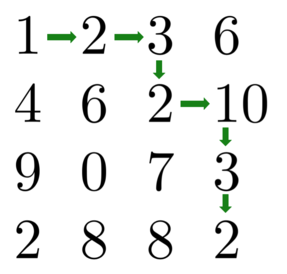
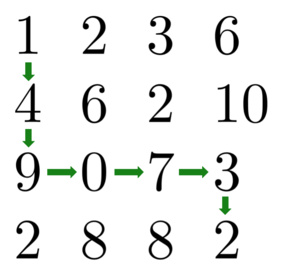
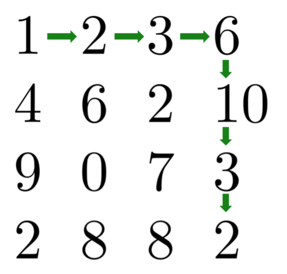
The duck's three journeys are illustrated below.
$1 + 2 + 3 + 2 + 10 + 3 + 2 = 23$
 $1 + 4 + 9 + 0 + 7 + 3 + 2 = 26$
 $1 + 2 + 3 + 6 + 10 + 3 + 2 = 27$
$1 + 2 + 3 + 2 + 10 + 3 + 2 = 23$
 $1 + 4 + 9 + 0 + 7 + 3 + 2 = 26$
 $1 + 2 + 3 + 6 + 10 + 3 + 2 = 27$

C++ 编辑器
输入
输出
可保存默认模板;新题优先使用已保存模板。
当前快捷键仅展示,暂不支持修改。
- 撤销
Ctrl / ⌘ + Z - 重做
Ctrl / ⌘ + Y - 查找
Ctrl / ⌘ + F - 全选
Ctrl / ⌘ + A - 复制
Ctrl / ⌘ + C - 剪切
Ctrl / ⌘ + X - 粘贴
Ctrl / ⌘ + V - 自动排版
工具栏排版按钮 - 草稿保存
编辑时自动保存到本机
历史
提交记录
状态说明时间源码
AI
作答助手
你好,我是作答助手。可以问思路、复杂度、样例含义或代码报错原因;不会直接给出完整 AC 代码。
确定要清空代码吗?
提交通过
评测结果:Accepted