A13505. Jog Around The Graph
编程题
普及/提高-
知识点
题目描述
You are given a simple weighted connected undirected graph, consisting of $n$ vertices and $m$ edges.
A path in the graph of length $k$ is a sequence of $k+1$ vertices $v_1, v_2, \dots, v_{k+1}$ such that for each $i$ $(1 \le i \le k)$ the edge $(v_i, v_{i+1})$ is present in the graph. A path from some vertex $v$ also has vertex $v_1=v$ . Note that edges and vertices are allowed to be included in the path multiple times.
The weight of the path is the total weight of edges in it.
For each $i$ from $1$ to $q$ consider a path from vertex $1$ of length $i$ of the maximum weight. What is the sum of weights of these $q$ paths?
Answer can be quite large, so print it modulo $10^9+7$ .
A path in the graph of length $k$ is a sequence of $k+1$ vertices $v_1, v_2, \dots, v_{k+1}$ such that for each $i$ $(1 \le i \le k)$ the edge $(v_i, v_{i+1})$ is present in the graph. A path from some vertex $v$ also has vertex $v_1=v$ . Note that edges and vertices are allowed to be included in the path multiple times.
The weight of the path is the total weight of edges in it.
For each $i$ from $1$ to $q$ consider a path from vertex $1$ of length $i$ of the maximum weight. What is the sum of weights of these $q$ paths?
Answer can be quite large, so print it modulo $10^9+7$ .
输入格式
The first line contains a three integers $n$ , $m$ , $q$ ( $2 \le n \le 2000$ ; $n - 1 \le m \le 2000$ ; $m \le q \le 10^9$ ) — the number of vertices in the graph, the number of edges in the graph and the number of lengths that should be included in the answer.
Each of the next $m$ lines contains a description of an edge: three integers $v$ , $u$ , $w$ ( $1 \le v, u \le n$ ; $1 \le w \le 10^6$ ) — two vertices $v$ and $u$ are connected by an undirected edge with weight $w$ . The graph contains no loops and no multiple edges. It is guaranteed that the given edges form a connected graph.
Each of the next $m$ lines contains a description of an edge: three integers $v$ , $u$ , $w$ ( $1 \le v, u \le n$ ; $1 \le w \le 10^6$ ) — two vertices $v$ and $u$ are connected by an undirected edge with weight $w$ . The graph contains no loops and no multiple edges. It is guaranteed that the given edges form a connected graph.
输出格式
Print a single integer — the sum of the weights of the paths from vertex $1$ of maximum weights of lengths $1, 2, \dots, q$ modulo $10^9+7$ .
输入输出样例
输入 #1
7 8 25
1 2 1
2 3 10
3 4 2
1 5 2
5 6 7
6 4 15
5 3 1
1 7 3
输出 #1
4361
输入 #2
2 1 5
1 2 4
输出 #2
60
输入 #3
15 15 23
13 10 12
11 14 12
2 15 5
4 10 8
10 2 4
10 7 5
3 10 1
5 6 11
1 13 8
9 15 4
4 2 9
11 15 1
11 12 14
10 8 12
3 6 11
输出 #3
3250
输入 #4
5 10 10000000
2 4 798
1 5 824
5 2 558
4 1 288
3 4 1890
3 1 134
2 3 1485
4 5 284
3 5 1025
1 2 649
输出 #4
768500592
说明/提示
Here is the graph for the first example:
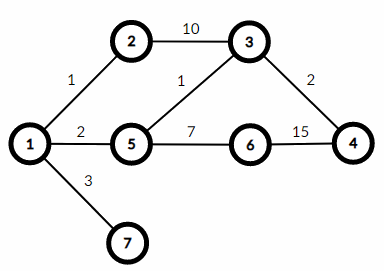Some maximum weight paths are:
- length $1$ : edges $(1, 7)$ — weight $3$ ;
- length $2$ : edges $(1, 2), (2, 3)$ — weight $1+10=11$ ;
- length $3$ : edges $(1, 5), (5, 6), (6, 4)$ — weight $2+7+15=24$ ;
- length $4$ : edges $(1, 5), (5, 6), (6, 4), (6, 4)$ — weight $2+7+15+15=39$ ;
- $\dots$
So the answer is the sum of $25$ terms: $3+11+24+39+\dots$
In the second example the maximum weight paths have weights $4$ , $8$ , $12$ , $16$ and $20$ .
Some maximum weight paths are:
- length $1$ : edges $(1, 7)$ — weight $3$ ;
- length $2$ : edges $(1, 2), (2, 3)$ — weight $1+10=11$ ;
- length $3$ : edges $(1, 5), (5, 6), (6, 4)$ — weight $2+7+15=24$ ;
- length $4$ : edges $(1, 5), (5, 6), (6, 4), (6, 4)$ — weight $2+7+15+15=39$ ;
- $\dots$
So the answer is the sum of $25$ terms: $3+11+24+39+\dots$
In the second example the maximum weight paths have weights $4$ , $8$ , $12$ , $16$ and $20$ .