A13459 | Road to 1600
时间限制1s
内存限制256MB
通过 / 提交0/0
题目描述
Egor wants to achieve a rating of 1600 points on the well-known chess portal ChessForces and he needs your help!
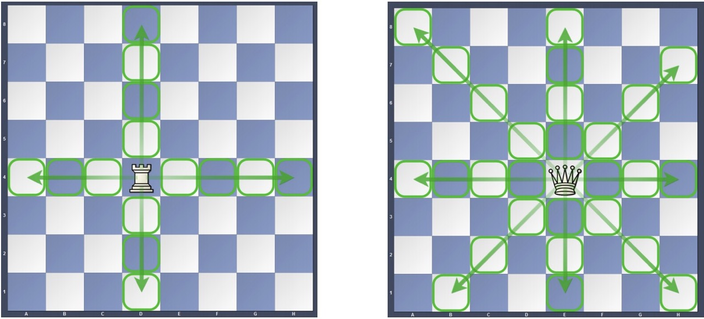
Before you start solving the problem, Egor wants to remind you how the chess pieces move. Chess rook moves along straight lines up and down, left and right, as many squares as it wants. And when it wants, it can stop. The queen walks in all directions vertically and diagonally at any distance. You can see the examples below.
To reach the goal, Egor should research the next topic:
There is an $N \times N$ board. Each cell of the board has a number from $1$ to $N ^ 2$ in it and numbers in all cells are distinct.
In the beginning, some chess figure stands in the cell with the number $1$ . Note that this cell is already considered as visited. After that every move is determined by the following rules:
1. Among all not visited yet cells to which the figure can get in one move, it goes to the cell that has minimal number.
2. If all accessible cells were already visited and some cells are not yet visited, then the figure is teleported to the not visited cell that has minimal number. If this step happens, the piece pays a fee of $1$ vun.
3. If all cells are already visited, the process is stopped.
Egor should find an $N \times N$ board on which the rook pays strictly less vuns than the queen during the round with this numbering. Help him to find such $N \times N$ numbered board, or tell that it doesn't exist.
Before you start solving the problem, Egor wants to remind you how the chess pieces move. Chess rook moves along straight lines up and down, left and right, as many squares as it wants. And when it wants, it can stop. The queen walks in all directions vertically and diagonally at any distance. You can see the examples below.
To reach the goal, Egor should research the next topic:
There is an $N \times N$ board. Each cell of the board has a number from $1$ to $N ^ 2$ in it and numbers in all cells are distinct.
In the beginning, some chess figure stands in the cell with the number $1$ . Note that this cell is already considered as visited. After that every move is determined by the following rules:
1. Among all not visited yet cells to which the figure can get in one move, it goes to the cell that has minimal number.
2. If all accessible cells were already visited and some cells are not yet visited, then the figure is teleported to the not visited cell that has minimal number. If this step happens, the piece pays a fee of $1$ vun.
3. If all cells are already visited, the process is stopped.
Egor should find an $N \times N$ board on which the rook pays strictly less vuns than the queen during the round with this numbering. Help him to find such $N \times N$ numbered board, or tell that it doesn't exist.
输入格式
The only line contains one integer $N$ — the size of the board, $1\le N \le 500$ .
输出格式
The output should contain $N$ lines.
In $i$ -th line output $N$ numbers — numbers on the $i$ -th row of the board. All numbers from $1$ to $N \times N$ must be used exactly once.
On your board rook must pay strictly less vuns than the queen.
If there are no solutions, print $-1$ .
If there are several solutions, you can output any of them.
In $i$ -th line output $N$ numbers — numbers on the $i$ -th row of the board. All numbers from $1$ to $N \times N$ must be used exactly once.
On your board rook must pay strictly less vuns than the queen.
If there are no solutions, print $-1$ .
If there are several solutions, you can output any of them.
输入输出样例
输入 #1
1
输出 #1
-1
输入 #2
4
输出 #2
4 3 6 12
7 5 9 15
14 1 11 10
13 8 16 2
In case we have $1 \times 1$ board, both rook and queen do not have a chance to pay fees.
In second sample rook goes through cells $1 \to 3 \to 4 \to 6 \to 9 \to 5 \to 7 \to 13 \to 2 \to 8 \to 16 \to 11 \to 10 \to 12 \to 15 \to \textbf{(1 vun)} \to 14$ .
Queen goes through $1 \to 3 \to 4 \to 2 \to 5 \to 6 \to 9 \to 7 \to 13 \to 8 \to 11 \to 10 \to 12 \to 15 \to \textbf{(1 vun)} \to 14 \to \textbf{(1 vun)} \to 16$ .
As a result rook pays 1 vun and queen pays 2 vuns.
In second sample rook goes through cells $1 \to 3 \to 4 \to 6 \to 9 \to 5 \to 7 \to 13 \to 2 \to 8 \to 16 \to 11 \to 10 \to 12 \to 15 \to \textbf{(1 vun)} \to 14$ .
Queen goes through $1 \to 3 \to 4 \to 2 \to 5 \to 6 \to 9 \to 7 \to 13 \to 8 \to 11 \to 10 \to 12 \to 15 \to \textbf{(1 vun)} \to 14 \to \textbf{(1 vun)} \to 16$ .
As a result rook pays 1 vun and queen pays 2 vuns.
C++ 编辑器
输入
输出
可保存默认模板;新题优先使用已保存模板。
当前快捷键仅展示,暂不支持修改。
- 撤销
Ctrl / ⌘ + Z - 重做
Ctrl / ⌘ + Y - 查找
Ctrl / ⌘ + F - 全选
Ctrl / ⌘ + A - 复制
Ctrl / ⌘ + C - 剪切
Ctrl / ⌘ + X - 粘贴
Ctrl / ⌘ + V - 自动排版
工具栏排版按钮 - 草稿保存
编辑时自动保存到本机
历史
提交记录
状态说明时间源码
AI
作答助手
你好,我是作答助手。可以问思路、复杂度、样例含义或代码报错原因;不会直接给出完整 AC 代码。
确定要清空代码吗?
提交通过
评测结果:Accepted