A13430 | JYPnation
时间限制1s
内存限制256MB
通过 / 提交0/0
题目描述
Due to the success of TWICE, JYP Entertainment has earned countless money and emerged as the biggest entertainment firm by market capitalization. Therefore, the boss, JYP, has decided to create a new nation and has appointed you to provide a design diagram.
The new nation consists of $n$ cities and some roads between them. JYP has given some restrictions:
- To guarantee efficiency while avoiding chaos, for any $2$ different cities $A$ and $B$ , there is exactly one road between them, and it is one-directional. There are no roads connecting a city to itself.
- The logo of rivaling companies should not appear in the plan, that is, there does not exist $4$ distinct cities $A$ , $B$ , $C$ , $D$ , such that the following configuration occurs.
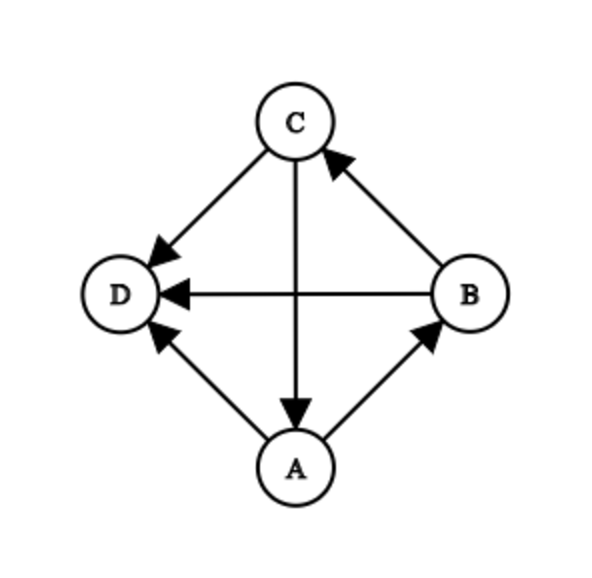JYP has given criteria for your diagram. For two cities $A$ , $B$ , let $dis(A,B)$ be the smallest number of roads you have to go through to get from $A$ to $B$ . If it is not possible to walk from $A$ to $B$ , $dis(A,B) = 614n$ . Then, the efficiency value is defined to be the sum of $dis(A,B)$ for all ordered pairs of distinct cities $(A,B)$ .
Note that $dis(A,B)$ doesn't have to be equal to $dis(B,A)$ .
You have drawn a design diagram that satisfies JYP's restrictions. Find the sum of $dis(A,B)$ over all ordered pairs of cities $(A,B)$ with $A\neq B$ .
Note that the input is given in compressed form. But even though it is compressed, you'd better use fast input.
The new nation consists of $n$ cities and some roads between them. JYP has given some restrictions:
- To guarantee efficiency while avoiding chaos, for any $2$ different cities $A$ and $B$ , there is exactly one road between them, and it is one-directional. There are no roads connecting a city to itself.
- The logo of rivaling companies should not appear in the plan, that is, there does not exist $4$ distinct cities $A$ , $B$ , $C$ , $D$ , such that the following configuration occurs.
JYP has given criteria for your diagram. For two cities $A$ , $B$ , let $dis(A,B)$ be the smallest number of roads you have to go through to get from $A$ to $B$ . If it is not possible to walk from $A$ to $B$ , $dis(A,B) = 614n$ . Then, the efficiency value is defined to be the sum of $dis(A,B)$ for all ordered pairs of distinct cities $(A,B)$ .
Note that $dis(A,B)$ doesn't have to be equal to $dis(B,A)$ .
You have drawn a design diagram that satisfies JYP's restrictions. Find the sum of $dis(A,B)$ over all ordered pairs of cities $(A,B)$ with $A\neq B$ .
Note that the input is given in compressed form. But even though it is compressed, you'd better use fast input.
输入格式
The first line contains a single integer $n$ ( $4 \le n \le 8000$ , $n \equiv 0 \pmod{4}$ ) — the number of cities.
A binary matrix is encrypted in the following format. Each of $n$ next lines contains $\frac{n}{4}$ one-digit hexadecimal numbers (that is, these numbers can be represented either as digits from $0$ to $9$ or as uppercase Latin letters from $A$ to $F$ ). Binary representation of each of these numbers denotes next $4$ elements of the matrix in the corresponding row. For example, if the number $B$ is given, then the corresponding elements are $1011$ , and if the number is $5$ , then the corresponding elements are $0101$ .
After you obtain the decrypted binary matrix, the $j$ -th character of the $i$ -th row is $1$ if the one-directional road between cities $i$ and $j$ is directed from $i$ to $j$ , and $0$ otherwise. It is guaranteed that the graph satisfies the restrictions mentioned above.
A binary matrix is encrypted in the following format. Each of $n$ next lines contains $\frac{n}{4}$ one-digit hexadecimal numbers (that is, these numbers can be represented either as digits from $0$ to $9$ or as uppercase Latin letters from $A$ to $F$ ). Binary representation of each of these numbers denotes next $4$ elements of the matrix in the corresponding row. For example, if the number $B$ is given, then the corresponding elements are $1011$ , and if the number is $5$ , then the corresponding elements are $0101$ .
After you obtain the decrypted binary matrix, the $j$ -th character of the $i$ -th row is $1$ if the one-directional road between cities $i$ and $j$ is directed from $i$ to $j$ , and $0$ otherwise. It is guaranteed that the graph satisfies the restrictions mentioned above.
输出格式
Output one integer, representing the sum of $dis(A,B)$ over all ordered pairs of cities $(A,B)$ with $A\neq B$ .
输入输出样例
输入 #1
4
7
2
1
4
输出 #1
7380
输入 #2
8
7F
3F
1F
0C
06
03
11
18
输出 #2
88464
The first example corresponds to the matrix:
$\begin{matrix} 0111 \\ 0010 \\ 0001 \\ 0100 \\ \end{matrix}$
Which corresponds to this graph:
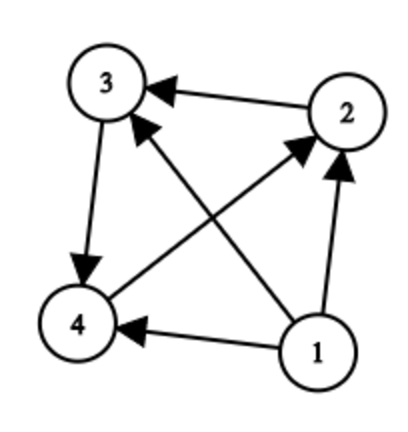
$dis(1,2)=dis(1,3)=dis(1,4)=dis(2,3)=dis(3,4)=dis(4,2)=1$
$dis(2,4)=dis(4,3)=dis(3,2)=2$
$dis(2,1)=dis(3,1)=dis(4,1)=2456$
Therefore the answer for the diagram is $7380$ .
$\begin{matrix} 0111 \\ 0010 \\ 0001 \\ 0100 \\ \end{matrix}$
Which corresponds to this graph:

$dis(1,2)=dis(1,3)=dis(1,4)=dis(2,3)=dis(3,4)=dis(4,2)=1$
$dis(2,4)=dis(4,3)=dis(3,2)=2$
$dis(2,1)=dis(3,1)=dis(4,1)=2456$
Therefore the answer for the diagram is $7380$ .
C++ 编辑器
输入
输出
可保存默认模板;新题优先使用已保存模板。
当前快捷键仅展示,暂不支持修改。
- 撤销
Ctrl / ⌘ + Z - 重做
Ctrl / ⌘ + Y - 查找
Ctrl / ⌘ + F - 全选
Ctrl / ⌘ + A - 复制
Ctrl / ⌘ + C - 剪切
Ctrl / ⌘ + X - 粘贴
Ctrl / ⌘ + V - 自动排版
工具栏排版按钮 - 草稿保存
编辑时自动保存到本机
历史
提交记录
状态说明时间源码
AI
作答助手
你好,我是作答助手。可以问思路、复杂度、样例含义或代码报错原因;不会直接给出完整 AC 代码。
确定要清空代码吗?
提交通过
评测结果:Accepted