A13359 | Double Elimination
时间限制1s
内存限制256MB
通过 / 提交0/0
题目描述
The biggest event of the year – Cota 2 world championship "The Innernational" is right around the corner. $2^n$ teams will compete in a double-elimination format (please, carefully read problem statement even if you know what is it) to identify the champion.
Teams are numbered from $1$ to $2^n$ and will play games one-on-one. All teams start in the upper bracket.
All upper bracket matches will be held played between teams that haven't lost any games yet. Teams are split into games by team numbers. Game winner advances in the next round of upper bracket, losers drop into the lower bracket.
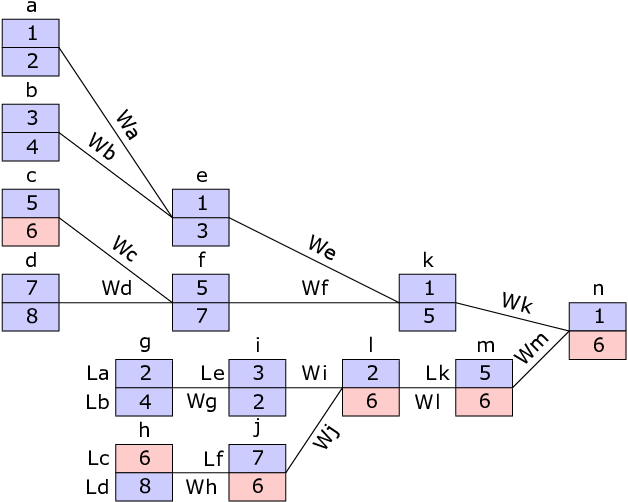
Lower bracket starts with $2^{n-1}$ teams that lost the first upper bracket game. Each lower bracket round consists of two games. In the first game of a round $2^k$ teams play a game with each other (teams are split into games by team numbers). $2^{k-1}$ loosing teams are eliminated from the championship, $2^{k-1}$ winning teams are playing $2^{k-1}$ teams that got eliminated in this round of upper bracket (again, teams are split into games by team numbers). As a result of each round both upper and lower bracket have $2^{k-1}$ teams remaining. See example notes for better understanding.
Single remaining team of upper bracket plays with single remaining team of lower bracket in grand-finals to identify championship winner.
You are a fan of teams with numbers $a_1, a_2, ..., a_k$ . You want the championship to have as many games with your favourite teams as possible. Luckily, you can affect results of every championship game the way you want. What's maximal possible number of championship games that include teams you're fan of?
Teams are numbered from $1$ to $2^n$ and will play games one-on-one. All teams start in the upper bracket.
All upper bracket matches will be held played between teams that haven't lost any games yet. Teams are split into games by team numbers. Game winner advances in the next round of upper bracket, losers drop into the lower bracket.
Lower bracket starts with $2^{n-1}$ teams that lost the first upper bracket game. Each lower bracket round consists of two games. In the first game of a round $2^k$ teams play a game with each other (teams are split into games by team numbers). $2^{k-1}$ loosing teams are eliminated from the championship, $2^{k-1}$ winning teams are playing $2^{k-1}$ teams that got eliminated in this round of upper bracket (again, teams are split into games by team numbers). As a result of each round both upper and lower bracket have $2^{k-1}$ teams remaining. See example notes for better understanding.
Single remaining team of upper bracket plays with single remaining team of lower bracket in grand-finals to identify championship winner.
You are a fan of teams with numbers $a_1, a_2, ..., a_k$ . You want the championship to have as many games with your favourite teams as possible. Luckily, you can affect results of every championship game the way you want. What's maximal possible number of championship games that include teams you're fan of?
输入格式
First input line has two integers $n, k$ — $2^n$ teams are competing in the championship. You are a fan of $k$ teams ( $2 \le n \le 17; 0 \le k \le 2^n$ ).
Second input line has $k$ distinct integers $a_1, \ldots, a_k$ — numbers of teams you're a fan of ( $1 \le a_i \le 2^n$ ).
Second input line has $k$ distinct integers $a_1, \ldots, a_k$ — numbers of teams you're a fan of ( $1 \le a_i \le 2^n$ ).
输出格式
Output single integer — maximal possible number of championship games that include teams you're fan of.
输入输出样例
输入 #1
3 1
6
输出 #1
6
输入 #2
3 3
1 7 8
输出 #2
11
输入 #3
3 4
1 3 5 7
输出 #3
14
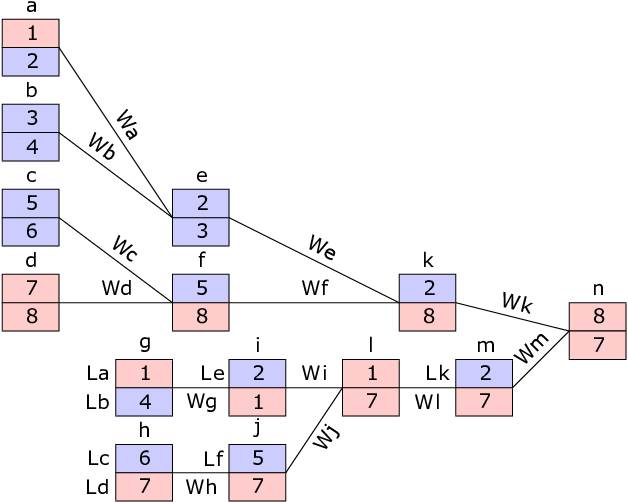
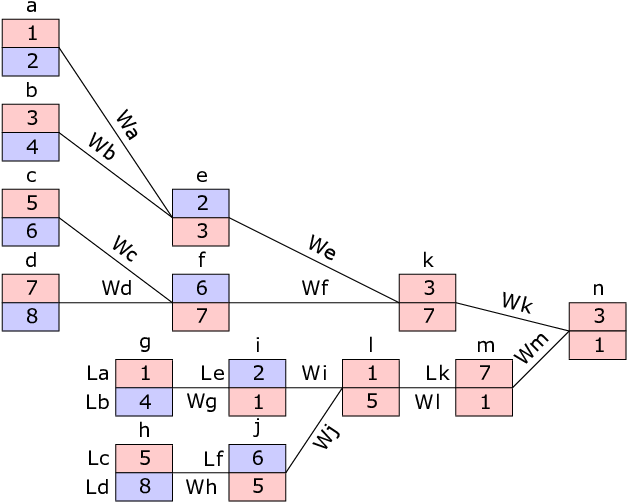
On the image, each game of the championship is denoted with an English letter ( $a$ to $n$ ). Winner of game $i$ is denoted as $Wi$ , loser is denoted as $Li$ . Teams you're a fan of are highlighted with red background.
In the first example, team $6$ will play in 6 games if it looses the first upper bracket game (game $c$ ) and wins all lower bracket games (games $h, j, l, m$ ).
In the second example, teams $7$ and $8$ have to play with each other in the first game of upper bracket (game $d$ ). Team $8$ can win all remaining games in upper bracket, when teams $1$ and $7$ will compete in the lower bracket.
In the third example, your favourite teams can play in all games of the championship.
In the first example, team $6$ will play in 6 games if it looses the first upper bracket game (game $c$ ) and wins all lower bracket games (games $h, j, l, m$ ).
In the second example, teams $7$ and $8$ have to play with each other in the first game of upper bracket (game $d$ ). Team $8$ can win all remaining games in upper bracket, when teams $1$ and $7$ will compete in the lower bracket.
In the third example, your favourite teams can play in all games of the championship.

C++ 编辑器
输入
输出
可保存默认模板;新题优先使用已保存模板。
当前快捷键仅展示,暂不支持修改。
- 撤销
Ctrl / ⌘ + Z - 重做
Ctrl / ⌘ + Y - 查找
Ctrl / ⌘ + F - 全选
Ctrl / ⌘ + A - 复制
Ctrl / ⌘ + C - 剪切
Ctrl / ⌘ + X - 粘贴
Ctrl / ⌘ + V - 自动排版
工具栏排版按钮 - 草稿保存
编辑时自动保存到本机
历史
提交记录
状态说明时间源码
AI
作答助手
你好,我是作答助手。可以问思路、复杂度、样例含义或代码报错原因;不会直接给出完整 AC 代码。
确定要清空代码吗?
提交通过
评测结果:Accepted