A13350. Construct the Binary Tree
编程题
普及/提高-
知识点
题目描述
You are given two integers $n$ and $d$ . You need to construct a rooted binary tree consisting of $n$ vertices with a root at the vertex $1$ and the sum of depths of all vertices equals to $d$ .
A tree is a connected graph without cycles. A rooted tree has a special vertex called the root. A parent of a vertex $v$ is the last different from $v$ vertex on the path from the root to the vertex $v$ . The depth of the vertex $v$ is the length of the path from the root to the vertex $v$ . Children of vertex $v$ are all vertices for which $v$ is the parent. The binary tree is such a tree that no vertex has more than $2$ children.
You have to answer $t$ independent test cases.
A tree is a connected graph without cycles. A rooted tree has a special vertex called the root. A parent of a vertex $v$ is the last different from $v$ vertex on the path from the root to the vertex $v$ . The depth of the vertex $v$ is the length of the path from the root to the vertex $v$ . Children of vertex $v$ are all vertices for which $v$ is the parent. The binary tree is such a tree that no vertex has more than $2$ children.
You have to answer $t$ independent test cases.
输入格式
The first line of the input contains one integer $t$ ( $1 \le t \le 1000$ ) — the number of test cases.
The only line of each test case contains two integers $n$ and $d$ ( $2 \le n, d \le 5000$ ) — the number of vertices in the tree and the required sum of depths of all vertices.
It is guaranteed that the sum of $n$ and the sum of $d$ both does not exceed $5000$ ( $\sum n \le 5000, \sum d \le 5000$ ).
The only line of each test case contains two integers $n$ and $d$ ( $2 \le n, d \le 5000$ ) — the number of vertices in the tree and the required sum of depths of all vertices.
It is guaranteed that the sum of $n$ and the sum of $d$ both does not exceed $5000$ ( $\sum n \le 5000, \sum d \le 5000$ ).
输出格式
For each test case, print the answer.
If it is impossible to construct such a tree, print "NO" (without quotes) in the first line. Otherwise, print "{YES}" in the first line. Then print $n-1$ integers $p_2, p_3, \dots, p_n$ in the second line, where $p_i$ is the parent of the vertex $i$ . Note that the sequence of parents you print should describe some binary tree.
If it is impossible to construct such a tree, print "NO" (without quotes) in the first line. Otherwise, print "{YES}" in the first line. Then print $n-1$ integers $p_2, p_3, \dots, p_n$ in the second line, where $p_i$ is the parent of the vertex $i$ . Note that the sequence of parents you print should describe some binary tree.
输入输出样例
输入 #1
3
5 7
10 19
10 18
输出 #1
YES
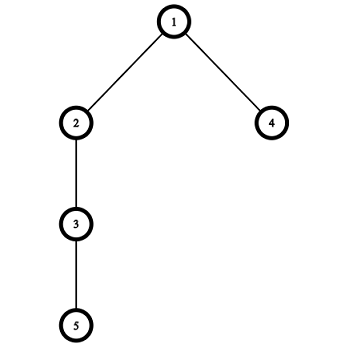
1 2 1 3
YES
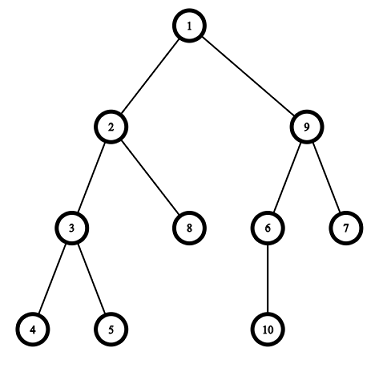
1 2 3 3 9 9 2 1 6
NO
说明/提示
Pictures corresponding to the first and the second test cases of the example: