A13309. Frog Jumps
编程题
普及/提高-
知识点
题目描述
There is a frog staying to the left of the string $s = s_1 s_2 \ldots s_n$ consisting of $n$ characters (to be more precise, the frog initially stays at the cell $0$ ). Each character of $s$ is either 'L' or 'R'. It means that if the frog is staying at the $i$ -th cell and the $i$ -th character is 'L', the frog can jump only to the left. If the frog is staying at the $i$ -th cell and the $i$ -th character is 'R', the frog can jump only to the right. The frog can jump only to the right from the cell $0$ .
Note that the frog can jump into the same cell twice and can perform as many jumps as it needs.
The frog wants to reach the $n+1$ -th cell. The frog chooses some positive integer value $d$ before the first jump (and cannot change it later) and jumps by no more than $d$ cells at once. I.e. if the $i$ -th character is 'L' then the frog can jump to any cell in a range $[max(0, i - d); i - 1]$ , and if the $i$ -th character is 'R' then the frog can jump to any cell in a range $[i + 1; min(n + 1; i + d)]$ .
The frog doesn't want to jump far, so your task is to find the minimum possible value of $d$ such that the frog can reach the cell $n+1$ from the cell $0$ if it can jump by no more than $d$ cells at once. It is guaranteed that it is always possible to reach $n+1$ from $0$ .
You have to answer $t$ independent test cases.
Note that the frog can jump into the same cell twice and can perform as many jumps as it needs.
The frog wants to reach the $n+1$ -th cell. The frog chooses some positive integer value $d$ before the first jump (and cannot change it later) and jumps by no more than $d$ cells at once. I.e. if the $i$ -th character is 'L' then the frog can jump to any cell in a range $[max(0, i - d); i - 1]$ , and if the $i$ -th character is 'R' then the frog can jump to any cell in a range $[i + 1; min(n + 1; i + d)]$ .
The frog doesn't want to jump far, so your task is to find the minimum possible value of $d$ such that the frog can reach the cell $n+1$ from the cell $0$ if it can jump by no more than $d$ cells at once. It is guaranteed that it is always possible to reach $n+1$ from $0$ .
You have to answer $t$ independent test cases.
输入格式
The first line of the input contains one integer $t$ ( $1 \le t \le 10^4$ ) — the number of test cases.
The next $t$ lines describe test cases. The $i$ -th test case is described as a string $s$ consisting of at least $1$ and at most $2 \cdot 10^5$ characters 'L' and 'R'.
It is guaranteed that the sum of lengths of strings over all test cases does not exceed $2 \cdot 10^5$ ( $\sum |s| \le 2 \cdot 10^5$ ).
The next $t$ lines describe test cases. The $i$ -th test case is described as a string $s$ consisting of at least $1$ and at most $2 \cdot 10^5$ characters 'L' and 'R'.
It is guaranteed that the sum of lengths of strings over all test cases does not exceed $2 \cdot 10^5$ ( $\sum |s| \le 2 \cdot 10^5$ ).
输出格式
For each test case, print the answer — the minimum possible value of $d$ such that the frog can reach the cell $n+1$ from the cell $0$ if it jumps by no more than $d$ at once.
输入输出样例
输入 #1
6
LRLRRLL
L
LLR
RRRR
LLLLLL
R
输出 #1
3
2
3
1
7
1
说明/提示
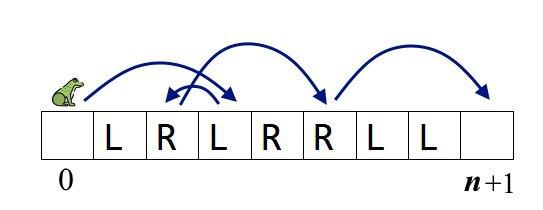
The picture describing the first test case of the example and one of the possible answers:
In the second test case of the example, the frog can only jump directly from $0$ to $n+1$ .
In the third test case of the example, the frog can choose $d=3$ , jump to the cell $3$ from the cell $0$ and then to the cell $4$ from the cell $3$ .
In the fourth test case of the example, the frog can choose $d=1$ and jump $5$ times to the right.
In the fifth test case of the example, the frog can only jump directly from $0$ to $n+1$ .
In the sixth test case of the example, the frog can choose $d=1$ and jump $2$ times to the right.

In the second test case of the example, the frog can only jump directly from $0$ to $n+1$ .
In the third test case of the example, the frog can choose $d=3$ , jump to the cell $3$ from the cell $0$ and then to the cell $4$ from the cell $3$ .
In the fourth test case of the example, the frog can choose $d=1$ and jump $5$ times to the right.
In the fifth test case of the example, the frog can only jump directly from $0$ to $n+1$ .
In the sixth test case of the example, the frog can choose $d=1$ and jump $2$ times to the right.