A13255. Harry The Potter
编程题
普及/提高-
知识点
题目描述
To defeat Lord Voldemort, Harry needs to destroy all horcruxes first. The last horcrux is an array $a$ of $n$ integers, which also needs to be destroyed. The array is considered destroyed is all its elements are zeroes. To destroy the array, Harry can perform two types of operations:
1. choose an index $i$ ( $1 \le i \le n$ ), an integer $x$ , and subtract $x$ from $a_i$ .
2. choose two indices $i$ and $j$ ( $1 \le i, j \le n; i \ne j$ ), an integer $x$ , and subtract $x$ from $a_i$ and $x + 1$ from $a_j$ .
Note that $x$ does not have to be positive.
Harry is in a hurry, please help him to find the minimum number of operations required to destroy the array and exterminate Lord Voldemort.
1. choose an index $i$ ( $1 \le i \le n$ ), an integer $x$ , and subtract $x$ from $a_i$ .
2. choose two indices $i$ and $j$ ( $1 \le i, j \le n; i \ne j$ ), an integer $x$ , and subtract $x$ from $a_i$ and $x + 1$ from $a_j$ .
Note that $x$ does not have to be positive.
Harry is in a hurry, please help him to find the minimum number of operations required to destroy the array and exterminate Lord Voldemort.
输入格式
The first line contains a single integer $n$ — the size of the array $a$ ( $1 \le n \le 20$ ).
The following line contains $n$ integers $a_1, a_2, \ldots, a_n$ — array elements ( $-10^{15} \le a_i \le 10^{15}$ ).
The following line contains $n$ integers $a_1, a_2, \ldots, a_n$ — array elements ( $-10^{15} \le a_i \le 10^{15}$ ).
输出格式
Output a single integer — the minimum number of operations required to destroy the array $a$ .
输入输出样例
输入 #1
3
1 10 100
输出 #1
3
输入 #2
3
5 3 -2
输出 #2
2
输入 #3
1
0
输出 #3
0
说明/提示
In the first example one can just apply the operation of the first kind three times.
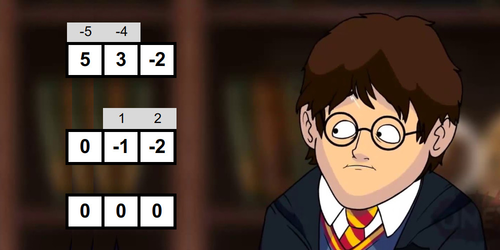
In the second example, one can apply the operation of the second kind two times: first, choose $i = 2, j = 1, x = 4$ , it transforms the array into $(0, -1, -2)$ , and then choose $i = 3, j = 2, x = -2$ to destroy the array.
In the third example, there is nothing to be done, since the array is already destroyed.
In the second example, one can apply the operation of the second kind two times: first, choose $i = 2, j = 1, x = 4$ , it transforms the array into $(0, -1, -2)$ , and then choose $i = 3, j = 2, x = -2$ to destroy the array.
In the third example, there is nothing to be done, since the array is already destroyed.