A13242 | Cartesian Tree
时间限制1s
内存限制256MB
通过 / 提交0/0
题目描述
Ildar is the algorithm teacher of William and Harris. Today, Ildar is teaching Cartesian Tree. However, Harris is sick, so Ildar is only teaching William.
A cartesian tree is a rooted tree, that can be constructed from a sequence of distinct integers. We build the cartesian tree as follows:
1. If the sequence is empty, return an empty tree;
2. Let the position of the maximum element be $x$ ;
3. Remove element on the position $x$ from the sequence and break it into the left part and the right part (which might be empty) (not actually removing it, just taking it away temporarily);
4. Build cartesian tree for each part;
5. Create a new vertex for the element, that was on the position $x$ which will serve as the root of the new tree. Then, for the root of the left part and right part, if exists, will become the children for this vertex;
6. Return the tree we have gotten.
For example, this is the cartesian tree for the sequence $4, 2, 7, 3, 5, 6, 1$ :
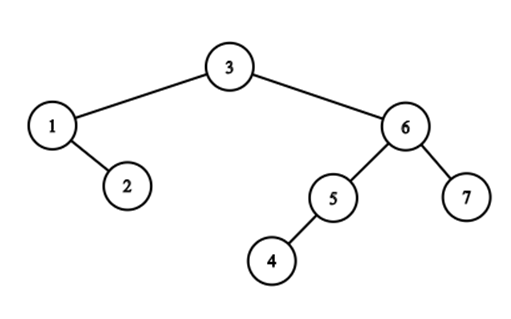After teaching what the cartesian tree is, Ildar has assigned homework. He starts with an empty sequence $a$ .
In the $i$ -th round, he inserts an element with value $i$ somewhere in $a$ . Then, he asks a question: what is the sum of the sizes of the subtrees for every node in the cartesian tree for the current sequence $a$ ?
Node $v$ is in the node $u$ subtree if and only if $v = u$ or $v$ is in the subtree of one of the vertex $u$ children. The size of the subtree of node $u$ is the number of nodes $v$ such that $v$ is in the subtree of $u$ .
Ildar will do $n$ rounds in total. The homework is the sequence of answers to the $n$ questions.
The next day, Ildar told Harris that he has to complete the homework as well. Harris obtained the final state of the sequence $a$ from William. However, he has no idea how to find the answers to the $n$ questions. Help Harris!
A cartesian tree is a rooted tree, that can be constructed from a sequence of distinct integers. We build the cartesian tree as follows:
1. If the sequence is empty, return an empty tree;
2. Let the position of the maximum element be $x$ ;
3. Remove element on the position $x$ from the sequence and break it into the left part and the right part (which might be empty) (not actually removing it, just taking it away temporarily);
4. Build cartesian tree for each part;
5. Create a new vertex for the element, that was on the position $x$ which will serve as the root of the new tree. Then, for the root of the left part and right part, if exists, will become the children for this vertex;
6. Return the tree we have gotten.
For example, this is the cartesian tree for the sequence $4, 2, 7, 3, 5, 6, 1$ :
After teaching what the cartesian tree is, Ildar has assigned homework. He starts with an empty sequence $a$ .
In the $i$ -th round, he inserts an element with value $i$ somewhere in $a$ . Then, he asks a question: what is the sum of the sizes of the subtrees for every node in the cartesian tree for the current sequence $a$ ?
Node $v$ is in the node $u$ subtree if and only if $v = u$ or $v$ is in the subtree of one of the vertex $u$ children. The size of the subtree of node $u$ is the number of nodes $v$ such that $v$ is in the subtree of $u$ .
Ildar will do $n$ rounds in total. The homework is the sequence of answers to the $n$ questions.
The next day, Ildar told Harris that he has to complete the homework as well. Harris obtained the final state of the sequence $a$ from William. However, he has no idea how to find the answers to the $n$ questions. Help Harris!
输入格式
The first line contains a single integer $n$ ( $1 \le n \le 150000$ ).
The second line contains $n$ integers $a_1, a_2, \ldots, a_n$ ( $1 \le a_i \le n$ ). It is guarenteed that each integer from $1$ to $n$ appears in the sequence exactly once.
The second line contains $n$ integers $a_1, a_2, \ldots, a_n$ ( $1 \le a_i \le n$ ). It is guarenteed that each integer from $1$ to $n$ appears in the sequence exactly once.
输出格式
Print $n$ lines, $i$ -th line should contain a single integer — the answer to the $i$ -th question.
输入输出样例
输入 #1
5
2 4 1 5 3
输出 #1
1
3
6
8
11
输入 #2
6
1 2 4 5 6 3
输出 #2
1
3
6
8
12
17
After the first round, the sequence is $1$ . The tree is
The answer is $1$ .
After the second round, the sequence is $2, 1$ . The tree is
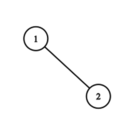The answer is $2+1=3$ .
After the third round, the sequence is $2, 1, 3$ . The tree is
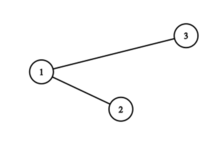The answer is $2+1+3=6$ .
After the fourth round, the sequence is $2, 4, 1, 3$ . The tree is
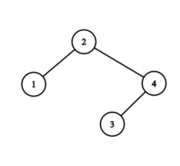The answer is $1+4+1+2=8$ .
After the fifth round, the sequence is $2, 4, 1, 5, 3$ . The tree is
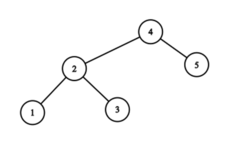The answer is $1+3+1+5+1=11$ .
The answer is $1$ .
After the second round, the sequence is $2, 1$ . The tree is
The answer is $2+1=3$ .
After the third round, the sequence is $2, 1, 3$ . The tree is
The answer is $2+1+3=6$ .
After the fourth round, the sequence is $2, 4, 1, 3$ . The tree is
The answer is $1+4+1+2=8$ .
After the fifth round, the sequence is $2, 4, 1, 5, 3$ . The tree is
The answer is $1+3+1+5+1=11$ .
C++ 编辑器
输入
输出
可保存默认模板;新题优先使用已保存模板。
当前快捷键仅展示,暂不支持修改。
- 撤销
Ctrl / ⌘ + Z - 重做
Ctrl / ⌘ + Y - 查找
Ctrl / ⌘ + F - 全选
Ctrl / ⌘ + A - 复制
Ctrl / ⌘ + C - 剪切
Ctrl / ⌘ + X - 粘贴
Ctrl / ⌘ + V - 自动排版
工具栏排版按钮 - 草稿保存
编辑时自动保存到本机
历史
提交记录
状态说明时间源码
AI
作答助手
你好,我是作答助手。可以问思路、复杂度、样例含义或代码报错原因;不会直接给出完整 AC 代码。
确定要清空代码吗?
提交通过
评测结果:Accepted