A13235 | Chaotic V.
时间限制1s
内存限制256MB
通过 / 提交0/0
题目描述
[Æsir - CHAOS](https://soundcloud.com/kivawu/aesir-chaos)
[Æsir - V.](https://soundcloud.com/kivawu/aesir-v)
"Everything has been planned out. No more hidden concerns. The condition of Cytus is also perfect.
The time right now...... 00:01:12......
It's time."
The emotion samples are now sufficient. After almost 3 years, it's time for Ivy to awake her bonded sister, Vanessa.
The system inside A.R.C.'s Library core can be considered as an undirected graph with infinite number of processing nodes, numbered with all positive integers ( $1, 2, 3, \ldots$ ). The node with a number $x$ ( $x > 1$ ), is directly connected with a node with number $\frac{x}{f(x)}$ , with $f(x)$ being the lowest prime divisor of $x$ .
Vanessa's mind is divided into $n$ fragments. Due to more than 500 years of coma, the fragments have been scattered: the $i$ -th fragment is now located at the node with a number $k_i!$ (a factorial of $k_i$ ).
To maximize the chance of successful awakening, Ivy decides to place the samples in a node $P$ , so that the total length of paths from each fragment to $P$ is smallest possible. If there are multiple fragments located at the same node, the path from that node to $P$ needs to be counted multiple times.
In the world of zeros and ones, such a requirement is very simple for Ivy. Not longer than a second later, she has already figured out such a node.
But for a mere human like you, is this still possible?
For simplicity, please answer the minimal sum of paths' lengths from every fragment to the emotion samples' assembly node $P$ .
[Æsir - V.](https://soundcloud.com/kivawu/aesir-v)
"Everything has been planned out. No more hidden concerns. The condition of Cytus is also perfect.
The time right now...... 00:01:12......
It's time."
The emotion samples are now sufficient. After almost 3 years, it's time for Ivy to awake her bonded sister, Vanessa.
The system inside A.R.C.'s Library core can be considered as an undirected graph with infinite number of processing nodes, numbered with all positive integers ( $1, 2, 3, \ldots$ ). The node with a number $x$ ( $x > 1$ ), is directly connected with a node with number $\frac{x}{f(x)}$ , with $f(x)$ being the lowest prime divisor of $x$ .
Vanessa's mind is divided into $n$ fragments. Due to more than 500 years of coma, the fragments have been scattered: the $i$ -th fragment is now located at the node with a number $k_i!$ (a factorial of $k_i$ ).
To maximize the chance of successful awakening, Ivy decides to place the samples in a node $P$ , so that the total length of paths from each fragment to $P$ is smallest possible. If there are multiple fragments located at the same node, the path from that node to $P$ needs to be counted multiple times.
In the world of zeros and ones, such a requirement is very simple for Ivy. Not longer than a second later, she has already figured out such a node.
But for a mere human like you, is this still possible?
For simplicity, please answer the minimal sum of paths' lengths from every fragment to the emotion samples' assembly node $P$ .
输入格式
The first line contains an integer $n$ ( $1 \le n \le 10^6$ ) — number of fragments of Vanessa's mind.
The second line contains $n$ integers: $k_1, k_2, \ldots, k_n$ ( $0 \le k_i \le 5000$ ), denoting the nodes where fragments of Vanessa's mind are located: the $i$ -th fragment is at the node with a number $k_i!$ .
The second line contains $n$ integers: $k_1, k_2, \ldots, k_n$ ( $0 \le k_i \le 5000$ ), denoting the nodes where fragments of Vanessa's mind are located: the $i$ -th fragment is at the node with a number $k_i!$ .
输出格式
Print a single integer, denoting the minimal sum of path from every fragment to the node with the emotion samples (a.k.a. node $P$ ).
As a reminder, if there are multiple fragments at the same node, the distance from that node to $P$ needs to be counted multiple times as well.
As a reminder, if there are multiple fragments at the same node, the distance from that node to $P$ needs to be counted multiple times as well.
输入输出样例
输入 #1
3
2 1 4
输出 #1
5
输入 #2
4
3 1 4 4
输出 #2
6
输入 #3
4
3 1 4 1
输出 #3
6
输入 #4
5
3 1 4 1 5
输出 #4
11
Considering the first $24$ nodes of the system, the node network will look as follows (the nodes $1!$ , $2!$ , $3!$ , $4!$ are drawn bold):
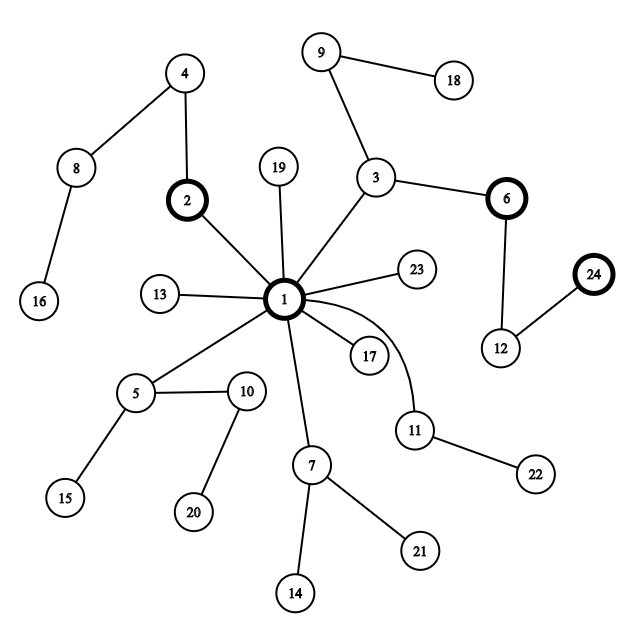
For the first example, Ivy will place the emotion samples at the node $1$ . From here:
- The distance from Vanessa's first fragment to the node $1$ is $1$ .
- The distance from Vanessa's second fragment to the node $1$ is $0$ .
- The distance from Vanessa's third fragment to the node $1$ is $4$ .
The total length is $5$ .
For the second example, the assembly node will be $6$ . From here:
- The distance from Vanessa's first fragment to the node $6$ is $0$ .
- The distance from Vanessa's second fragment to the node $6$ is $2$ .
- The distance from Vanessa's third fragment to the node $6$ is $2$ .
- The distance from Vanessa's fourth fragment to the node $6$ is again $2$ .
The total path length is $6$ .

For the first example, Ivy will place the emotion samples at the node $1$ . From here:
- The distance from Vanessa's first fragment to the node $1$ is $1$ .
- The distance from Vanessa's second fragment to the node $1$ is $0$ .
- The distance from Vanessa's third fragment to the node $1$ is $4$ .
The total length is $5$ .
For the second example, the assembly node will be $6$ . From here:
- The distance from Vanessa's first fragment to the node $6$ is $0$ .
- The distance from Vanessa's second fragment to the node $6$ is $2$ .
- The distance from Vanessa's third fragment to the node $6$ is $2$ .
- The distance from Vanessa's fourth fragment to the node $6$ is again $2$ .
The total path length is $6$ .
C++ 编辑器
输入
输出
可保存默认模板;新题优先使用已保存模板。
当前快捷键仅展示,暂不支持修改。
- 撤销
Ctrl / ⌘ + Z - 重做
Ctrl / ⌘ + Y - 查找
Ctrl / ⌘ + F - 全选
Ctrl / ⌘ + A - 复制
Ctrl / ⌘ + C - 剪切
Ctrl / ⌘ + X - 粘贴
Ctrl / ⌘ + V - 自动排版
工具栏排版按钮 - 草稿保存
编辑时自动保存到本机
历史
提交记录
状态说明时间源码
AI
作答助手
你好,我是作答助手。可以问思路、复杂度、样例含义或代码报错原因;不会直接给出完整 AC 代码。
确定要清空代码吗?
提交通过
评测结果:Accepted