A13178. 1-Trees and Queries
编程题
普及/提高-
知识点
题目描述
Gildong was hiking a mountain, walking by millions of trees. Inspired by them, he suddenly came up with an interesting idea for trees in data structures: What if we add another edge in a tree?
Then he found that such tree-like graphs are called 1-trees. Since Gildong was bored of solving too many tree problems, he wanted to see if similar techniques in trees can be used in 1-trees as well. Instead of solving it by himself, he's going to test you by providing queries on 1-trees.
First, he'll provide you a tree (not 1-tree) with $n$ vertices, then he will ask you $q$ queries. Each query contains $5$ integers: $x$ , $y$ , $a$ , $b$ , and $k$ . This means you're asked to determine if there exists a path from vertex $a$ to $b$ that contains exactly $k$ edges after adding a bidirectional edge between vertices $x$ and $y$ . A path can contain the same vertices and same edges multiple times. All queries are independent of each other; i.e. the added edge in a query is removed in the next query.
Then he found that such tree-like graphs are called 1-trees. Since Gildong was bored of solving too many tree problems, he wanted to see if similar techniques in trees can be used in 1-trees as well. Instead of solving it by himself, he's going to test you by providing queries on 1-trees.
First, he'll provide you a tree (not 1-tree) with $n$ vertices, then he will ask you $q$ queries. Each query contains $5$ integers: $x$ , $y$ , $a$ , $b$ , and $k$ . This means you're asked to determine if there exists a path from vertex $a$ to $b$ that contains exactly $k$ edges after adding a bidirectional edge between vertices $x$ and $y$ . A path can contain the same vertices and same edges multiple times. All queries are independent of each other; i.e. the added edge in a query is removed in the next query.
输入格式
The first line contains an integer $n$ ( $3 \le n \le 10^5$ ), the number of vertices of the tree.
Next $n-1$ lines contain two integers $u$ and $v$ ( $1 \le u,v \le n$ , $u \ne v$ ) each, which means there is an edge between vertex $u$ and $v$ . All edges are bidirectional and distinct.
Next line contains an integer $q$ ( $1 \le q \le 10^5$ ), the number of queries Gildong wants to ask.
Next $q$ lines contain five integers $x$ , $y$ , $a$ , $b$ , and $k$ each ( $1 \le x,y,a,b \le n$ , $x \ne y$ , $1 \le k \le 10^9$ ) – the integers explained in the description. It is guaranteed that the edge between $x$ and $y$ does not exist in the original tree.
Next $n-1$ lines contain two integers $u$ and $v$ ( $1 \le u,v \le n$ , $u \ne v$ ) each, which means there is an edge between vertex $u$ and $v$ . All edges are bidirectional and distinct.
Next line contains an integer $q$ ( $1 \le q \le 10^5$ ), the number of queries Gildong wants to ask.
Next $q$ lines contain five integers $x$ , $y$ , $a$ , $b$ , and $k$ each ( $1 \le x,y,a,b \le n$ , $x \ne y$ , $1 \le k \le 10^9$ ) – the integers explained in the description. It is guaranteed that the edge between $x$ and $y$ does not exist in the original tree.
输出格式
For each query, print "YES" if there exists a path that contains exactly $k$ edges from vertex $a$ to $b$ after adding an edge between vertices $x$ and $y$ . Otherwise, print "NO".
You can print each letter in any case (upper or lower).
You can print each letter in any case (upper or lower).
输入输出样例
输入 #1
5
1 2
2 3
3 4
4 5
5
1 3 1 2 2
1 4 1 3 2
1 4 1 3 3
4 2 3 3 9
5 2 3 3 9
输出 #1
YES
YES
NO
YES
NO
说明/提示
The image below describes the tree (circles and solid lines) and the added edges for each query (dotted lines).
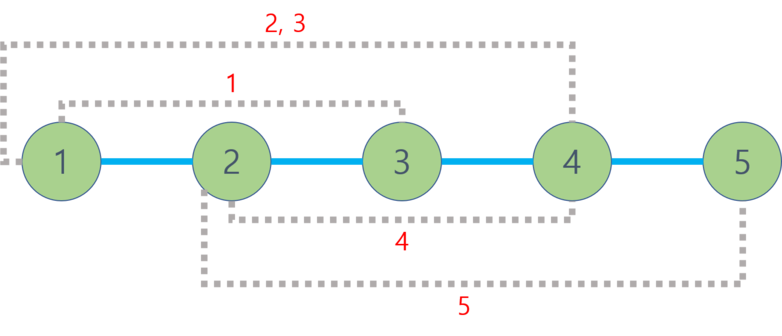Possible paths for the queries with "YES" answers are:
- $1$ -st query: $1$ – $3$ – $2$
- $2$ -nd query: $1$ – $2$ – $3$
- $4$ -th query: $3$ – $4$ – $2$ – $3$ – $4$ – $2$ – $3$ – $4$ – $2$ – $3$
Possible paths for the queries with "YES" answers are:
- $1$ -st query: $1$ – $3$ – $2$
- $2$ -nd query: $1$ – $2$ – $3$
- $4$ -th query: $3$ – $4$ – $2$ – $3$ – $4$ – $2$ – $3$ – $4$ – $2$ – $3$