A13074 | New Year and Naming
时间限制1s
内存限制256MB
通过 / 提交0/0
题目描述
Happy new year! The year 2020 is also known as Year Gyeongja (경자년, gyeongja-nyeon) in Korea. Where did the name come from? Let's briefly look at the Gapja system, which is traditionally used in Korea to name the years.
There are two sequences of $n$ strings $s_1, s_2, s_3, \ldots, s_{n}$ and $m$ strings $t_1, t_2, t_3, \ldots, t_{m}$ . These strings contain only lowercase letters. There might be duplicates among these strings.
Let's call a concatenation of strings $x$ and $y$ as the string that is obtained by writing down strings $x$ and $y$ one right after another without changing the order. For example, the concatenation of the strings "code" and "forces" is the string "codeforces".
The year 1 has a name which is the concatenation of the two strings $s_1$ and $t_1$ . When the year increases by one, we concatenate the next two strings in order from each of the respective sequences. If the string that is currently being used is at the end of its sequence, we go back to the first string in that sequence.
For example, if $n = 3, m = 4, s = $ {"a", "b", "c"}, $t =$ {"d", "e", "f", "g"}, the following table denotes the resulting year names. Note that the names of the years may repeat.
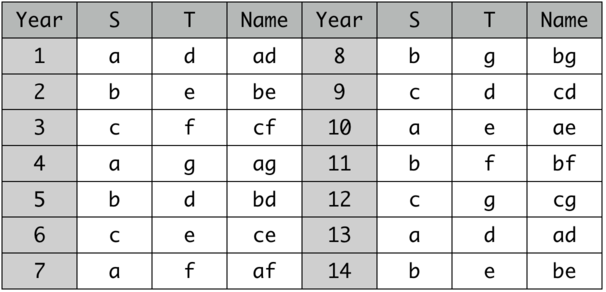You are given two sequences of strings of size $n$ and $m$ and also $q$ queries. For each query, you will be given the current year. Could you find the name corresponding to the given year, according to the Gapja system?
There are two sequences of $n$ strings $s_1, s_2, s_3, \ldots, s_{n}$ and $m$ strings $t_1, t_2, t_3, \ldots, t_{m}$ . These strings contain only lowercase letters. There might be duplicates among these strings.
Let's call a concatenation of strings $x$ and $y$ as the string that is obtained by writing down strings $x$ and $y$ one right after another without changing the order. For example, the concatenation of the strings "code" and "forces" is the string "codeforces".
The year 1 has a name which is the concatenation of the two strings $s_1$ and $t_1$ . When the year increases by one, we concatenate the next two strings in order from each of the respective sequences. If the string that is currently being used is at the end of its sequence, we go back to the first string in that sequence.
For example, if $n = 3, m = 4, s = $ {"a", "b", "c"}, $t =$ {"d", "e", "f", "g"}, the following table denotes the resulting year names. Note that the names of the years may repeat.
You are given two sequences of strings of size $n$ and $m$ and also $q$ queries. For each query, you will be given the current year. Could you find the name corresponding to the given year, according to the Gapja system?
输入格式
The first line contains two integers $n, m$ ( $1 \le n, m \le 20$ ).
The next line contains $n$ strings $s_1, s_2, \ldots, s_{n}$ . Each string contains only lowercase letters, and they are separated by spaces. The length of each string is at least $1$ and at most $10$ .
The next line contains $m$ strings $t_1, t_2, \ldots, t_{m}$ . Each string contains only lowercase letters, and they are separated by spaces. The length of each string is at least $1$ and at most $10$ .
Among the given $n + m$ strings may be duplicates (that is, they are not necessarily all different).
The next line contains a single integer $q$ ( $1 \le q \le 2\,020$ ).
In the next $q$ lines, an integer $y$ ( $1 \le y \le 10^9$ ) is given, denoting the year we want to know the name for.
The next line contains $n$ strings $s_1, s_2, \ldots, s_{n}$ . Each string contains only lowercase letters, and they are separated by spaces. The length of each string is at least $1$ and at most $10$ .
The next line contains $m$ strings $t_1, t_2, \ldots, t_{m}$ . Each string contains only lowercase letters, and they are separated by spaces. The length of each string is at least $1$ and at most $10$ .
Among the given $n + m$ strings may be duplicates (that is, they are not necessarily all different).
The next line contains a single integer $q$ ( $1 \le q \le 2\,020$ ).
In the next $q$ lines, an integer $y$ ( $1 \le y \le 10^9$ ) is given, denoting the year we want to know the name for.
输出格式
Print $q$ lines. For each line, print the name of the year as per the rule described above.
输入输出样例
输入 #1
10 12
sin im gye gap eul byeong jeong mu gi gyeong
yu sul hae ja chuk in myo jin sa o mi sin
14
1
2
3
4
10
11
12
13
73
2016
2017
2018
2019
2020
输出 #1
sinyu
imsul
gyehae
gapja
gyeongo
sinmi
imsin
gyeyu
gyeyu
byeongsin
jeongyu
musul
gihae
gyeongja
The first example denotes the actual names used in the Gapja system. These strings usually are either a number or the name of some animal.
C++ 编辑器
输入
输出
可保存默认模板;新题优先使用已保存模板。
当前快捷键仅展示,暂不支持修改。
- 撤销
Ctrl / ⌘ + Z - 重做
Ctrl / ⌘ + Y - 查找
Ctrl / ⌘ + F - 全选
Ctrl / ⌘ + A - 复制
Ctrl / ⌘ + C - 剪切
Ctrl / ⌘ + X - 粘贴
Ctrl / ⌘ + V - 自动排版
工具栏排版按钮 - 草稿保存
编辑时自动保存到本机
历史
提交记录
状态说明时间源码
AI
作答助手
你好,我是作答助手。可以问思路、复杂度、样例含义或代码报错原因;不会直接给出完整 AC 代码。
确定要清空代码吗?
提交通过
评测结果:Accepted