A13049. Grow The Tree
编程题
普及/提高-
知识点
题目描述
Gardener Alexey teaches competitive programming to high school students. To congratulate Alexey on the Teacher's Day, the students have gifted him a collection of wooden sticks, where every stick has an integer length. Now Alexey wants to grow a tree from them.
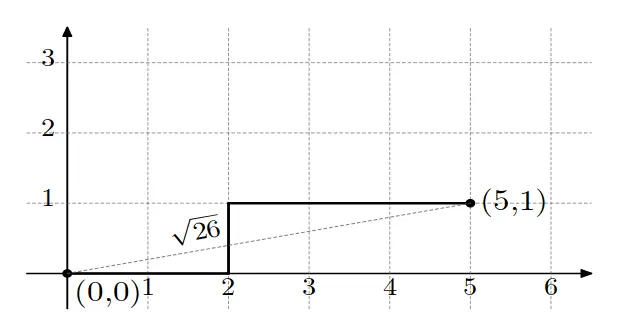
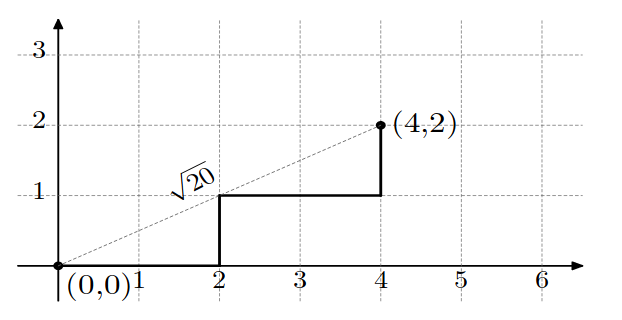
The tree looks like a polyline on the plane, consisting of all sticks. The polyline starts at the point $(0, 0)$ . While constructing the polyline, Alexey will attach sticks to it one by one in arbitrary order. Each stick must be either vertical or horizontal (that is, parallel to $OX$ or $OY$ axis). It is not allowed for two consecutive sticks to be aligned simultaneously horizontally or simultaneously vertically. See the images below for clarification.
Alexey wants to make a polyline in such a way that its end is as far as possible from $(0, 0)$ . Please help him to grow the tree this way.
Note that the polyline defining the form of the tree may have self-intersections and self-touches, but it can be proved that the optimal answer does not contain any self-intersections or self-touches.
The tree looks like a polyline on the plane, consisting of all sticks. The polyline starts at the point $(0, 0)$ . While constructing the polyline, Alexey will attach sticks to it one by one in arbitrary order. Each stick must be either vertical or horizontal (that is, parallel to $OX$ or $OY$ axis). It is not allowed for two consecutive sticks to be aligned simultaneously horizontally or simultaneously vertically. See the images below for clarification.
Alexey wants to make a polyline in such a way that its end is as far as possible from $(0, 0)$ . Please help him to grow the tree this way.
Note that the polyline defining the form of the tree may have self-intersections and self-touches, but it can be proved that the optimal answer does not contain any self-intersections or self-touches.
输入格式
The first line contains an integer $n$ ( $1 \le n \le 100\,000$ ) — the number of sticks Alexey got as a present.
The second line contains $n$ integers $a_1, \ldots, a_n$ ( $1 \le a_i \le 10\,000$ ) — the lengths of the sticks.
The second line contains $n$ integers $a_1, \ldots, a_n$ ( $1 \le a_i \le 10\,000$ ) — the lengths of the sticks.
输出格式
Print one integer — the square of the largest possible distance from $(0, 0)$ to the tree end.
输入输出样例
输入 #1
3
1 2 3
输出 #1
26
输入 #2
4
1 1 2 2
输出 #2
20
说明/提示
The following pictures show optimal trees for example tests. The squared distance in the first example equals $5 \cdot 5 + 1 \cdot 1 = 26$ , and in the second example $4 \cdot 4 + 2 \cdot 2 = 20$ .