A12864. DIY Wooden Ladder
编程题
普及/提高-
知识点
题目描述
Let's denote a $k$ -step ladder as the following structure: exactly $k + 2$ wooden planks, of which
- two planks of length at least $k+1$ — the base of the ladder;
- $k$ planks of length at least $1$ — the steps of the ladder;
Note that neither the base planks, nor the steps planks are required to be equal.
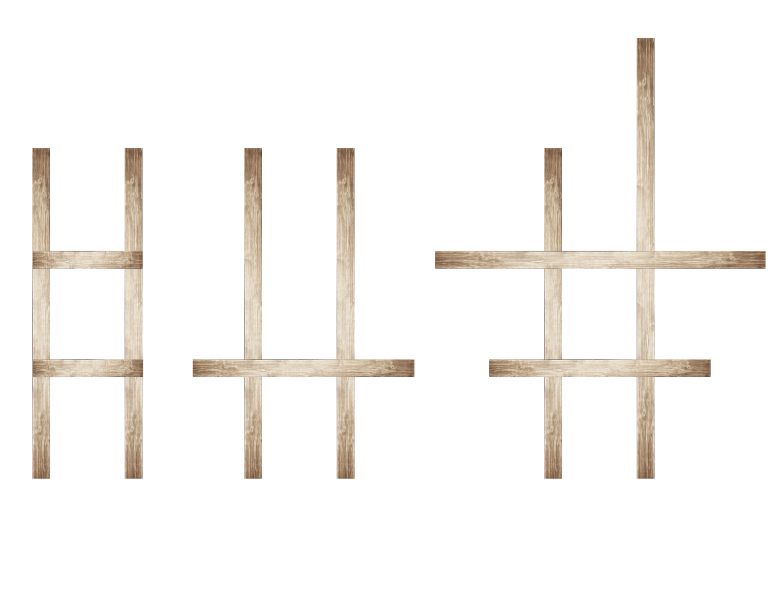
For example, ladders $1$ and $3$ are correct $2$ -step ladders and ladder $2$ is a correct $1$ -step ladder. On the first picture the lengths of planks are $[3, 3]$ for the base and $[1]$ for the step. On the second picture lengths are $[3, 3]$ for the base and $[2]$ for the step. On the third picture lengths are $[3, 4]$ for the base and $[2, 3]$ for the steps.
You have $n$ planks. The length of the $i$ -th planks is $a_i$ . You don't have a saw, so you can't cut the planks you have. Though you have a hammer and nails, so you can assemble the improvised "ladder" from the planks.
The question is: what is the maximum number $k$ such that you can choose some subset of the given planks and assemble a $k$ -step ladder using them?
- two planks of length at least $k+1$ — the base of the ladder;
- $k$ planks of length at least $1$ — the steps of the ladder;
Note that neither the base planks, nor the steps planks are required to be equal.
For example, ladders $1$ and $3$ are correct $2$ -step ladders and ladder $2$ is a correct $1$ -step ladder. On the first picture the lengths of planks are $[3, 3]$ for the base and $[1]$ for the step. On the second picture lengths are $[3, 3]$ for the base and $[2]$ for the step. On the third picture lengths are $[3, 4]$ for the base and $[2, 3]$ for the steps.
You have $n$ planks. The length of the $i$ -th planks is $a_i$ . You don't have a saw, so you can't cut the planks you have. Though you have a hammer and nails, so you can assemble the improvised "ladder" from the planks.
The question is: what is the maximum number $k$ such that you can choose some subset of the given planks and assemble a $k$ -step ladder using them?
输入格式
The first line contains a single integer $T$ ( $1 \le T \le 100$ ) — the number of queries. The queries are independent.
Each query consists of two lines. The first line contains a single integer $n$ ( $2 \le n \le 10^5$ ) — the number of planks you have.
The second line contains $n$ integers $a_1, a_2, \dots, a_n$ ( $1 \le a_i \le 10^5$ ) — the lengths of the corresponding planks.
It's guaranteed that the total number of planks from all queries doesn't exceed $10^5$ .
Each query consists of two lines. The first line contains a single integer $n$ ( $2 \le n \le 10^5$ ) — the number of planks you have.
The second line contains $n$ integers $a_1, a_2, \dots, a_n$ ( $1 \le a_i \le 10^5$ ) — the lengths of the corresponding planks.
It's guaranteed that the total number of planks from all queries doesn't exceed $10^5$ .
输出格式
Print $T$ integers — one per query. The $i$ -th integer is the maximum number $k$ , such that you can choose some subset of the planks given in the $i$ -th query and assemble a $k$ -step ladder using them.
Print $0$ if you can't make even $1$ -step ladder from the given set of planks.
Print $0$ if you can't make even $1$ -step ladder from the given set of planks.
输入输出样例
输入 #1
4
4
1 3 1 3
3
3 3 2
5
2 3 3 4 2
3
1 1 2
输出 #1
2
1
2
0
说明/提示
Examples for the queries $1-3$ are shown at the image in the legend section.
The Russian meme to express the quality of the ladders:

The Russian meme to express the quality of the ladders:
