A12836. You Are Given a WASD-string...
编程题
普及/提高-
知识点
题目描述
You have a string $s$ — a sequence of commands for your toy robot. The robot is placed in some cell of a rectangular grid. He can perform four commands:
- 'W' — move one cell up;
- 'S' — move one cell down;
- 'A' — move one cell left;
- 'D' — move one cell right.
Let $Grid(s)$ be the grid of minimum possible area such that there is a position in the grid where you can place the robot in such a way that it will not fall from the grid while running the sequence of commands $s$ . For example, if $s = \text{DSAWWAW}$ then $Grid(s)$ is the $4 \times 3$ grid:
1. you can place the robot in the cell $(3, 2)$ ;
2. the robot performs the command 'D' and moves to $(3, 3)$ ;
3. the robot performs the command 'S' and moves to $(4, 3)$ ;
4. the robot performs the command 'A' and moves to $(4, 2)$ ;
5. the robot performs the command 'W' and moves to $(3, 2)$ ;
6. the robot performs the command 'W' and moves to $(2, 2)$ ;
7. the robot performs the command 'A' and moves to $(2, 1)$ ;
8. the robot performs the command 'W' and moves to $(1, 1)$ .
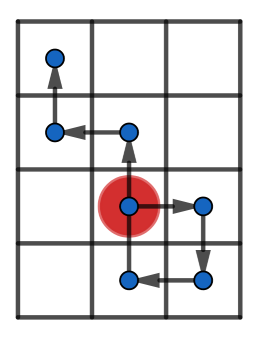You have $4$ extra letters: one 'W', one 'A', one 'S', one 'D'. You'd like to insert at most one of these letters in any position of sequence $s$ to minimize the area of $Grid(s)$ .
What is the minimum area of $Grid(s)$ you can achieve?
- 'W' — move one cell up;
- 'S' — move one cell down;
- 'A' — move one cell left;
- 'D' — move one cell right.
Let $Grid(s)$ be the grid of minimum possible area such that there is a position in the grid where you can place the robot in such a way that it will not fall from the grid while running the sequence of commands $s$ . For example, if $s = \text{DSAWWAW}$ then $Grid(s)$ is the $4 \times 3$ grid:
1. you can place the robot in the cell $(3, 2)$ ;
2. the robot performs the command 'D' and moves to $(3, 3)$ ;
3. the robot performs the command 'S' and moves to $(4, 3)$ ;
4. the robot performs the command 'A' and moves to $(4, 2)$ ;
5. the robot performs the command 'W' and moves to $(3, 2)$ ;
6. the robot performs the command 'W' and moves to $(2, 2)$ ;
7. the robot performs the command 'A' and moves to $(2, 1)$ ;
8. the robot performs the command 'W' and moves to $(1, 1)$ .
You have $4$ extra letters: one 'W', one 'A', one 'S', one 'D'. You'd like to insert at most one of these letters in any position of sequence $s$ to minimize the area of $Grid(s)$ .
What is the minimum area of $Grid(s)$ you can achieve?
输入格式
The first line contains one integer $T$ ( $1 \le T \le 1000$ ) — the number of queries.
Next $T$ lines contain queries: one per line. This line contains single string $s$ ( $1 \le |s| \le 2 \cdot 10^5$ , $s_i \in \{\text{W}, \text{A}, \text{S}, \text{D}\}$ ) — the sequence of commands.
It's guaranteed that the total length of $s$ over all queries doesn't exceed $2 \cdot 10^5$ .
Next $T$ lines contain queries: one per line. This line contains single string $s$ ( $1 \le |s| \le 2 \cdot 10^5$ , $s_i \in \{\text{W}, \text{A}, \text{S}, \text{D}\}$ ) — the sequence of commands.
It's guaranteed that the total length of $s$ over all queries doesn't exceed $2 \cdot 10^5$ .
输出格式
Print $T$ integers: one per query. For each query print the minimum area of $Grid(s)$ you can achieve.
输入输出样例
输入 #1
3
DSAWWAW
D
WA
输出 #1
8
2
4
说明/提示
In the first query you have to get string $\text{DSAWW}\underline{D}\text{AW}$ .
In second and third queries you can not decrease the area of $Grid(s)$ .
In second and third queries you can not decrease the area of $Grid(s)$ .