A12524 | Tree Diameter
时间限制1s
内存限制256MB
通过 / 提交0/0
题目描述
There is a weighted tree with $n$ nodes and $n-1$ edges. The nodes are conveniently labeled from $1$ to $n$ . The weights are positive integers at most $100$ . Define the distance between two nodes to be the sum of edges on the unique path between the nodes. You would like to find the diameter of the tree. Diameter is the maximum distance between a pair of nodes.
Unfortunately, the tree isn't given to you, but you can ask some questions about it. In one question, you can specify two nonempty disjoint sets of nodes $p$ and $q$ , and the judge will return the maximum distance between a node in $p$ and a node in $q$ . In the words, maximum distance between $x$ and $y$ , where $x \in p$ and $y \in q$ . After asking not more than $9$ questions, you must report the maximum distance between any pair of nodes.
Unfortunately, the tree isn't given to you, but you can ask some questions about it. In one question, you can specify two nonempty disjoint sets of nodes $p$ and $q$ , and the judge will return the maximum distance between a node in $p$ and a node in $q$ . In the words, maximum distance between $x$ and $y$ , where $x \in p$ and $y \in q$ . After asking not more than $9$ questions, you must report the maximum distance between any pair of nodes.
输入格式
无
输出格式
Each test contains multiple test cases. The first line contains the number of test cases $t$ ( $1 \le t \le 1\,000$ ). Description of the test cases follows.
The first line of each test case contains an integer $n$ ( $2 \leq n \leq 100$ ) — the number of nodes in the tree.
To ask a question, print " $k_1\ k_2\ a_1\ a_2\ \ldots\ a_{k_1}\ b_1\ b_2\ \ldots\ b_{k_2}$ " $(k_1, k_2 \geq 1$ and $k_1+k_2 \leq n$ ). These two sets must be nonempty and disjoint. The judge will respond with a single integer $\max_{p,q} dist(a_p, b_q)$ . If you ever get a result of $-1$ (because you printed an invalid query), exit immediately to avoid getting other verdicts.
After printing a query do not forget to output end of line and flush the output. Otherwise, you will get Idleness limit exceeded. To do this, use:
- fflush(stdout) or cout.flush() in C++;
- System.out.flush() in Java;
- flush(output) in Pascal;
- stdout.flush() in Python;
- see documentation for other languages.
When you are ready to answer, print " $-1\ d$ ", where $d$ is the maximum shortest distance over all pairs of nodes.
You can only ask at most $9$ questions per test case.
Hack Format
To hack, use the following format. Note that you can only hack with one test case.
The first line should contain a single integer $t$ ( $t=1$ ).
The second line should contain a single integer $n$ ( $2 \leq n \leq 100$ ).
Each of the next $n-1$ lines should contain three integers $a_i, b_i, c_i$ ( $1\leq a_i, b_i\leq n$ , $1 \leq c_i \leq 100$ ). This denotes an undirected edge between nodes $a_i$ and $b_i$ with weight $c_i$ . These edges must form a tree.
The first line of each test case contains an integer $n$ ( $2 \leq n \leq 100$ ) — the number of nodes in the tree.
To ask a question, print " $k_1\ k_2\ a_1\ a_2\ \ldots\ a_{k_1}\ b_1\ b_2\ \ldots\ b_{k_2}$ " $(k_1, k_2 \geq 1$ and $k_1+k_2 \leq n$ ). These two sets must be nonempty and disjoint. The judge will respond with a single integer $\max_{p,q} dist(a_p, b_q)$ . If you ever get a result of $-1$ (because you printed an invalid query), exit immediately to avoid getting other verdicts.
After printing a query do not forget to output end of line and flush the output. Otherwise, you will get Idleness limit exceeded. To do this, use:
- fflush(stdout) or cout.flush() in C++;
- System.out.flush() in Java;
- flush(output) in Pascal;
- stdout.flush() in Python;
- see documentation for other languages.
When you are ready to answer, print " $-1\ d$ ", where $d$ is the maximum shortest distance over all pairs of nodes.
You can only ask at most $9$ questions per test case.
Hack Format
To hack, use the following format. Note that you can only hack with one test case.
The first line should contain a single integer $t$ ( $t=1$ ).
The second line should contain a single integer $n$ ( $2 \leq n \leq 100$ ).
Each of the next $n-1$ lines should contain three integers $a_i, b_i, c_i$ ( $1\leq a_i, b_i\leq n$ , $1 \leq c_i \leq 100$ ). This denotes an undirected edge between nodes $a_i$ and $b_i$ with weight $c_i$ . These edges must form a tree.
输入输出样例
输入 #1
2
5
9
6
10
9
10
2
99
输出 #1
1 4 1 2 3 4 5
1 4 2 3 4 5 1
1 4 3 4 5 1 2
1 4 4 5 1 2 3
1 4 5 1 2 3 4
-1 10
1 1 1 2
-1 99
In the first example, the first tree looks as follows: 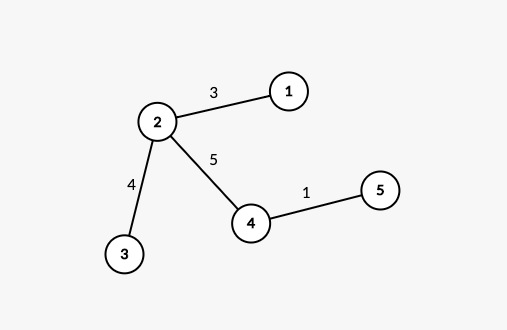
In the first question, we have $p = {1}$ , and $q = {2, 3, 4, 5}$ . The maximum distance between a node in $p$ and a node in $q$ is $9$ (the distance between nodes $1$ and $5$ ).
The second tree is a tree with two nodes with an edge with weight $99$ between them.
In the first question, we have $p = {1}$ , and $q = {2, 3, 4, 5}$ . The maximum distance between a node in $p$ and a node in $q$ is $9$ (the distance between nodes $1$ and $5$ ).
The second tree is a tree with two nodes with an edge with weight $99$ between them.
C++ 编辑器
输入
输出
可保存默认模板;新题优先使用已保存模板。
当前快捷键仅展示,暂不支持修改。
- 撤销
Ctrl / ⌘ + Z - 重做
Ctrl / ⌘ + Y - 查找
Ctrl / ⌘ + F - 全选
Ctrl / ⌘ + A - 复制
Ctrl / ⌘ + C - 剪切
Ctrl / ⌘ + X - 粘贴
Ctrl / ⌘ + V - 自动排版
工具栏排版按钮 - 草稿保存
编辑时自动保存到本机
历史
提交记录
状态说明时间源码
AI
作答助手
你好,我是作答助手。可以问思路、复杂度、样例含义或代码报错原因;不会直接给出完整 AC 代码。
确定要清空代码吗?
提交通过
评测结果:Accepted