A12412 | Toy Train (Simplified)
时间限制1s
内存限制256MB
通过 / 提交0/0
题目描述
This is a simplified version of the task Toy Train. These two versions differ only in the constraints. Hacks for this version are disabled.
Alice received a set of Toy Train™ from Bob. It consists of one train and a connected railway network of $n$ stations, enumerated from $1$ through $n$ . The train occupies one station at a time and travels around the network of stations in a circular manner. More precisely, the immediate station that the train will visit after station $i$ is station $i+1$ if $1 \leq i < n$ or station $1$ if $i = n$ . It takes the train $1$ second to travel to its next station as described.
Bob gave Alice a fun task before he left: to deliver $m$ candies that are initially at some stations to their independent destinations using the train. The candies are enumerated from $1$ through $m$ . Candy $i$ ( $1 \leq i \leq m$ ), now at station $a_i$ , should be delivered to station $b_i$ ( $a_i \neq b_i$ ).
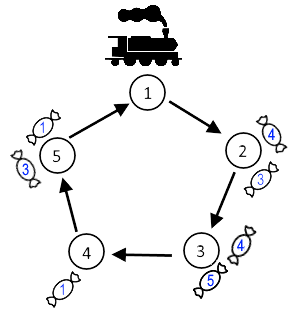The blue numbers on the candies correspond to $b_i$ values. The image corresponds to the $1$ -st example.The train has infinite capacity, and it is possible to load off any number of candies at a station. However, only at most one candy can be loaded from a station onto the train before it leaves the station. You can choose any candy at this station. The time it takes to move the candies is negligible.
Now, Alice wonders how much time is needed for the train to deliver all candies. Your task is to find, for each station, the minimum time the train would need to deliver all the candies were it to start from there.
Alice received a set of Toy Train™ from Bob. It consists of one train and a connected railway network of $n$ stations, enumerated from $1$ through $n$ . The train occupies one station at a time and travels around the network of stations in a circular manner. More precisely, the immediate station that the train will visit after station $i$ is station $i+1$ if $1 \leq i < n$ or station $1$ if $i = n$ . It takes the train $1$ second to travel to its next station as described.
Bob gave Alice a fun task before he left: to deliver $m$ candies that are initially at some stations to their independent destinations using the train. The candies are enumerated from $1$ through $m$ . Candy $i$ ( $1 \leq i \leq m$ ), now at station $a_i$ , should be delivered to station $b_i$ ( $a_i \neq b_i$ ).
The blue numbers on the candies correspond to $b_i$ values. The image corresponds to the $1$ -st example.The train has infinite capacity, and it is possible to load off any number of candies at a station. However, only at most one candy can be loaded from a station onto the train before it leaves the station. You can choose any candy at this station. The time it takes to move the candies is negligible.
Now, Alice wonders how much time is needed for the train to deliver all candies. Your task is to find, for each station, the minimum time the train would need to deliver all the candies were it to start from there.
输入格式
The first line contains two space-separated integers $n$ and $m$ ( $2 \leq n \leq 100$ ; $1 \leq m \leq 200$ ) — the number of stations and the number of candies, respectively.
The $i$ -th of the following $m$ lines contains two space-separated integers $a_i$ and $b_i$ ( $1 \leq a_i, b_i \leq n$ ; $a_i \neq b_i$ ) — the station that initially contains candy $i$ and the destination station of the candy, respectively.
The $i$ -th of the following $m$ lines contains two space-separated integers $a_i$ and $b_i$ ( $1 \leq a_i, b_i \leq n$ ; $a_i \neq b_i$ ) — the station that initially contains candy $i$ and the destination station of the candy, respectively.
输出格式
In the first and only line, print $n$ space-separated integers, the $i$ -th of which is the minimum time, in seconds, the train would need to deliver all the candies were it to start from station $i$ .
输入输出样例
输入 #1
5 7
2 4
5 1
2 3
3 4
4 1
5 3
3 5
输出 #1
10 9 10 10 9
输入 #2
2 3
1 2
1 2
1 2
输出 #2
5 6
Consider the second sample.
If the train started at station $1$ , the optimal strategy is as follows.
1. Load the first candy onto the train.
2. Proceed to station $2$ . This step takes $1$ second.
3. Deliver the first candy.
4. Proceed to station $1$ . This step takes $1$ second.
5. Load the second candy onto the train.
6. Proceed to station $2$ . This step takes $1$ second.
7. Deliver the second candy.
8. Proceed to station $1$ . This step takes $1$ second.
9. Load the third candy onto the train.
10. Proceed to station $2$ . This step takes $1$ second.
11. Deliver the third candy.
Hence, the train needs $5$ seconds to complete the tasks.
If the train were to start at station $2$ , however, it would need to move to station $1$ before it could load the first candy, which would take one additional second. Thus, the answer in this scenario is $5+1 = 6$ seconds.
If the train started at station $1$ , the optimal strategy is as follows.
1. Load the first candy onto the train.
2. Proceed to station $2$ . This step takes $1$ second.
3. Deliver the first candy.
4. Proceed to station $1$ . This step takes $1$ second.
5. Load the second candy onto the train.
6. Proceed to station $2$ . This step takes $1$ second.
7. Deliver the second candy.
8. Proceed to station $1$ . This step takes $1$ second.
9. Load the third candy onto the train.
10. Proceed to station $2$ . This step takes $1$ second.
11. Deliver the third candy.
Hence, the train needs $5$ seconds to complete the tasks.
If the train were to start at station $2$ , however, it would need to move to station $1$ before it could load the first candy, which would take one additional second. Thus, the answer in this scenario is $5+1 = 6$ seconds.
C++ 编辑器
输入
输出
可保存默认模板;新题优先使用已保存模板。
当前快捷键仅展示,暂不支持修改。
- 撤销
Ctrl / ⌘ + Z - 重做
Ctrl / ⌘ + Y - 查找
Ctrl / ⌘ + F - 全选
Ctrl / ⌘ + A - 复制
Ctrl / ⌘ + C - 剪切
Ctrl / ⌘ + X - 粘贴
Ctrl / ⌘ + V - 自动排版
工具栏排版按钮 - 草稿保存
编辑时自动保存到本机
历史
提交记录
状态说明时间源码
AI
作答助手
你好,我是作答助手。可以问思路、复杂度、样例含义或代码报错原因;不会直接给出完整 AC 代码。
确定要清空代码吗?
提交通过
评测结果:Accepted