A12375 | Museums Tour
时间限制1s
内存限制256MB
通过 / 提交0/0
题目描述
In the country $N$ , there are $n$ cities connected by $m$ one-way roads. Although this country seems unremarkable, there are two interesting facts about it. At first, a week lasts $d$ days here. At second, there is exactly one museum in each city of the country $N$ .
Travel agency "Open museums" is developing a new program for tourists interested in museums. Agency's employees know which days each of the museums is open. The tour should start in the capital — the city number $1$ , and the first day of the tour must be on the first day of a week. Each day a tourist will be in some city, watching the exposition in its museum (in case museum is open today), and by the end of the day, the tour either ends or the tourist goes into another city connected by a road with the current one. The road system of $N$ is designed in such a way that traveling by a road always takes one night and also all the roads are one-way. It's allowed to visit a city multiple times during the trip.
You should develop such route for the trip that the number of distinct museums, possible to visit during it, is maximum.
Travel agency "Open museums" is developing a new program for tourists interested in museums. Agency's employees know which days each of the museums is open. The tour should start in the capital — the city number $1$ , and the first day of the tour must be on the first day of a week. Each day a tourist will be in some city, watching the exposition in its museum (in case museum is open today), and by the end of the day, the tour either ends or the tourist goes into another city connected by a road with the current one. The road system of $N$ is designed in such a way that traveling by a road always takes one night and also all the roads are one-way. It's allowed to visit a city multiple times during the trip.
You should develop such route for the trip that the number of distinct museums, possible to visit during it, is maximum.
输入格式
The first line contains three integers $n$ , $m$ and $d$ ( $1 \leq n \leq 100\,000$ , $0 \leq m \leq 100\,000$ , $1 \leq d \leq 50$ ), the number of cities, the number of roads and the number of days in a week.
Each of next $m$ lines contains two integers $u_i$ and $v_i$ ( $1 \le u_i, v_i \le n$ , $u_i \ne v_i$ ), denoting a one-way road from the city $u_i$ to the city $v_i$ .
The next $n$ lines contain the museums' schedule. The schedule of the museum located in the $i$ -th city is described in the $i$ -th of these lines. Each line consists of exactly $d$ characters "0" or "1", the $j$ -th character of the string equals to "1" if the museum is open at the $j$ -th day of a week, and "0", otherwise.
It's guaranteed that for each pair of cities $(u, v)$ there exists no more than one road leading from $u$ to $v$ .
Each of next $m$ lines contains two integers $u_i$ and $v_i$ ( $1 \le u_i, v_i \le n$ , $u_i \ne v_i$ ), denoting a one-way road from the city $u_i$ to the city $v_i$ .
The next $n$ lines contain the museums' schedule. The schedule of the museum located in the $i$ -th city is described in the $i$ -th of these lines. Each line consists of exactly $d$ characters "0" or "1", the $j$ -th character of the string equals to "1" if the museum is open at the $j$ -th day of a week, and "0", otherwise.
It's guaranteed that for each pair of cities $(u, v)$ there exists no more than one road leading from $u$ to $v$ .
输出格式
Print a single integer — the maximum number of distinct museums, that it's possible to visit, starting a trip in the first city on the first day of the week.
输入输出样例
输入 #1
4 5 3
3 1
1 2
2 4
4 1
2 3
011
110
111
001
输出 #1
3
输入 #2
3 3 7
1 2
1 3
2 3
1111111
0000000
0111111
输出 #2
2
Explanation of the first example 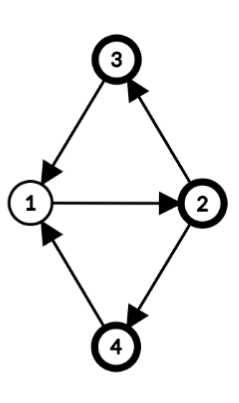The maximum number of distinct museums to visit is $3$ . It's possible to visit $3$ museums, for example, in the way described below.
- Day 1. Now it's the 1st day of a week, and the tourist is in the city $1$ . The museum there is closed. At night the tourist goes to the city number $2$ .
- Day 2. Now it's the 2nd day of a week, and the tourist is in the city $2$ . The museum there is open, and the tourist visits it. At night the tourist goes to the city number $4$ .
- Day 3. Now it's the 3rd day of a week, and the tourist is in the city $4$ . The museum there is open, and the tourist visits it. At night the tourist goes to the city number $1$ .
- Day 4. Now it's the 1st day of a week, and the tourist is in the city $1$ . The museum there is closed. At night the tourist goes to the city number $2$ .
- Day 5. Now it's the 2nd of a week number $2$ , and the tourist is in the city $2$ . The museum there is open, but the tourist has already visited it. At night the tourist goes to the city number $3$ .
- Day 6. Now it's the 3rd day of a week, and the tourist is in the city $3$ . The museum there is open, and the tourist visits it. After this, the tour is over.
Explanation of the second example 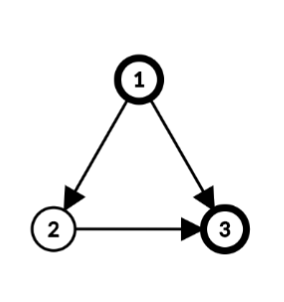The maximum number of distinct museums to visit is $2$ . It's possible to visit $2$ museums, for example, in the way described below.
- Day 1. Now it's the 1st day of a week, and the tourist is in the city $1$ . The museum there is open, and the tourist visits it. At night the tourist goes to the city number $2$ .
- Day 2. Now it's the 2nd day of a week, and the tourist is in the city $2$ . The museum there is closed. At night the tourist goes to the city number $3$ .
- Day 3. Now it's the 3rd day of a week, and the tourist is in the city $3$ . The museum there is open, and the tourist visits it. After this, the tour is over.
- Day 1. Now it's the 1st day of a week, and the tourist is in the city $1$ . The museum there is closed. At night the tourist goes to the city number $2$ .
- Day 2. Now it's the 2nd day of a week, and the tourist is in the city $2$ . The museum there is open, and the tourist visits it. At night the tourist goes to the city number $4$ .
- Day 3. Now it's the 3rd day of a week, and the tourist is in the city $4$ . The museum there is open, and the tourist visits it. At night the tourist goes to the city number $1$ .
- Day 4. Now it's the 1st day of a week, and the tourist is in the city $1$ . The museum there is closed. At night the tourist goes to the city number $2$ .
- Day 5. Now it's the 2nd of a week number $2$ , and the tourist is in the city $2$ . The museum there is open, but the tourist has already visited it. At night the tourist goes to the city number $3$ .
- Day 6. Now it's the 3rd day of a week, and the tourist is in the city $3$ . The museum there is open, and the tourist visits it. After this, the tour is over.
Explanation of the second example The maximum number of distinct museums to visit is $2$ . It's possible to visit $2$ museums, for example, in the way described below.
- Day 1. Now it's the 1st day of a week, and the tourist is in the city $1$ . The museum there is open, and the tourist visits it. At night the tourist goes to the city number $2$ .
- Day 2. Now it's the 2nd day of a week, and the tourist is in the city $2$ . The museum there is closed. At night the tourist goes to the city number $3$ .
- Day 3. Now it's the 3rd day of a week, and the tourist is in the city $3$ . The museum there is open, and the tourist visits it. After this, the tour is over.
C++ 编辑器
输入
输出
可保存默认模板;新题优先使用已保存模板。
当前快捷键仅展示,暂不支持修改。
- 撤销
Ctrl / ⌘ + Z - 重做
Ctrl / ⌘ + Y - 查找
Ctrl / ⌘ + F - 全选
Ctrl / ⌘ + A - 复制
Ctrl / ⌘ + C - 剪切
Ctrl / ⌘ + X - 粘贴
Ctrl / ⌘ + V - 自动排版
工具栏排版按钮 - 草稿保存
编辑时自动保存到本机
历史
提交记录
状态说明时间源码
AI
作答助手
你好,我是作答助手。可以问思路、复杂度、样例含义或代码报错原因;不会直接给出完整 AC 代码。
确定要清空代码吗?
提交通过
评测结果:Accepted