A12327 | Mateusz and an Infinite Sequence
时间限制1s
内存限制256MB
通过 / 提交0/0
题目描述
A Thue-Morse-Radecki-Mateusz sequence (Thorse-Radewoosh sequence in short) is an infinite sequence constructed from a finite sequence $\mathrm{gen}$ of length $d$ and an integer $m$ , obtained in the following sequence of steps:
- In the beginning, we define the one-element sequence $M_0=(0)$ .
- In the $k$ -th step, $k \geq 1$ , we define the sequence $M_k$ to be the concatenation of the $d$ copies of $M_{k-1}$ . However, each of them is altered slightly — in the $i$ -th of them ( $1 \leq i \leq d$ ), each element $x$ is changed to $(x+\mathrm{gen}_i) \pmod{m}$ .
For instance, if we pick $\mathrm{gen} = (0, \color{blue}{1}, \color{green}{2})$ and $m = 4$ :
- $M_0 = (0)$ ,
- $M_1 = (0, \color{blue}{1}, \color{green}{2})$ ,
- $M_2 = (0, 1, 2, \color{blue}{1, 2, 3}, \color{green}{2, 3, 0})$ ,
- $M_3 = (0, 1, 2, 1, 2, 3, 2, 3, 0, \color{blue}{1, 2, 3, 2, 3, 0, 3, 0, 1}, \color{green}{2, 3, 0, 3, 0, 1, 0, 1, 2})$ , and so on.
As you can see, as long as the first element of $\mathrm{gen}$ is $0$ , each consecutive step produces a sequence whose prefix is the sequence generated in the previous step. Therefore, we can define the infinite Thorse-Radewoosh sequence $M_\infty$ as the sequence obtained by applying the step above indefinitely. For the parameters above, $M_\infty = (0, 1, 2, 1, 2, 3, 2, 3, 0, 1, 2, 3, 2, 3, 0, 3, 0, 1, \dots)$ .
Mateusz picked a sequence $\mathrm{gen}$ and an integer $m$ , and used them to obtain a Thorse-Radewoosh sequence $M_\infty$ . He then picked two integers $l$ , $r$ , and wrote down a subsequence of this sequence $A := ((M_\infty)_l, (M_\infty)_{l+1}, \dots, (M_\infty)_r)$ .
Note that we use the $1$ -based indexing both for $M_\infty$ and $A$ .
Mateusz has his favorite sequence $B$ with length $n$ , and would like to see how large it is compared to $A$ . Let's say that $B$ majorizes sequence $X$ of length $n$ (let's denote it as $B \geq X$ ) if and only if for all $i \in \{1, 2, \dots, n\}$ , we have $B_i \geq X_i$ .
He now asks himself how many integers $x$ in the range $[1, |A| - n + 1]$ there are such that $B \geq (A_x, A_{x+1}, A_{x+2}, \dots, A_{x+n-1})$ . As both sequences were huge, answering the question using only his pen and paper turned out to be too time-consuming. Can you help him automate his research?
- In the beginning, we define the one-element sequence $M_0=(0)$ .
- In the $k$ -th step, $k \geq 1$ , we define the sequence $M_k$ to be the concatenation of the $d$ copies of $M_{k-1}$ . However, each of them is altered slightly — in the $i$ -th of them ( $1 \leq i \leq d$ ), each element $x$ is changed to $(x+\mathrm{gen}_i) \pmod{m}$ .
For instance, if we pick $\mathrm{gen} = (0, \color{blue}{1}, \color{green}{2})$ and $m = 4$ :
- $M_0 = (0)$ ,
- $M_1 = (0, \color{blue}{1}, \color{green}{2})$ ,
- $M_2 = (0, 1, 2, \color{blue}{1, 2, 3}, \color{green}{2, 3, 0})$ ,
- $M_3 = (0, 1, 2, 1, 2, 3, 2, 3, 0, \color{blue}{1, 2, 3, 2, 3, 0, 3, 0, 1}, \color{green}{2, 3, 0, 3, 0, 1, 0, 1, 2})$ , and so on.
As you can see, as long as the first element of $\mathrm{gen}$ is $0$ , each consecutive step produces a sequence whose prefix is the sequence generated in the previous step. Therefore, we can define the infinite Thorse-Radewoosh sequence $M_\infty$ as the sequence obtained by applying the step above indefinitely. For the parameters above, $M_\infty = (0, 1, 2, 1, 2, 3, 2, 3, 0, 1, 2, 3, 2, 3, 0, 3, 0, 1, \dots)$ .
Mateusz picked a sequence $\mathrm{gen}$ and an integer $m$ , and used them to obtain a Thorse-Radewoosh sequence $M_\infty$ . He then picked two integers $l$ , $r$ , and wrote down a subsequence of this sequence $A := ((M_\infty)_l, (M_\infty)_{l+1}, \dots, (M_\infty)_r)$ .
Note that we use the $1$ -based indexing both for $M_\infty$ and $A$ .
Mateusz has his favorite sequence $B$ with length $n$ , and would like to see how large it is compared to $A$ . Let's say that $B$ majorizes sequence $X$ of length $n$ (let's denote it as $B \geq X$ ) if and only if for all $i \in \{1, 2, \dots, n\}$ , we have $B_i \geq X_i$ .
He now asks himself how many integers $x$ in the range $[1, |A| - n + 1]$ there are such that $B \geq (A_x, A_{x+1}, A_{x+2}, \dots, A_{x+n-1})$ . As both sequences were huge, answering the question using only his pen and paper turned out to be too time-consuming. Can you help him automate his research?
输入格式
The first line contains two integers $d$ and $m$ ( $2 \leq d \leq 20$ , $2 \leq m \leq 60$ ) — the length of the sequence $\mathrm{gen}$ and an integer used to perform the modular operations. The second line contains $d$ integers $\mathrm{gen}_i$ ( $0 \leq \mathrm{gen}_i < m$ ). It's guaranteed that the first element of the sequence $\mathrm{gen}$ is equal to zero.
The third line contains one integer $n$ ( $1 \leq n \leq 30000$ ) — the length of the sequence $B$ . The fourth line contains $n$ integers $B_i$ ( $0 \leq B_i < m$ ). The fifth line contains two integers $l$ and $r$ ( $1 \leq l \leq r \leq 10^{18}$ , $r-l+1 \geq n$ ).
The third line contains one integer $n$ ( $1 \leq n \leq 30000$ ) — the length of the sequence $B$ . The fourth line contains $n$ integers $B_i$ ( $0 \leq B_i < m$ ). The fifth line contains two integers $l$ and $r$ ( $1 \leq l \leq r \leq 10^{18}$ , $r-l+1 \geq n$ ).
输出格式
Print a single integer — the answer to the problem.
输入输出样例
输入 #1
2 2
0 1
4
0 1 1 0
2 21
输出 #1
6
输入 #2
3 4
0 1 2
2
0 2
6 11
输出 #2
1
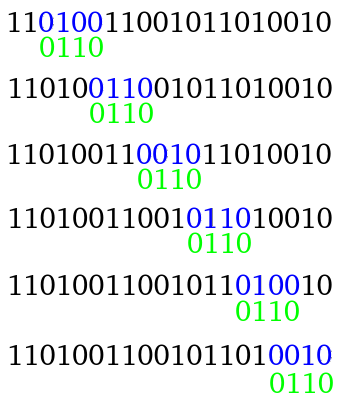
Thorse-Radewoosh sequence in the first example is the standard Thue-Morse sequence, so the sequence $A$ is as follows: $11010011001011010010$ . Here are the places where the sequence $B$ majorizes $A$ :

C++ 编辑器
输入
输出
可保存默认模板;新题优先使用已保存模板。
当前快捷键仅展示,暂不支持修改。
- 撤销
Ctrl / ⌘ + Z - 重做
Ctrl / ⌘ + Y - 查找
Ctrl / ⌘ + F - 全选
Ctrl / ⌘ + A - 复制
Ctrl / ⌘ + C - 剪切
Ctrl / ⌘ + X - 粘贴
Ctrl / ⌘ + V - 自动排版
工具栏排版按钮 - 草稿保存
编辑时自动保存到本机
历史
提交记录
状态说明时间源码
AI
作答助手
你好,我是作答助手。可以问思路、复杂度、样例含义或代码报错原因;不会直接给出完整 AC 代码。
确定要清空代码吗?
提交通过
评测结果:Accepted