A12117. Tree and XOR
编程题
普及/提高-
知识点
题目描述
You are given a connected undirected graph without cycles (that is, a tree) of $n$ vertices, moreover, there is a non-negative integer written on every edge.
Consider all pairs of vertices $(v, u)$ (that is, there are exactly $n^2$ such pairs) and for each pair calculate the bitwise exclusive or (xor) of all integers on edges of the simple path between $v$ and $u$ . If the path consists of one vertex only, then xor of all integers on edges of this path is equal to $0$ .
Suppose we sorted the resulting $n^2$ values in non-decreasing order. You need to find the $k$ -th of them.
The definition of xor is as follows.
Given two integers $x$ and $y$ , consider their binary representations (possibly with leading zeros): $x_k \dots x_2 x_1 x_0$ and $y_k \dots y_2 y_1 y_0$ (where $k$ is any number so that all bits of $x$ and $y$ can be represented). Here, $x_i$ is the $i$ -th bit of the number $x$ and $y_i$ is the $i$ -th bit of the number $y$ . Let $r = x \oplus y$ be the result of the xor operation of $x$ and $y$ . Then $r$ is defined as $r_k \dots r_2 r_1 r_0$ where:
$$$$ r_i = \left\{ \begin{aligned} 1, ~ \text{if} ~ x_i \ne y_i \\ 0, ~ \text{if} ~ x_i = y_i \end{aligned} \right. $$$$
Consider all pairs of vertices $(v, u)$ (that is, there are exactly $n^2$ such pairs) and for each pair calculate the bitwise exclusive or (xor) of all integers on edges of the simple path between $v$ and $u$ . If the path consists of one vertex only, then xor of all integers on edges of this path is equal to $0$ .
Suppose we sorted the resulting $n^2$ values in non-decreasing order. You need to find the $k$ -th of them.
The definition of xor is as follows.
Given two integers $x$ and $y$ , consider their binary representations (possibly with leading zeros): $x_k \dots x_2 x_1 x_0$ and $y_k \dots y_2 y_1 y_0$ (where $k$ is any number so that all bits of $x$ and $y$ can be represented). Here, $x_i$ is the $i$ -th bit of the number $x$ and $y_i$ is the $i$ -th bit of the number $y$ . Let $r = x \oplus y$ be the result of the xor operation of $x$ and $y$ . Then $r$ is defined as $r_k \dots r_2 r_1 r_0$ where:
$$$$ r_i = \left\{ \begin{aligned} 1, ~ \text{if} ~ x_i \ne y_i \\ 0, ~ \text{if} ~ x_i = y_i \end{aligned} \right. $$$$
输入格式
The first line contains two integers $n$ and $k$ ( $2 \le n \le 10^6$ , $1 \le k \le n^2$ ) — the number of vertices in the tree and the number of path in the list with non-decreasing order.
Each of the following $n - 1$ lines contains two integers $p_i$ and $w_i$ ( $1 \le p_i \le i$ , $0 \le w_i < 2^{62}$ ) — the ancestor of vertex $i + 1$ and the weight of the corresponding edge.
Each of the following $n - 1$ lines contains two integers $p_i$ and $w_i$ ( $1 \le p_i \le i$ , $0 \le w_i < 2^{62}$ ) — the ancestor of vertex $i + 1$ and the weight of the corresponding edge.
输出格式
Print one integer: $k$ -th smallest xor of a path in the tree.
输入输出样例
输入 #1
2 1
1 3
输出 #1
0
输入 #2
3 6
1 2
1 3
输出 #2
2
说明/提示
The tree in the second sample test looks like this:
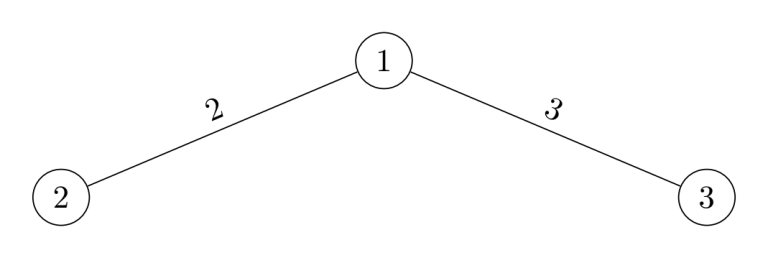
For such a tree in total $9$ paths exist:
1. $1 \to 1$ of value $0$
2. $2 \to 2$ of value $0$
3. $3 \to 3$ of value $0$
4. $2 \to 3$ (goes through $1$ ) of value $1 = 2 \oplus 3$
5. $3 \to 2$ (goes through $1$ ) of value $1 = 2 \oplus 3$
6. $1 \to 2$ of value $2$
7. $2 \to 1$ of value $2$
8. $1 \to 3$ of value $3$
9. $3 \to 1$ of value $3$

For such a tree in total $9$ paths exist:
1. $1 \to 1$ of value $0$
2. $2 \to 2$ of value $0$
3. $3 \to 3$ of value $0$
4. $2 \to 3$ (goes through $1$ ) of value $1 = 2 \oplus 3$
5. $3 \to 2$ (goes through $1$ ) of value $1 = 2 \oplus 3$
6. $1 \to 2$ of value $2$
7. $2 \to 1$ of value $2$
8. $1 \to 3$ of value $3$
9. $3 \to 1$ of value $3$