A12077 | Dwarves, Hats and Extrasensory Abilities
时间限制1s
内存限制256MB
通过 / 提交0/0
题目描述
This is an interactive problem.
In good old times dwarves tried to develop extrasensory abilities:
- Exactly $n$ dwarves entered completely dark cave.
- Each dwarf received a hat — white or black. While in cave, none of the dwarves was able to see either his own hat or hats of other Dwarves.
- Dwarves went out of the cave to the meadow and sat at an arbitrary place one after the other. When a dwarf leaves the cave, he sees the colors of all hats of all dwarves that are seating on the meadow (i.e. left the cave before him). However, he is not able to see the color of his own hat and none of the dwarves can give him this information.
- The task for dwarves was to got diverged into two parts — one with dwarves with white hats and one with black hats.
After many centuries, dwarves finally managed to select the right place on the meadow without error. Will you be able to repeat their success?
You are asked to successively name $n$ different integer points on the plane. After naming each new point you will be given its color — black or white. Your task is to ensure that the named points can be split by a line in such a way that all points of one color lie on the same side from the line and points of different colors lie on different sides. Moreover, no points can belong to the line. Also, you need to report any such line at the end of the process.
In this problem, the interactor is adaptive — the colors of the points in the tests are not fixed beforehand and the jury program can select them arbitrarily, in particular, depending on your program output.
In good old times dwarves tried to develop extrasensory abilities:
- Exactly $n$ dwarves entered completely dark cave.
- Each dwarf received a hat — white or black. While in cave, none of the dwarves was able to see either his own hat or hats of other Dwarves.
- Dwarves went out of the cave to the meadow and sat at an arbitrary place one after the other. When a dwarf leaves the cave, he sees the colors of all hats of all dwarves that are seating on the meadow (i.e. left the cave before him). However, he is not able to see the color of his own hat and none of the dwarves can give him this information.
- The task for dwarves was to got diverged into two parts — one with dwarves with white hats and one with black hats.
After many centuries, dwarves finally managed to select the right place on the meadow without error. Will you be able to repeat their success?
You are asked to successively name $n$ different integer points on the plane. After naming each new point you will be given its color — black or white. Your task is to ensure that the named points can be split by a line in such a way that all points of one color lie on the same side from the line and points of different colors lie on different sides. Moreover, no points can belong to the line. Also, you need to report any such line at the end of the process.
In this problem, the interactor is adaptive — the colors of the points in the tests are not fixed beforehand and the jury program can select them arbitrarily, in particular, depending on your program output.
输入格式
无
输出格式
The first line of the standard input stream contains an integer $n$ ( $1<=n<=30$ ) — the number of points your program should name.
Then $n$ times your program must print two integer coordinates $x$ and $y$ ( $0<=x<=10^{9}$ , $0<=y<=10^{9}$ ). All points you print must be distinct.
In response to each coordinate pair your program will receive the string "black", if the point is black, or "white", if the point is white.
When all $n$ points are processed, you need to print four integers $x_{1}$ , $y_{1}$ , $x_{2}$ and $y_{2}$ ( $0<=x_{1},y_{1}<=10^{9}$ , $0<=x_{2},y_{2}<=10^{9}$ ) — coordinates of points $(x_{1},y_{1})$ and $(x_{2},y_{2})$ , which form a line, which separates $n$ points into black and white. Points $(x_{1},y_{1})$ and $(x_{2},y_{2})$ should not coincide.
Hacks
To hack solution use the following format. The first line must contain word "hack", the second line should contain the number $n$ and the last line should contain the sequence of $0$ and $1$ — colors of points, which will be reported to the solution. Unlike the jury tests, colors of points in hacks are always fixed in advance. Of course, the hacked solution wouldn't be able to get the information about the colors in advance.
For example, the hack corresponding to sample test will look like this:
```
hack
5
0 0 1 1 0
```
Then $n$ times your program must print two integer coordinates $x$ and $y$ ( $0<=x<=10^{9}$ , $0<=y<=10^{9}$ ). All points you print must be distinct.
In response to each coordinate pair your program will receive the string "black", if the point is black, or "white", if the point is white.
When all $n$ points are processed, you need to print four integers $x_{1}$ , $y_{1}$ , $x_{2}$ and $y_{2}$ ( $0<=x_{1},y_{1}<=10^{9}$ , $0<=x_{2},y_{2}<=10^{9}$ ) — coordinates of points $(x_{1},y_{1})$ and $(x_{2},y_{2})$ , which form a line, which separates $n$ points into black and white. Points $(x_{1},y_{1})$ and $(x_{2},y_{2})$ should not coincide.
Hacks
To hack solution use the following format. The first line must contain word "hack", the second line should contain the number $n$ and the last line should contain the sequence of $0$ and $1$ — colors of points, which will be reported to the solution. Unlike the jury tests, colors of points in hacks are always fixed in advance. Of course, the hacked solution wouldn't be able to get the information about the colors in advance.
For example, the hack corresponding to sample test will look like this:
```
hack
5
0 0 1 1 0
```
输入输出样例
输入 #1
5

black

black

white

white

black
输出 #1
0 0

3 1

2 3

4 4

0 2

1 3 4 1
In the sample input and output values are aligned only for simplicity of interpreting them chronologically. In real interaction no "extra" line breaks should appear.
The following picture illustrates the first test.
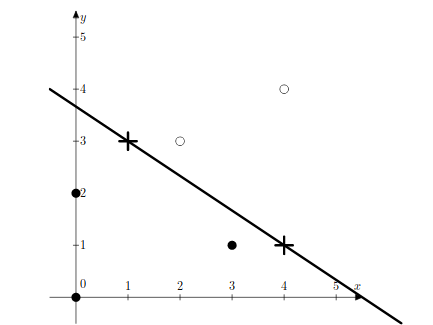
The following picture illustrates the first test.

C++ 编辑器
输入
输出
可保存默认模板;新题优先使用已保存模板。
当前快捷键仅展示,暂不支持修改。
- 撤销
Ctrl / ⌘ + Z - 重做
Ctrl / ⌘ + Y - 查找
Ctrl / ⌘ + F - 全选
Ctrl / ⌘ + A - 复制
Ctrl / ⌘ + C - 剪切
Ctrl / ⌘ + X - 粘贴
Ctrl / ⌘ + V - 自动排版
工具栏排版按钮 - 草稿保存
编辑时自动保存到本机
历史
提交记录
状态说明时间源码
AI
作答助手
你好,我是作答助手。可以问思路、复杂度、样例含义或代码报错原因;不会直接给出完整 AC 代码。
确定要清空代码吗?
提交通过
评测结果:Accepted