A12037. Tree with Small Distances
编程题
普及/提高-
知识点
题目描述
You are given an undirected tree consisting of $n$ vertices. An undirected tree is a connected undirected graph with $n - 1$ edges.
Your task is to add the minimum number of edges in such a way that the length of the shortest path from the vertex $1$ to any other vertex is at most $2$ . Note that you are not allowed to add loops and multiple edges.
Your task is to add the minimum number of edges in such a way that the length of the shortest path from the vertex $1$ to any other vertex is at most $2$ . Note that you are not allowed to add loops and multiple edges.
输入格式
The first line contains one integer $n$ ( $2 \le n \le 2 \cdot 10^5$ ) — the number of vertices in the tree.
The following $n - 1$ lines contain edges: edge $i$ is given as a pair of vertices $u_i, v_i$ ( $1 \le u_i, v_i \le n$ ). It is guaranteed that the given edges form a tree. It is guaranteed that there are no loops and multiple edges in the given edges.
The following $n - 1$ lines contain edges: edge $i$ is given as a pair of vertices $u_i, v_i$ ( $1 \le u_i, v_i \le n$ ). It is guaranteed that the given edges form a tree. It is guaranteed that there are no loops and multiple edges in the given edges.
输出格式
Print a single integer — the minimum number of edges you have to add in order to make the shortest distance from the vertex $1$ to any other vertex at most $2$ . Note that you are not allowed to add loops and multiple edges.
输入输出样例
输入 #1
7
1 2
2 3
2 4
4 5
4 6
5 7
输出 #1
2
输入 #2
7
1 2
1 3
2 4
2 5
3 6
1 7
输出 #2
0
输入 #3
7
1 2
2 3
3 4
3 5
3 6
3 7
输出 #3
1
说明/提示
The tree corresponding to the first example: 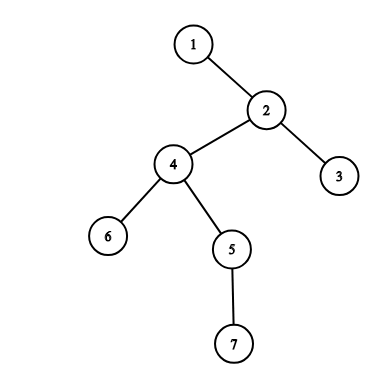 The answer is $2$ , some of the possible answers are the following: $[(1, 5), (1, 6)]$ , $[(1, 4), (1, 7)]$ , $[(1, 6), (1, 7)]$ .
The tree corresponding to the second example: 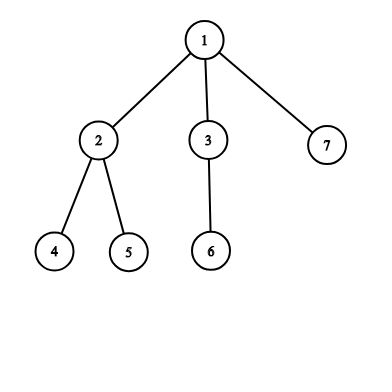 The answer is $0$ .
The tree corresponding to the third example: 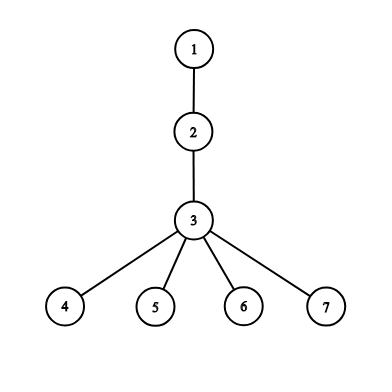 The answer is $1$ , only one possible way to reach it is to add the edge $(1, 3)$ .
The tree corresponding to the second example:  The answer is $0$ .
The tree corresponding to the third example:  The answer is $1$ , only one possible way to reach it is to add the edge $(1, 3)$ .