A11972 | Glider
时间限制1s
内存限制256MB
通过 / 提交0/0
题目描述
A plane is flying at a constant height of $h$ meters above the ground surface. Let's consider that it is flying from the point $(-10^9, h)$ to the point $(10^9, h)$ parallel with $Ox$ axis.
A glider is inside the plane, ready to start his flight at any moment (for the sake of simplicity let's consider that he may start only when the plane's coordinates are integers). After jumping from the plane, he will fly in the same direction as the plane, parallel to $Ox$ axis, covering a unit of distance every second. Naturally, he will also descend; thus his second coordinate will decrease by one unit every second.
There are ascending air flows on certain segments, each such segment is characterized by two numbers $x_1$ and $x_2$ ( $x_1 < x_2$ ) representing its endpoints. No two segments share any common points. When the glider is inside one of such segments, he doesn't descend, so his second coordinate stays the same each second. The glider still flies along $Ox$ axis, covering one unit of distance every second.
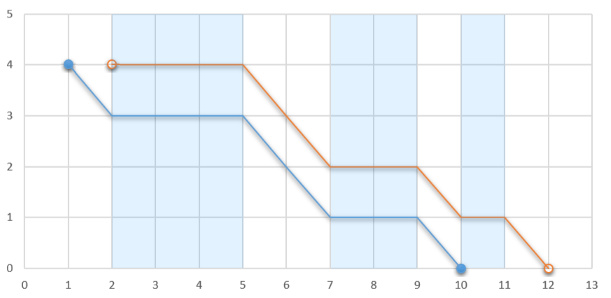If the glider jumps out at $1$ , he will stop at $10$ . Otherwise, if he jumps out at $2$ , he will stop at $12$ .Determine the maximum distance along $Ox$ axis from the point where the glider's flight starts to the point where his flight ends if the glider can choose any integer coordinate to jump from the plane and start his flight. After touching the ground the glider stops altogether, so he cannot glide through an ascending airflow segment if his second coordinate is $0$ .
A glider is inside the plane, ready to start his flight at any moment (for the sake of simplicity let's consider that he may start only when the plane's coordinates are integers). After jumping from the plane, he will fly in the same direction as the plane, parallel to $Ox$ axis, covering a unit of distance every second. Naturally, he will also descend; thus his second coordinate will decrease by one unit every second.
There are ascending air flows on certain segments, each such segment is characterized by two numbers $x_1$ and $x_2$ ( $x_1 < x_2$ ) representing its endpoints. No two segments share any common points. When the glider is inside one of such segments, he doesn't descend, so his second coordinate stays the same each second. The glider still flies along $Ox$ axis, covering one unit of distance every second.
If the glider jumps out at $1$ , he will stop at $10$ . Otherwise, if he jumps out at $2$ , he will stop at $12$ .Determine the maximum distance along $Ox$ axis from the point where the glider's flight starts to the point where his flight ends if the glider can choose any integer coordinate to jump from the plane and start his flight. After touching the ground the glider stops altogether, so he cannot glide through an ascending airflow segment if his second coordinate is $0$ .
输入格式
The first line contains two integers $n$ and $h$ $(1 \le n \le 2\cdot10^{5}, 1 \le h \le 10^{9})$ — the number of ascending air flow segments and the altitude at which the plane is flying, respectively.
Each of the next $n$ lines contains two integers $x_{i1}$ and $x_{i2}$ $(1 \le x_{i1} < x_{i2} \le 10^{9})$ — the endpoints of the $i$ -th ascending air flow segment. No two segments intersect, and they are given in ascending order.
Each of the next $n$ lines contains two integers $x_{i1}$ and $x_{i2}$ $(1 \le x_{i1} < x_{i2} \le 10^{9})$ — the endpoints of the $i$ -th ascending air flow segment. No two segments intersect, and they are given in ascending order.
输出格式
Print one integer — the maximum distance along $Ox$ axis that the glider can fly from the point where he jumps off the plane to the point where he lands if he can start his flight at any integer coordinate.
输入输出样例
输入 #1
3 4
2 5
7 9
10 11
输出 #1
10
输入 #2
5 10
5 7
11 12
16 20
25 26
30 33
输出 #2
18
输入 #3
1 1000000000
1 1000000000
输出 #3
1999999999
In the first example if the glider can jump out at $(2, 4)$ , then the landing point is $(12, 0)$ , so the distance is $12-2 = 10$ .
In the second example the glider can fly from $(16,10)$ to $(34,0)$ , and the distance is $34-16=18$ .
In the third example the glider can fly from $(-100,1000000000)$ to $(1999999899,0)$ , so the distance is $1999999899-(-100)=1999999999$ .
In the second example the glider can fly from $(16,10)$ to $(34,0)$ , and the distance is $34-16=18$ .
In the third example the glider can fly from $(-100,1000000000)$ to $(1999999899,0)$ , so the distance is $1999999899-(-100)=1999999999$ .
C++ 编辑器
输入
输出
可保存默认模板;新题优先使用已保存模板。
当前快捷键仅展示,暂不支持修改。
- 撤销
Ctrl / ⌘ + Z - 重做
Ctrl / ⌘ + Y - 查找
Ctrl / ⌘ + F - 全选
Ctrl / ⌘ + A - 复制
Ctrl / ⌘ + C - 剪切
Ctrl / ⌘ + X - 粘贴
Ctrl / ⌘ + V - 自动排版
工具栏排版按钮 - 草稿保存
编辑时自动保存到本机
历史
提交记录
状态说明时间源码
AI
作答助手
你好,我是作答助手。可以问思路、复杂度、样例含义或代码报错原因;不会直接给出完整 AC 代码。
确定要清空代码吗?
提交通过
评测结果:Accepted