A11837. Liebig's Barrels
编程题
普及/提高-
知识点
题目描述
You have $m=n·k$ wooden staves. The $i$ -th stave has length $a_{i}$ . You have to assemble $n$ barrels consisting of $k$ staves each, you can use any $k$ staves to construct a barrel. Each stave must belong to exactly one barrel.
Let volume $v_{j}$ of barrel $j$ be equal to the length of the minimal stave in it.
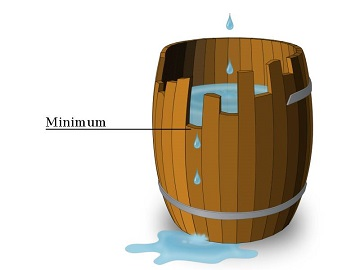You want to assemble exactly $n$ barrels with the maximal total sum of volumes. But you have to make them equal enough, so a difference between volumes of any pair of the resulting barrels must not exceed $l$ , i.e. $|v_{x}-v_{y}|<=l$ for any $1<=x<=n$ and $1<=y<=n$ .
Print maximal total sum of volumes of equal enough barrels or $0$ if it's impossible to satisfy the condition above.
Let volume $v_{j}$ of barrel $j$ be equal to the length of the minimal stave in it.
You want to assemble exactly $n$ barrels with the maximal total sum of volumes. But you have to make them equal enough, so a difference between volumes of any pair of the resulting barrels must not exceed $l$ , i.e. $|v_{x}-v_{y}|<=l$ for any $1<=x<=n$ and $1<=y<=n$ .
Print maximal total sum of volumes of equal enough barrels or $0$ if it's impossible to satisfy the condition above.
输入格式
The first line contains three space-separated integers $n$ , $k$ and $l$ ( $1<=n,k<=10^{5}$ , $1<=n·k<=10^{5}$ , $0<=l<=10^{9}$ ).
The second line contains $m=n·k$ space-separated integers $a_{1},a_{2},...,a_{m}$ ( $1<=a_{i}<=10^{9}$ ) — lengths of staves.
The second line contains $m=n·k$ space-separated integers $a_{1},a_{2},...,a_{m}$ ( $1<=a_{i}<=10^{9}$ ) — lengths of staves.
输出格式
Print single integer — maximal total sum of the volumes of barrels or $0$ if it's impossible to construct exactly $n$ barrels satisfying the condition $|v_{x}-v_{y}|<=l$ for any $1<=x<=n$ and $1<=y<=n$ .
输入输出样例
输入 #1
4 2 1
2 2 1 2 3 2 2 3
输出 #1
7
输入 #2
2 1 0
10 10
输出 #2
20
输入 #3
1 2 1
5 2
输出 #3
2
输入 #4
3 2 1
1 2 3 4 5 6
输出 #4
0
说明/提示
In the first example you can form the following barrels: $[1,2]$ , $[2,2]$ , $[2,3]$ , $[2,3]$ .
In the second example you can form the following barrels: $[10]$ , $[10]$ .
In the third example you can form the following barrels: $[2,5]$ .
In the fourth example difference between volumes of barrels in any partition is at least $2$ so it is impossible to make barrels equal enough.
In the second example you can form the following barrels: $[10]$ , $[10]$ .
In the third example you can form the following barrels: $[2,5]$ .
In the fourth example difference between volumes of barrels in any partition is at least $2$ so it is impossible to make barrels equal enough.