A11755. Heaps
编程题
普及/提高-
知识点
题目描述
You're given a tree with $n$ vertices rooted at $1$ .
We say that there's a $k$ -ary heap of depth $m$ located at $u$ if the following holds:
- For $m=1$ $u$ itself is a $k$ -ary heap of depth $1$ .
- For $m>1$ vertex $u$ is a $k$ -ary heap of depth $m$ if at least $k$ of its children are $k$ -ary heaps of depth at least $m-1$ .
Denote $dp_{k}(u)$ as maximum depth of $k$ -ary heap in the subtree of $u$ (including $u$ ). Your goal is to compute 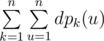.
We say that there's a $k$ -ary heap of depth $m$ located at $u$ if the following holds:
- For $m=1$ $u$ itself is a $k$ -ary heap of depth $1$ .
- For $m>1$ vertex $u$ is a $k$ -ary heap of depth $m$ if at least $k$ of its children are $k$ -ary heaps of depth at least $m-1$ .
Denote $dp_{k}(u)$ as maximum depth of $k$ -ary heap in the subtree of $u$ (including $u$ ). Your goal is to compute .
输入格式
The first line contains an integer $n$ denoting the size of the tree $(2<=n<=3·10^{5})$ .
The next $n-1$ lines contain two integers $u$ , $v$ each, describing vertices connected by $i$ -th edge.
It's guaranteed that the given configuration forms a tree.
The next $n-1$ lines contain two integers $u$ , $v$ each, describing vertices connected by $i$ -th edge.
It's guaranteed that the given configuration forms a tree.
输出格式
Output the answer to the task.
输入输出样例
输入 #1
4
1 3
2 3
4 3
输出 #1
21
输入 #2
4
1 2
2 3
3 4
输出 #2
22
说明/提示
Consider sample case one.
For $k>=3$ all $dp_{k}$ will be equal to $1$ .
For $k=2$ $dp_{k}$ is $2$ if  and $1$ otherwise.
For $k=1$ $dp_{k}$ values are $(3,1,2,1)$ respectively.
To sum up, $4·1+4·1+2·2+2·1+3+1+2+1=21$ .
For $k>=3$ all $dp_{k}$ will be equal to $1$ .
For $k=2$ $dp_{k}$ is $2$ if  and $1$ otherwise.
For $k=1$ $dp_{k}$ values are $(3,1,2,1)$ respectively.
To sum up, $4·1+4·1+2·2+2·1+3+1+2+1=21$ .