A11370. Bipartite Segments
编程题
普及/提高-
知识点
题目描述
You are given an undirected graph with $n$ vertices. There are no edge-simple cycles with the even length in it. In other words, there are no cycles of even length that pass each edge at most once. Let's enumerate vertices from $1$ to $n$ .
You have to answer $q$ queries. Each query is described by a segment of vertices $[l;r]$ , and you have to count the number of its subsegments $[x;y]$ ( $l<=x<=y<=r$ ), such that if we delete all vertices except the segment of vertices $[x;y]$ (including $x$ and $y$ ) and edges between them, the resulting graph is bipartite.
You have to answer $q$ queries. Each query is described by a segment of vertices $[l;r]$ , and you have to count the number of its subsegments $[x;y]$ ( $l<=x<=y<=r$ ), such that if we delete all vertices except the segment of vertices $[x;y]$ (including $x$ and $y$ ) and edges between them, the resulting graph is bipartite.
输入格式
The first line contains two integers $n$ and $m$ ( $1<=n<=3·10^{5}$ , $1<=m<=3·10^{5}$ ) — the number of vertices and the number of edges in the graph.
The next $m$ lines describe edges in the graph. The $i$ -th of these lines contains two integers $a_{i}$ and $b_{i}$ ( $1<=a_{i},b_{i}<=n$ ; $a_{i}≠b_{i}$ ), denoting an edge between vertices $a_{i}$ and $b_{i}$ . It is guaranteed that this graph does not contain edge-simple cycles of even length.
The next line contains a single integer $q$ ( $1<=q<=3·10^{5}$ ) — the number of queries.
The next $q$ lines contain queries. The $i$ -th of these lines contains two integers $l_{i}$ and $r_{i}$ ( $1<=l_{i}<=r_{i}<=n$ ) — the query parameters.
The next $m$ lines describe edges in the graph. The $i$ -th of these lines contains two integers $a_{i}$ and $b_{i}$ ( $1<=a_{i},b_{i}<=n$ ; $a_{i}≠b_{i}$ ), denoting an edge between vertices $a_{i}$ and $b_{i}$ . It is guaranteed that this graph does not contain edge-simple cycles of even length.
The next line contains a single integer $q$ ( $1<=q<=3·10^{5}$ ) — the number of queries.
The next $q$ lines contain queries. The $i$ -th of these lines contains two integers $l_{i}$ and $r_{i}$ ( $1<=l_{i}<=r_{i}<=n$ ) — the query parameters.
输出格式
Print $q$ numbers, each in new line: the $i$ -th of them should be the number of subsegments $[x;y]$ ( $l_{i}<=x<=y<=r_{i}$ ), such that the graph that only includes vertices from segment $[x;y]$ and edges between them is bipartite.
输入输出样例
输入 #1
6 6
1 2
2 3
3 1
4 5
5 6
6 4
3
1 3
4 6
1 6
输出 #1
5
5
14
输入 #2
8 9
1 2
2 3
3 1
4 5
5 6
6 7
7 8
8 4
7 2
3
1 8
1 4
3 8
输出 #2
27
8
19
说明/提示
The first example is shown on the picture below:
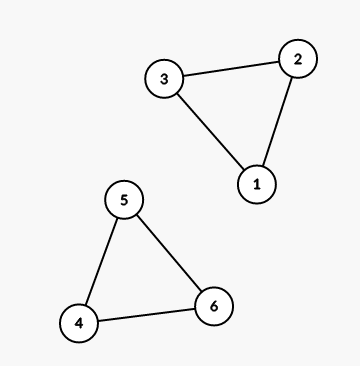
For the first query, all subsegments of $[1;3]$ , except this segment itself, are suitable.
For the first query, all subsegments of $[4;6]$ , except this segment itself, are suitable.
For the third query, all subsegments of $[1;6]$ are suitable, except $[1;3]$ , $[1;4]$ , $[1;5]$ , $[1;6]$ , $[2;6]$ , $[3;6]$ , $[4;6]$ .
The second example is shown on the picture below:
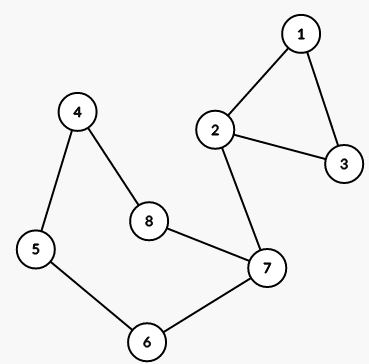

For the first query, all subsegments of $[1;3]$ , except this segment itself, are suitable.
For the first query, all subsegments of $[4;6]$ , except this segment itself, are suitable.
For the third query, all subsegments of $[1;6]$ are suitable, except $[1;3]$ , $[1;4]$ , $[1;5]$ , $[1;6]$ , $[2;6]$ , $[3;6]$ , $[4;6]$ .
The second example is shown on the picture below:
