A11330. Sasha and the Drawing
编程题
普及/提高-
知识点
题目描述
Even in kindergarten, Sasha liked a girl. Therefore, he wanted to give her a drawing and attract her attention.
As a drawing, he decided to draw a square grid of size $n \times n$ , in which some cells are colored. But coloring the cells is difficult, so he wants to color as few cells as possible. But at the same time, he wants at least $k$ diagonals to have at least one colored cell. Note that the square grid of size $n \times n$ has a total of $4n - 2$ diagonals.
Help little Sasha to make the girl fall in love with him and tell him the minimum number of cells he needs to color.
As a drawing, he decided to draw a square grid of size $n \times n$ , in which some cells are colored. But coloring the cells is difficult, so he wants to color as few cells as possible. But at the same time, he wants at least $k$ diagonals to have at least one colored cell. Note that the square grid of size $n \times n$ has a total of $4n - 2$ diagonals.
Help little Sasha to make the girl fall in love with him and tell him the minimum number of cells he needs to color.
输入格式
Each test consists of multiple test cases. The first line contains a single integer $t$ ( $1 \le t \le 1000$ ) — the number of test cases. The description of the test cases follows.
The only line of each test case contains two integers $n$ and $k$ ( $2 \leq n \leq 10^8$ , $1 \leq k \leq 4n - 2$ ) — the size of the square grid and the minimum number of diagonals in which there should be at least one colored cell.
The only line of each test case contains two integers $n$ and $k$ ( $2 \leq n \leq 10^8$ , $1 \leq k \leq 4n - 2$ ) — the size of the square grid and the minimum number of diagonals in which there should be at least one colored cell.
输出格式
For each test case, output a single integer — the minimum number of cells that need to be colored.
输入输出样例
输入 #1
7
3 4
3 3
3 10
3 9
4 7
7 11
2 3
输出 #1
2
2
6
5
4
6
2
说明/提示
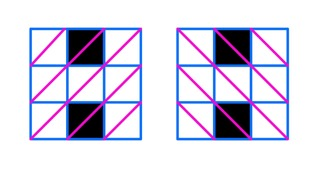
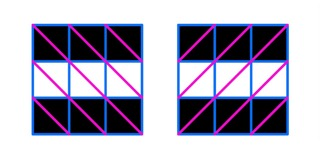
In the pictures below, the colored cells are marked in black, and all diagonals are marked in purple.
In the first test case, you can color $2$ cells so that $4$ diagonals contain at least one colored cell:
In the third test case, you can color $6$ cells so that all $10$ diagonals contain at least one colored cell:
In the first test case, you can color $2$ cells so that $4$ diagonals contain at least one colored cell:
In the third test case, you can color $6$ cells so that all $10$ diagonals contain at least one colored cell:
