A11283. Andrey's Tree
编程题
普及/提高-
知识点
题目描述
Master Andrey loves trees $^{\dagger}$ very much, so he has a tree consisting of $n$ vertices.
But it's not that simple. Master Timofey decided to steal one vertex from the tree. If Timofey stole vertex $v$ from the tree, then vertex $v$ and all edges with one end at vertex $v$ are removed from the tree, while the numbers of other vertices remain unchanged. To prevent Andrey from getting upset, Timofey decided to make the resulting graph a tree again. To do this, he can add edges between any vertices $a$ and $b$ , but when adding such an edge, he must pay $|a - b|$ coins to the Master's Assistance Center.
Note that the resulting tree does not contain vertex $v$ .
Timofey has not yet decided which vertex $v$ he will remove from the tree, so he wants to know for each vertex $1 \leq v \leq n$ , the minimum number of coins needed to be spent to make the graph a tree again after removing vertex $v$ , as well as which edges need to be added.
$^{\dagger}$ A tree is an undirected connected graph without cycles.
But it's not that simple. Master Timofey decided to steal one vertex from the tree. If Timofey stole vertex $v$ from the tree, then vertex $v$ and all edges with one end at vertex $v$ are removed from the tree, while the numbers of other vertices remain unchanged. To prevent Andrey from getting upset, Timofey decided to make the resulting graph a tree again. To do this, he can add edges between any vertices $a$ and $b$ , but when adding such an edge, he must pay $|a - b|$ coins to the Master's Assistance Center.
Note that the resulting tree does not contain vertex $v$ .
Timofey has not yet decided which vertex $v$ he will remove from the tree, so he wants to know for each vertex $1 \leq v \leq n$ , the minimum number of coins needed to be spent to make the graph a tree again after removing vertex $v$ , as well as which edges need to be added.
$^{\dagger}$ A tree is an undirected connected graph without cycles.
输入格式
Each test consists of multiple test cases. The first line contains a single integer $t$ ( $1 \le t \le 10^4$ ) — the number of test cases. The description of the test cases follows.
The first line of each test case contains a single integer $n$ ( $5 \le n \le 2\cdot10^5$ ) — the number of vertices in Andrey's tree.
The next $n - 1$ lines contain a description of the tree's edges. The $i$ -th of these lines contains two integers $u_i$ and $v_i$ ( $1 \le u_i, v_i \le n$ ) — the numbers of vertices connected by the $i$ -th edge.
It is guaranteed that the given edges form a tree.
It is guaranteed that the sum of $n$ over all test cases does not exceed $2\cdot10^5$ .
The first line of each test case contains a single integer $n$ ( $5 \le n \le 2\cdot10^5$ ) — the number of vertices in Andrey's tree.
The next $n - 1$ lines contain a description of the tree's edges. The $i$ -th of these lines contains two integers $u_i$ and $v_i$ ( $1 \le u_i, v_i \le n$ ) — the numbers of vertices connected by the $i$ -th edge.
It is guaranteed that the given edges form a tree.
It is guaranteed that the sum of $n$ over all test cases does not exceed $2\cdot10^5$ .
输出格式
For each test case, output the answer in the following format:
For each vertex $v$ (in the order from $1$ to $n$ ), in the first line output two integers $w$ and $m$ — the minimum number of coins that need to be spent to make the graph a tree again after removing vertex $v$ , and the number of added edges.
Then output $m$ lines, each containing two integers $a$ and $b$ ( $1 \le a, b \le n, a \ne v, b \ne v$ , $a \ne b$ ) — the ends of the added edge.
If there are multiple ways to add edges, you can output any solution with the minimum cost.
For each vertex $v$ (in the order from $1$ to $n$ ), in the first line output two integers $w$ and $m$ — the minimum number of coins that need to be spent to make the graph a tree again after removing vertex $v$ , and the number of added edges.
Then output $m$ lines, each containing two integers $a$ and $b$ ( $1 \le a, b \le n, a \ne v, b \ne v$ , $a \ne b$ ) — the ends of the added edge.
If there are multiple ways to add edges, you can output any solution with the minimum cost.
输入输出样例
输入 #1
3
5
1 3
1 4
4 5
3 2
5
4 2
4 3
3 5
5 1
5
2 1
1 5
1 4
1 3
输出 #1
1 1
3 4

0 0

1 1
1 2

2 1
3 5

0 0

0 0

0 0

1 1
1 2

1 1
1 2

1 1
1 2

3 3
2 3
4 5
3 4

0 0

0 0

0 0

0 0
说明/提示
In the first test case:
Consider the removal of vertex $4$ :
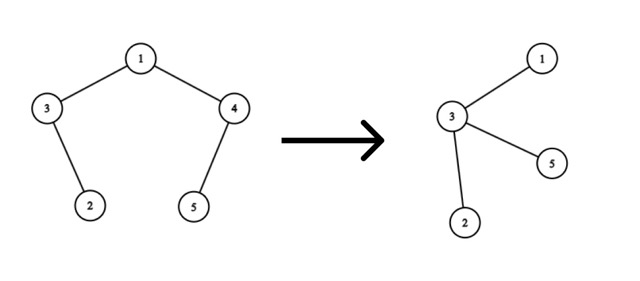The optimal solution would be to add an edge from vertex $5$ to vertex $3$ . Then we will spend $|5 - 3| = 2$ coins.
In the third test case:
Consider the removal of vertex $1$ :
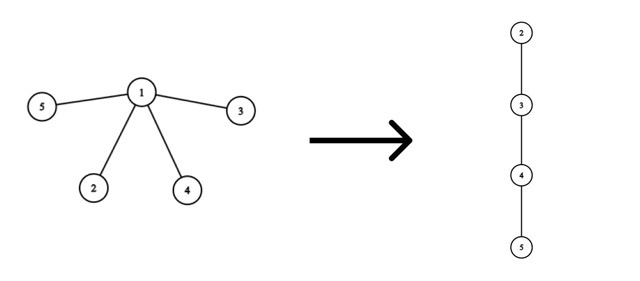The optimal solution would be:
- Add an edge from vertex $2$ to vertex $3$ , spending $|2 - 3| = 1$ coin.
- Add an edge from vertex $3$ to vertex $4$ , spending $|3 - 4| = 1$ coin.
- Add an edge from vertex $4$ to vertex $5$ , spending $|4 - 5| = 1$ coin.
Then we will spend a total of $1 + 1 + 1 = 3$ coins.
Consider the removal of vertex $2$ :
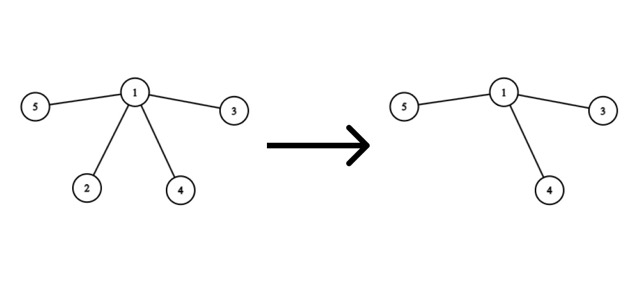No edges need to be added, as the graph will remain a tree after removing the vertex.
Consider the removal of vertex $4$ :
The optimal solution would be to add an edge from vertex $5$ to vertex $3$ . Then we will spend $|5 - 3| = 2$ coins.
In the third test case:
Consider the removal of vertex $1$ :
The optimal solution would be:
- Add an edge from vertex $2$ to vertex $3$ , spending $|2 - 3| = 1$ coin.
- Add an edge from vertex $3$ to vertex $4$ , spending $|3 - 4| = 1$ coin.
- Add an edge from vertex $4$ to vertex $5$ , spending $|4 - 5| = 1$ coin.
Then we will spend a total of $1 + 1 + 1 = 3$ coins.
Consider the removal of vertex $2$ :
No edges need to be added, as the graph will remain a tree after removing the vertex.