A11030 | An overnight dance in discotheque
时间限制1s
内存限制256MB
通过 / 提交0/0
题目描述
The crowdedness of the discotheque would never stop our friends from having fun, but a bit more spaciousness won't hurt, will it?
The discotheque can be seen as an infinite $xy$ -plane, in which there are a total of $n$ dancers. Once someone starts moving around, they will move only inside their own movement range, which is a circular area $C_{i}$ described by a center $(x_{i},y_{i})$ and a radius $r_{i}$ . No two ranges' borders have more than one common point, that is for every pair $(i,j)$ ( $1<=i<j<=n$ ) either ranges $C_{i}$ and $C_{j}$ are disjoint, or one of them is a subset of the other. Note that it's possible that two ranges' borders share a single common point, but no two dancers have exactly the same ranges.
Tsukihi, being one of them, defines the spaciousness to be the area covered by an odd number of movement ranges of dancers who are moving. An example is shown below, with shaded regions representing the spaciousness if everyone moves at the same time.
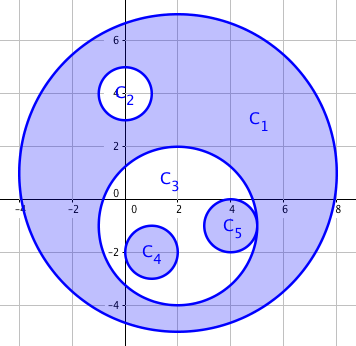But no one keeps moving for the whole night after all, so the whole night's time is divided into two halves — before midnight and after midnight. Every dancer moves around in one half, while sitting down with friends in the other. The spaciousness of two halves are calculated separately and their sum should, of course, be as large as possible. The following figure shows an optimal solution to the example above.
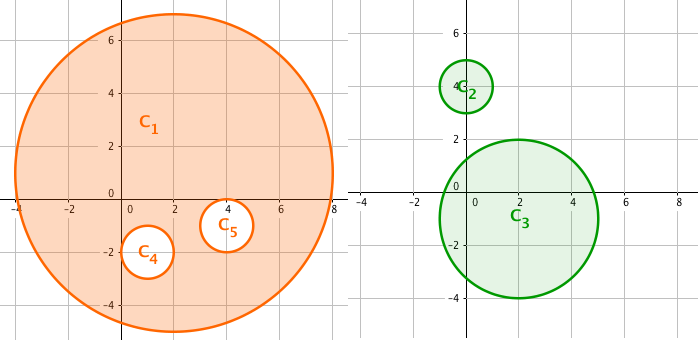By different plans of who dances in the first half and who does in the other, different sums of spaciousness over two halves are achieved. You are to find the largest achievable value of this sum.
The discotheque can be seen as an infinite $xy$ -plane, in which there are a total of $n$ dancers. Once someone starts moving around, they will move only inside their own movement range, which is a circular area $C_{i}$ described by a center $(x_{i},y_{i})$ and a radius $r_{i}$ . No two ranges' borders have more than one common point, that is for every pair $(i,j)$ ( $1<=i<j<=n$ ) either ranges $C_{i}$ and $C_{j}$ are disjoint, or one of them is a subset of the other. Note that it's possible that two ranges' borders share a single common point, but no two dancers have exactly the same ranges.
Tsukihi, being one of them, defines the spaciousness to be the area covered by an odd number of movement ranges of dancers who are moving. An example is shown below, with shaded regions representing the spaciousness if everyone moves at the same time.
But no one keeps moving for the whole night after all, so the whole night's time is divided into two halves — before midnight and after midnight. Every dancer moves around in one half, while sitting down with friends in the other. The spaciousness of two halves are calculated separately and their sum should, of course, be as large as possible. The following figure shows an optimal solution to the example above.
By different plans of who dances in the first half and who does in the other, different sums of spaciousness over two halves are achieved. You are to find the largest achievable value of this sum.
输入格式
The first line of input contains a positive integer $n$ ( $1<=n<=1000$ ) — the number of dancers.
The following $n$ lines each describes a dancer: the $i$ -th line among them contains three space-separated integers $x_{i}$ , $y_{i}$ and $r_{i}$ ( $-10^{6}<=x_{i},y_{i}<=10^{6}$ , $1<=r_{i}<=10^{6}$ ), describing a circular movement range centered at $(x_{i},y_{i})$ with radius $r_{i}$ .
The following $n$ lines each describes a dancer: the $i$ -th line among them contains three space-separated integers $x_{i}$ , $y_{i}$ and $r_{i}$ ( $-10^{6}<=x_{i},y_{i}<=10^{6}$ , $1<=r_{i}<=10^{6}$ ), describing a circular movement range centered at $(x_{i},y_{i})$ with radius $r_{i}$ .
输出格式
Output one decimal number — the largest achievable sum of spaciousness over two halves of the night.
The output is considered correct if it has a relative or absolute error of at most $10^{-9}$ . Formally, let your answer be $a$ , and the jury's answer be $b$ . Your answer is considered correct if 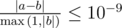.
The output is considered correct if it has a relative or absolute error of at most $10^{-9}$ . Formally, let your answer be $a$ , and the jury's answer be $b$ . Your answer is considered correct if .
输入输出样例
输入 #1
5
2 1 6
0 4 1
2 -1 3
1 -2 1
4 -1 1
输出 #1
138.23007676
输入 #2
8
0 0 1
0 0 2
0 0 3
0 0 4
0 0 5
0 0 6
0 0 7
0 0 8
输出 #2
289.02652413
The first sample corresponds to the illustrations in the legend.
C++ 编辑器
输入
输出
可保存默认模板;新题优先使用已保存模板。
当前快捷键仅展示,暂不支持修改。
- 撤销
Ctrl / ⌘ + Z - 重做
Ctrl / ⌘ + Y - 查找
Ctrl / ⌘ + F - 全选
Ctrl / ⌘ + A - 复制
Ctrl / ⌘ + C - 剪切
Ctrl / ⌘ + X - 粘贴
Ctrl / ⌘ + V - 自动排版
工具栏排版按钮 - 草稿保存
编辑时自动保存到本机
历史
提交记录
状态说明时间源码
AI
作答助手
你好,我是作答助手。可以问思路、复杂度、样例含义或代码报错原因;不会直接给出完整 AC 代码。
确定要清空代码吗?
提交通过
评测结果:Accepted