A11028. Karen and Game
编程题
普及/提高-
知识点
题目描述
On the way to school, Karen became fixated on the puzzle game on her phone!
The game is played as follows. In each level, you have a grid with $n$ rows and $m$ columns. Each cell originally contains the number $0$ .
One move consists of choosing one row or column, and adding $1$ to all of the cells in that row or column.
To win the level, after all the moves, the number in the cell at the $i$ -th row and $j$ -th column should be equal to $g_{i,j}$ .
Karen is stuck on one level, and wants to know a way to beat this level using the minimum number of moves. Please, help her with this task!
The game is played as follows. In each level, you have a grid with $n$ rows and $m$ columns. Each cell originally contains the number $0$ .
One move consists of choosing one row or column, and adding $1$ to all of the cells in that row or column.
To win the level, after all the moves, the number in the cell at the $i$ -th row and $j$ -th column should be equal to $g_{i,j}$ .
Karen is stuck on one level, and wants to know a way to beat this level using the minimum number of moves. Please, help her with this task!
输入格式
The first line of input contains two integers, $n$ and $m$ ( $1<=n,m<=100$ ), the number of rows and the number of columns in the grid, respectively.
The next $n$ lines each contain $m$ integers. In particular, the $j$ -th integer in the $i$ -th of these rows contains $g_{i,j}$ ( $0<=g_{i,j}<=500$ ).
The next $n$ lines each contain $m$ integers. In particular, the $j$ -th integer in the $i$ -th of these rows contains $g_{i,j}$ ( $0<=g_{i,j}<=500$ ).
输出格式
If there is an error and it is actually not possible to beat the level, output a single integer -1.
Otherwise, on the first line, output a single integer $k$ , the minimum number of moves necessary to beat the level.
The next $k$ lines should each contain one of the following, describing the moves in the order they must be done:
- row $x$ , ( $1<=x<=n$ ) describing a move of the form "choose the $x$ -th row".
- col $x$ , ( $1<=x<=m$ ) describing a move of the form "choose the $x$ -th column".
If there are multiple optimal solutions, output any one of them.
Otherwise, on the first line, output a single integer $k$ , the minimum number of moves necessary to beat the level.
The next $k$ lines should each contain one of the following, describing the moves in the order they must be done:
- row $x$ , ( $1<=x<=n$ ) describing a move of the form "choose the $x$ -th row".
- col $x$ , ( $1<=x<=m$ ) describing a move of the form "choose the $x$ -th column".
If there are multiple optimal solutions, output any one of them.
输入输出样例
输入 #1
3 5
2 2 2 3 2
0 0 0 1 0
1 1 1 2 1
输出 #1
4
row 1
row 1
col 4
row 3
输入 #2
3 3
0 0 0
0 1 0
0 0 0
输出 #2
-1
输入 #3
3 3
1 1 1
1 1 1
1 1 1
输出 #3
3
row 1
row 2
row 3
说明/提示
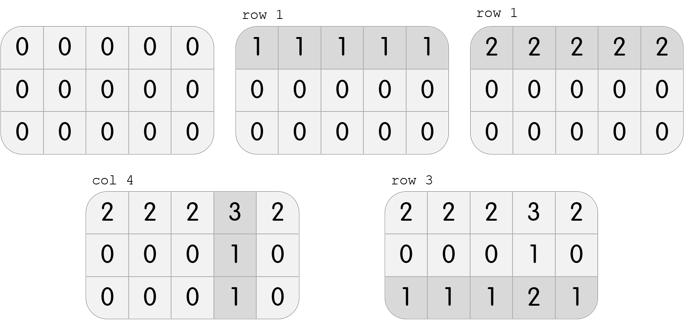
In the first test case, Karen has a grid with $3$ rows and $5$ columns. She can perform the following $4$ moves to beat the level:
In the second test case, Karen has a grid with $3$ rows and $3$ columns. It is clear that it is impossible to beat the level; performing any move will create three $1$ s on the grid, but it is required to only have one $1$ in the center.
In the third test case, Karen has a grid with $3$ rows and $3$ columns. She can perform the following $3$ moves to beat the level:
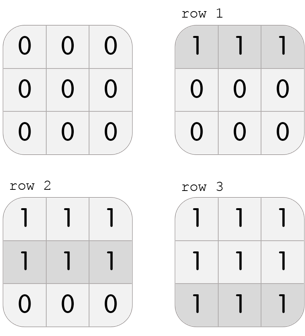Note that this is not the only solution; another solution, among others, is col 1, col 2, col 3.
In the second test case, Karen has a grid with $3$ rows and $3$ columns. It is clear that it is impossible to beat the level; performing any move will create three $1$ s on the grid, but it is required to only have one $1$ in the center.
In the third test case, Karen has a grid with $3$ rows and $3$ columns. She can perform the following $3$ moves to beat the level:
Note that this is not the only solution; another solution, among others, is col 1, col 2, col 3.