A10892 | Marmots (easy)
时间限制1s
内存限制256MB
通过 / 提交0/0
题目描述
Heidi is a statistician to the core, and she likes to study the evolution of marmot populations in each of $V$ ( $1<=V<=100$ ) villages! So it comes that every spring, when Heidi sees the first snowdrops sprout in the meadows around her barn, she impatiently dons her snowshoes and sets out to the Alps, to welcome her friends the marmots to a new season of thrilling adventures.
Arriving in a village, Heidi asks each and every marmot she comes across for the number of inhabitants of that village. This year, the marmots decide to play an April Fools' joke on Heidi. Instead of consistently providing the exact number of inhabitants $P$ ( $10<=P<=1000$ ) of the village, they respond with a random non-negative integer $k$ , drawn from one of two types of probability distributions:
- Poisson (d'avril) distribution: the probability of getting an answer $k$ is  for $k=0,1,2,3,...$ ,
- Uniform distribution: the probability of getting an answer $k$ is  for $k=0,1,2,...,2P$ .
Heidi collects exactly 250 answers per village. Every village follows either the Poisson or the uniform distribution. Heidi cannot tell marmots apart, so she may query some marmots several times, and each time the marmot will answer with a new number drawn from the village's distribution.
Can you help Heidi to find out whether a village follows a Poisson or a uniform distribution?
Arriving in a village, Heidi asks each and every marmot she comes across for the number of inhabitants of that village. This year, the marmots decide to play an April Fools' joke on Heidi. Instead of consistently providing the exact number of inhabitants $P$ ( $10<=P<=1000$ ) of the village, they respond with a random non-negative integer $k$ , drawn from one of two types of probability distributions:
- Poisson (d'avril) distribution: the probability of getting an answer $k$ is  for $k=0,1,2,3,...$ ,
- Uniform distribution: the probability of getting an answer $k$ is  for $k=0,1,2,...,2P$ .
Heidi collects exactly 250 answers per village. Every village follows either the Poisson or the uniform distribution. Heidi cannot tell marmots apart, so she may query some marmots several times, and each time the marmot will answer with a new number drawn from the village's distribution.
Can you help Heidi to find out whether a village follows a Poisson or a uniform distribution?
输入格式
The first line of input will contain the number of villages $V$ ( $1<=V<=100$ ). The following $V$ lines each describe one village. The description of each village consists of 250 space-separated integers $k$ , drawn from one of the above distributions.
输出格式
Output one line per village, in the same order as provided in the input. The village's line shall state poisson if the village's distribution is of the Poisson type, and uniform if the answer came from a uniform distribution.
输入输出样例
输入 #1
2
92 100 99 109 93 105 103 106 101 99 ... (input is truncated)
28 180 147 53 84 80 180 85 8 16 ... (input is truncated)
输出 #1
poisson
uniform
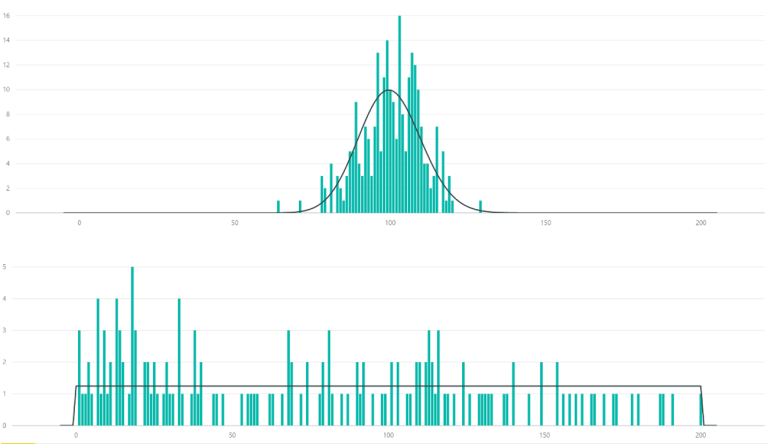
The full example input is visually represented below, along with the probability distribution function it was drawn from (the $y$ -axis is labeled by its values multiplied by 250).

C++ 编辑器
输入
输出
可保存默认模板;新题优先使用已保存模板。
当前快捷键仅展示,暂不支持修改。
- 撤销
Ctrl / ⌘ + Z - 重做
Ctrl / ⌘ + Y - 查找
Ctrl / ⌘ + F - 全选
Ctrl / ⌘ + A - 复制
Ctrl / ⌘ + C - 剪切
Ctrl / ⌘ + X - 粘贴
Ctrl / ⌘ + V - 自动排版
工具栏排版按钮 - 草稿保存
编辑时自动保存到本机
历史
提交记录
状态说明时间源码
AI
作答助手
你好,我是作答助手。可以问思路、复杂度、样例含义或代码报错原因;不会直接给出完整 AC 代码。
确定要清空代码吗?
提交通过
评测结果:Accepted