A10864 | Dasha and friends
时间限制1s
内存限制256MB
通过 / 提交0/0
题目描述
Running with barriers on the circle track is very popular in the country where Dasha lives, so no wonder that on her way to classes she saw the following situation:
The track is the circle with length $L$ , in distinct points of which there are $n$ barriers. Athlete always run the track in counterclockwise direction if you look on him from above. All barriers are located at integer distance from each other along the track.
Her friends the parrot Kefa and the leopard Sasha participated in competitions and each of them ran one lap. Each of the friends started from some integral point on the track. Both friends wrote the distance from their start along the track to each of the $n$ barriers. Thus, each of them wrote $n$ integers in the ascending order, each of them was between $0$ and $L-1$ , inclusively.
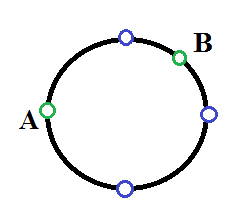Consider an example. Let $L=8$ , blue points are barriers, and green points are Kefa's start (A) and Sasha's start (B). Then Kefa writes down the sequence $[2,4,6]$ , and Sasha writes down $[1,5,7]$ .There are several tracks in the country, all of them have same length and same number of barriers, but the positions of the barriers can differ among different tracks. Now Dasha is interested if it is possible that Kefa and Sasha ran the same track or they participated on different tracks.
Write the program which will check that Kefa's and Sasha's tracks coincide (it means that one can be obtained from the other by changing the start position). Note that they always run the track in one direction — counterclockwise, if you look on a track from above.
The track is the circle with length $L$ , in distinct points of which there are $n$ barriers. Athlete always run the track in counterclockwise direction if you look on him from above. All barriers are located at integer distance from each other along the track.
Her friends the parrot Kefa and the leopard Sasha participated in competitions and each of them ran one lap. Each of the friends started from some integral point on the track. Both friends wrote the distance from their start along the track to each of the $n$ barriers. Thus, each of them wrote $n$ integers in the ascending order, each of them was between $0$ and $L-1$ , inclusively.
Consider an example. Let $L=8$ , blue points are barriers, and green points are Kefa's start (A) and Sasha's start (B). Then Kefa writes down the sequence $[2,4,6]$ , and Sasha writes down $[1,5,7]$ .There are several tracks in the country, all of them have same length and same number of barriers, but the positions of the barriers can differ among different tracks. Now Dasha is interested if it is possible that Kefa and Sasha ran the same track or they participated on different tracks.
Write the program which will check that Kefa's and Sasha's tracks coincide (it means that one can be obtained from the other by changing the start position). Note that they always run the track in one direction — counterclockwise, if you look on a track from above.
输入格式
The first line contains two integers $n$ and $L$ ( $1<=n<=50$ , $n<=L<=100$ ) — the number of barriers on a track and its length.
The second line contains $n$ distinct integers in the ascending order — the distance from Kefa's start to each barrier in the order of its appearance. All integers are in the range from $0$ to $L-1$ inclusively.
The second line contains $n$ distinct integers in the ascending order — the distance from Sasha's start to each barrier in the order of its overcoming. All integers are in the range from $0$ to $L-1$ inclusively.
The second line contains $n$ distinct integers in the ascending order — the distance from Kefa's start to each barrier in the order of its appearance. All integers are in the range from $0$ to $L-1$ inclusively.
The second line contains $n$ distinct integers in the ascending order — the distance from Sasha's start to each barrier in the order of its overcoming. All integers are in the range from $0$ to $L-1$ inclusively.
输出格式
Print "YES" (without quotes), if Kefa and Sasha ran the coinciding tracks (it means that the position of all barriers coincides, if they start running from the same points on the track). Otherwise print "NO" (without quotes).
输入输出样例
输入 #1
3 8
2 4 6
1 5 7
输出 #1
YES
输入 #2
4 9
2 3 5 8
0 1 3 6
输出 #2
YES
输入 #3
2 4
1 3
1 2
输出 #3
NO
The first test is analyzed in the statement.
C++ 编辑器
输入
输出
可保存默认模板;新题优先使用已保存模板。
当前快捷键仅展示,暂不支持修改。
- 撤销
Ctrl / ⌘ + Z - 重做
Ctrl / ⌘ + Y - 查找
Ctrl / ⌘ + F - 全选
Ctrl / ⌘ + A - 复制
Ctrl / ⌘ + C - 剪切
Ctrl / ⌘ + X - 粘贴
Ctrl / ⌘ + V - 自动排版
工具栏排版按钮 - 草稿保存
编辑时自动保存到本机
历史
提交记录
状态说明时间源码
AI
作答助手
你好,我是作答助手。可以问思路、复杂度、样例含义或代码报错原因;不会直接给出完整 AC 代码。
确定要清空代码吗?
提交通过
评测结果:Accepted