A10144 | Wilbur and Trees
时间限制1s
内存限制256MB
通过 / 提交0/0
题目描述
Wilbur the pig really wants to be a beaver, so he decided today to pretend he is a beaver and bite at trees to cut them down.
There are $n$ trees located at various positions on a line. Tree $i$ is located at position $x_{i}$ . All the given positions of the trees are distinct.
The trees are equal, i.e. each tree has height $h$ . Due to the wind, when a tree is cut down, it either falls left with probability $p$ , or falls right with probability $1-p$ . If a tree hits another tree while falling, that tree will fall in the same direction as the tree that hit it. A tree can hit another tree only if the distance between them is strictly less than $h$ .
For example, imagine there are $4$ trees located at positions $1$ , $3$ , $5$ and $8$ , while $h=3$ and the tree at position $1$ falls right. It hits the tree at position $3$ and it starts to fall too. In it's turn it hits the tree at position $5$ and it also starts to fall. The distance between $8$ and $5$ is exactly $3$ , so the tree at position $8$ will not fall.
As long as there are still trees standing, Wilbur will select either the leftmost standing tree with probability $0.5$ or the rightmost standing tree with probability $0.5$ . Selected tree is then cut down. If there is only one tree remaining, Wilbur always selects it. As the ground is covered with grass, Wilbur wants to know the expected total length of the ground covered with fallen trees after he cuts them all down because he is concerned about his grass-eating cow friends. Please help Wilbur.
There are $n$ trees located at various positions on a line. Tree $i$ is located at position $x_{i}$ . All the given positions of the trees are distinct.
The trees are equal, i.e. each tree has height $h$ . Due to the wind, when a tree is cut down, it either falls left with probability $p$ , or falls right with probability $1-p$ . If a tree hits another tree while falling, that tree will fall in the same direction as the tree that hit it. A tree can hit another tree only if the distance between them is strictly less than $h$ .
For example, imagine there are $4$ trees located at positions $1$ , $3$ , $5$ and $8$ , while $h=3$ and the tree at position $1$ falls right. It hits the tree at position $3$ and it starts to fall too. In it's turn it hits the tree at position $5$ and it also starts to fall. The distance between $8$ and $5$ is exactly $3$ , so the tree at position $8$ will not fall.
As long as there are still trees standing, Wilbur will select either the leftmost standing tree with probability $0.5$ or the rightmost standing tree with probability $0.5$ . Selected tree is then cut down. If there is only one tree remaining, Wilbur always selects it. As the ground is covered with grass, Wilbur wants to know the expected total length of the ground covered with fallen trees after he cuts them all down because he is concerned about his grass-eating cow friends. Please help Wilbur.
输入格式
The first line of the input contains two integers, $n$ $(1<=n<=2000)$ and $h$ $(1<=h<=10^{8})$ and a real number $p$ ( $0<=p<=1$ ), given with no more than six decimal places.
The second line of the input contains $n$ integers, $x_{1},x_{2},...,x_{n}$ $(-10^{8}<=x_{i}<=10^{8})$ in no particular order.
The second line of the input contains $n$ integers, $x_{1},x_{2},...,x_{n}$ $(-10^{8}<=x_{i}<=10^{8})$ in no particular order.
输出格式
Print a single real number — the expected total length of the ground covered by trees when they have all fallen down. Your answer will be considered correct if its absolute or relative error does not exceed $10^{-6}$ .
Namely: let's assume that your answer is $a$ , and the answer of the jury is $b$ . The checker program will consider your answer correct, if 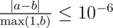.
Namely: let's assume that your answer is $a$ , and the answer of the jury is $b$ . The checker program will consider your answer correct, if .
输入输出样例
输入 #1
2 2 0.500000
1 2
输出 #1
3.250000000
输入 #2
4 3 0.4
4 3 1 2
输出 #2
6.631200000
Consider the first example, we have 2 trees with height 2.
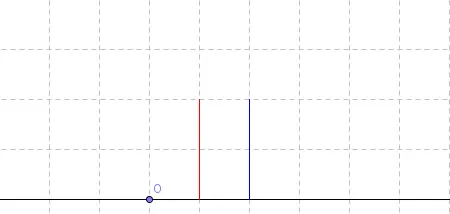 There are 3 scenarios: 1. Both trees falls left. This can either happen with the right tree falling left first, which has  probability (also knocking down the left tree), or the left tree can fall left and then the right tree can fall left, which has  probability. Total probability is .
2. Both trees fall right. This is analogous to (1), so the probability of this happening is .
3. The left tree fall left and the right tree falls right. This is the only remaining scenario so it must have 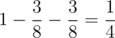 probability.
Cases 1 and 2 lead to a total of 3 units of ground covered, while case 3 leads to a total of 4 units of ground covered. Thus, the expected value is .
 There are 3 scenarios: 1. Both trees falls left. This can either happen with the right tree falling left first, which has  probability (also knocking down the left tree), or the left tree can fall left and then the right tree can fall left, which has  probability. Total probability is .
2. Both trees fall right. This is analogous to (1), so the probability of this happening is .
3. The left tree fall left and the right tree falls right. This is the only remaining scenario so it must have  probability.
Cases 1 and 2 lead to a total of 3 units of ground covered, while case 3 leads to a total of 4 units of ground covered. Thus, the expected value is .
C++ 编辑器
输入
输出
可保存默认模板;新题优先使用已保存模板。
当前快捷键仅展示,暂不支持修改。
- 撤销
Ctrl / ⌘ + Z - 重做
Ctrl / ⌘ + Y - 查找
Ctrl / ⌘ + F - 全选
Ctrl / ⌘ + A - 复制
Ctrl / ⌘ + C - 剪切
Ctrl / ⌘ + X - 粘贴
Ctrl / ⌘ + V - 自动排版
工具栏排版按钮 - 草稿保存
编辑时自动保存到本机
历史
提交记录
状态说明时间源码
AI
作答助手
你好,我是作答助手。可以问思路、复杂度、样例含义或代码报错原因;不会直接给出完整 AC 代码。
确定要清空代码吗?
提交通过
评测结果:Accepted