A10069 | Peter and Snow Blower
时间限制1s
内存限制256MB
通过 / 提交0/0
题目描述
Peter got a new snow blower as a New Year present. Of course, Peter decided to try it immediately. After reading the instructions he realized that it does not work like regular snow blowing machines. In order to make it work, you need to tie it to some point that it does not cover, and then switch it on. As a result it will go along a circle around this point and will remove all the snow from its path.
Formally, we assume that Peter's machine is a polygon on a plane. Then, after the machine is switched on, it will make a circle around the point to which Peter tied it (this point lies strictly outside the polygon). That is, each of the points lying within or on the border of the polygon will move along the circular trajectory, with the center of the circle at the point to which Peter tied his machine.
Peter decided to tie his car to point $P$ and now he is wondering what is the area of the region that will be cleared from snow. Help him.
Formally, we assume that Peter's machine is a polygon on a plane. Then, after the machine is switched on, it will make a circle around the point to which Peter tied it (this point lies strictly outside the polygon). That is, each of the points lying within or on the border of the polygon will move along the circular trajectory, with the center of the circle at the point to which Peter tied his machine.
Peter decided to tie his car to point $P$ and now he is wondering what is the area of the region that will be cleared from snow. Help him.
输入格式
The first line of the input contains three integers — the number of vertices of the polygon $n$ (), and coordinates of point $P$ .
Each of the next $n$ lines contains two integers — coordinates of the vertices of the polygon in the clockwise or counterclockwise order. It is guaranteed that no three consecutive vertices lie on a common straight line.
All the numbers in the input are integers that do not exceed $1000000$ in their absolute value.
Each of the next $n$ lines contains two integers — coordinates of the vertices of the polygon in the clockwise or counterclockwise order. It is guaranteed that no three consecutive vertices lie on a common straight line.
All the numbers in the input are integers that do not exceed $1000000$ in their absolute value.
输出格式
Print a single real value number — the area of the region that will be cleared. Your answer will be considered correct if its absolute or relative error does not exceed $10^{-6}$ .
Namely: let's assume that your answer is $a$ , and the answer of the jury is $b$ . The checker program will consider your answer correct, if .
Namely: let's assume that your answer is $a$ , and the answer of the jury is $b$ . The checker program will consider your answer correct, if .
输入输出样例
输入 #1
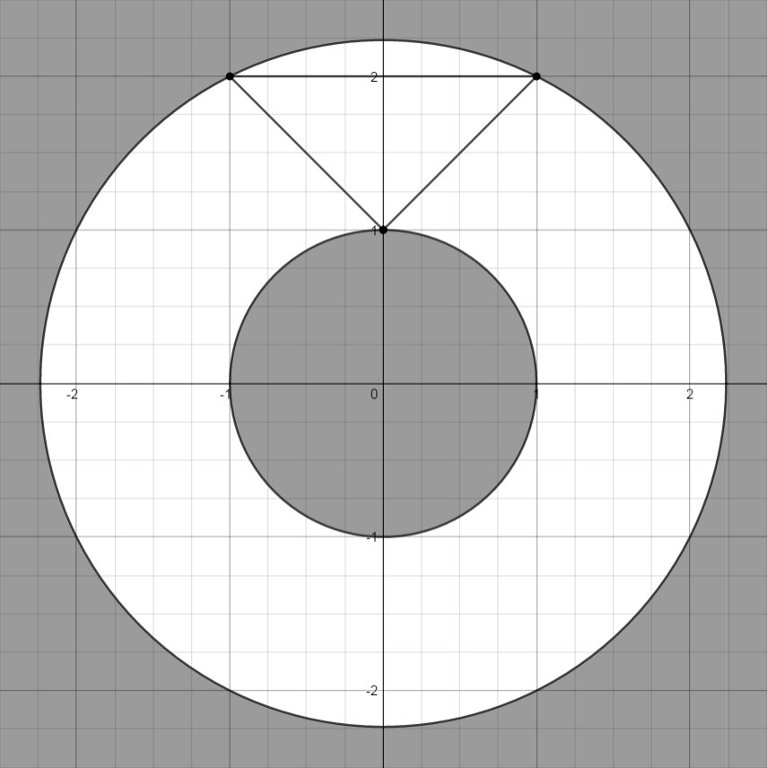
3 0 0
0 1
-1 2
1 2
输出 #1
12.566370614359172464
输入 #2
4 1 -1
0 0
1 2
2 0
1 1
输出 #2
21.991148575128551812
In the first sample snow will be removed from that area:

C++ 编辑器
输入
输出
可保存默认模板;新题优先使用已保存模板。
当前快捷键仅展示,暂不支持修改。
- 撤销
Ctrl / ⌘ + Z - 重做
Ctrl / ⌘ + Y - 查找
Ctrl / ⌘ + F - 全选
Ctrl / ⌘ + A - 复制
Ctrl / ⌘ + C - 剪切
Ctrl / ⌘ + X - 粘贴
Ctrl / ⌘ + V - 自动排版
工具栏排版按钮 - 草稿保存
编辑时自动保存到本机
历史
提交记录
状态说明时间源码
AI
作答助手
你好,我是作答助手。可以问思路、复杂度、样例含义或代码报错原因;不会直接给出完整 AC 代码。
确定要清空代码吗?
提交通过
评测结果:Accepted