A10049 | Pig and Palindromes
时间限制1s
内存限制256MB
通过 / 提交0/0
题目描述
Peppa the Pig was walking and walked into the forest. What a strange coincidence! The forest has the shape of a rectangle, consisting of $n$ rows and $m$ columns. We enumerate the rows of the rectangle from top to bottom with numbers from $1$ to $n$ , and the columns — from left to right with numbers from $1$ to $m$ . Let's denote the cell at the intersection of the $r$ -th row and the $c$ -th column as $(r,c)$ .
Initially the pig stands in cell $(1,1)$ , and in the end she wants to be in cell $(n,m)$ . Since the pig is in a hurry to get home, she can go from cell $(r,c)$ , only to either cell $(r+1,c)$ or $(r,c+1)$ . She cannot leave the forest.
The forest, where the pig is, is very unusual. Some cells of the forest similar to each other, and some look very different. Peppa enjoys taking pictures and at every step she takes a picture of the cell where she is now. The path through the forest is considered to be beautiful if photographs taken on her way, can be viewed in both forward and in reverse order, showing the same sequence of photos. More formally, the line formed by the cells in order of visiting should be a palindrome (you can read a formal definition of a palindrome in the previous problem).
Count the number of beautiful paths from cell $(1,1)$ to cell $(n,m)$ . Since this number can be very large, determine the remainder after dividing it by $10^{9}+7$ .
Initially the pig stands in cell $(1,1)$ , and in the end she wants to be in cell $(n,m)$ . Since the pig is in a hurry to get home, she can go from cell $(r,c)$ , only to either cell $(r+1,c)$ or $(r,c+1)$ . She cannot leave the forest.
The forest, where the pig is, is very unusual. Some cells of the forest similar to each other, and some look very different. Peppa enjoys taking pictures and at every step she takes a picture of the cell where she is now. The path through the forest is considered to be beautiful if photographs taken on her way, can be viewed in both forward and in reverse order, showing the same sequence of photos. More formally, the line formed by the cells in order of visiting should be a palindrome (you can read a formal definition of a palindrome in the previous problem).
Count the number of beautiful paths from cell $(1,1)$ to cell $(n,m)$ . Since this number can be very large, determine the remainder after dividing it by $10^{9}+7$ .
输入格式
The first line contains two integers $n,m$ ( $1<=n,m<=500$ ) — the height and width of the field.
Each of the following $n$ lines contains $m$ lowercase English letters identifying the types of cells of the forest. Identical cells are represented by identical letters, different cells are represented by different letters.
Each of the following $n$ lines contains $m$ lowercase English letters identifying the types of cells of the forest. Identical cells are represented by identical letters, different cells are represented by different letters.
输出格式
Print a single integer — the number of beautiful paths modulo $10^{9}+7$ .
输入输出样例
输入 #1
3 4
aaab
baaa
abba
输出 #1
3
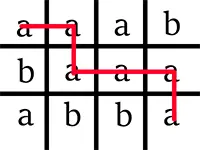
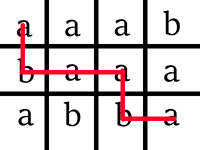
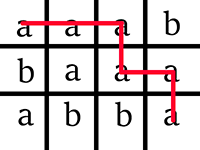
Picture illustrating possibilities for the sample test.


C++ 编辑器
输入
输出
可保存默认模板;新题优先使用已保存模板。
当前快捷键仅展示,暂不支持修改。
- 撤销
Ctrl / ⌘ + Z - 重做
Ctrl / ⌘ + Y - 查找
Ctrl / ⌘ + F - 全选
Ctrl / ⌘ + A - 复制
Ctrl / ⌘ + C - 剪切
Ctrl / ⌘ + X - 粘贴
Ctrl / ⌘ + V - 自动排版
工具栏排版按钮 - 草稿保存
编辑时自动保存到本机
历史
提交记录
状态说明时间源码
AI
作答助手
你好,我是作答助手。可以问思路、复杂度、样例含义或代码报错原因;不会直接给出完整 AC 代码。
确定要清空代码吗?
提交通过
评测结果:Accepted